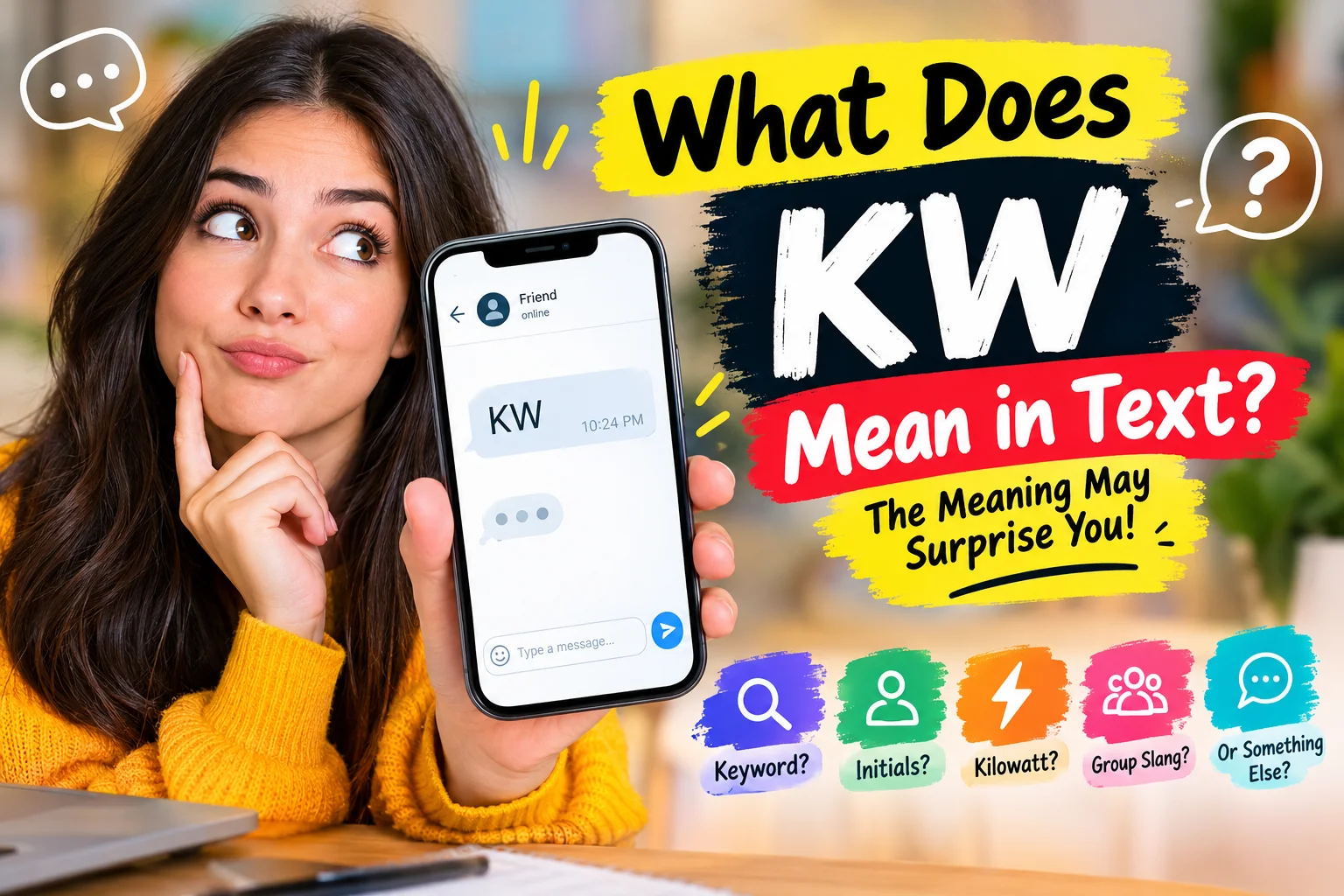
You get a message that says “Send me the KW.” Or maybe someone texts, “Check KW 42.” You stare at the screen. What is KW?
Don’t worry. You are not alone. Plenty of people search what does KW mean in text every single day, because this tiny abbreviation changes meaning depending on who sends it and where.
Here is the good news. Once you know the common meanings and a simple trick for reading the context, you will decode KW in seconds. 🔥
Let’s break it down in plain English.
What Does KW Mean in Text?
KW most often stands for “keyword” in work and marketing chats. It can also mean “kilowatt” (a unit of power), “Kalenderwoche” (the German word for calendar week), or “Keller Williams” (a real estate company). In casual texting, some people also use it as a quick, lazy way to type “know.”
Unlike “LOL” or “BRB,” KW has no single universal meaning. The right answer depends on the conversation.
That is why guessing can backfire. ⚠️
Here is a quick snapshot:
- ✅ Keyword – used by writers, marketers, and SEO teams
- ✅ Kilowatt – used for electricity, solar panels, and engines
- ✅ Kalenderwoche – used in German-speaking work chats and emails
- ✅ Keller Williams – used in real estate conversations
- ✅ Know – an informal shortcut in very casual messages
- ✅ Kuwait – used as a country code
- ✅ Key West – used by travelers and locals in Florida
Next, let’s make the meaning easy to remember.
KW Meaning in Simple Words
Think of KW as a two-letter shortcut that borrows its meaning from the topic.
Talking about content or Google? KW means keyword.
Talking about power bills or solar panels? KW means kilowatt.
Talking about a work schedule in German? KW means calendar week.
Talking about houses and agents? KW probably means Keller Williams.
That is the whole secret. The topic of the chat tells you the answer. 🧠
If the topic is unclear, you can simply ask, “Do you mean keyword?” Nobody will judge you for that. In fact, it saves everyone time and avoids mistakes.
Where Is KW Used? (Platforms and Situations)
KW pops up in more places than you might expect. Here are the most common ones.
KW in Work Chats and Email
In Slack, Microsoft Teams, and email, KW usually points to a keyword. Content teams write things like “Add the KW to the title” or “What’s the main KW for this post?”
In German-speaking offices, you will also see KW followed by a number, such as “Meeting in KW 42.” That means week 42 of the year.
KW in Text Messages and WhatsApp
Between friends, KW is rare. When it does appear, it is often a quick spelling of “know” or a reference to a topic you were already discussing.
Because it is not standard slang, always read the earlier messages for clues.
KW on Social Media
On Instagram, TikTok, and X, KW can show up in bios or captions. Creators may use it for keyword, Key West, or Kuwait, depending on their niche.
A travel blogger might tag a post with “KW sunset.” A marketing coach might write “KW research tips.” Same letters, totally different meaning.
KW in Real Estate
Many agents work with Keller Williams, so you will often see “KW agent” or “KW listing.” If you are house hunting, this is probably what the message means.
KW in Technical and Energy Talk
Engineers, electricians, and anyone who reads an electricity bill will see kW, the short form of kilowatt. One kilowatt equals 1,000 watts.
You will also see kWh, which stands for kilowatt-hour. That is the unit your power company uses to charge you.
Here is an easy way to keep them apart. kW tells you how strong something is. kWh tells you how much energy it used over time.
For example, a 2 kW heater running for 3 hours uses 6 kWh of electricity (2 × 3 = 6). The heater’s power never changed. Only the time did.
How to Read KW Followed by a Number
A number right after KW is one of the strongest clues you will ever get. 🔍
In many European countries, KW 42 means calendar week 42. Most of them follow the ISO system, where weeks start on Monday and week 1 is the week that contains the year’s first Thursday.
So if a German colleague writes “Lieferung in KW 45,” they mean the delivery will arrive sometime during week 45. That is a time window, not a single day.
Compare that with these patterns:
- “KW 42” – Usually calendar week 42
- “5 KW” – Usually five kilowatts
- “KW research” – Usually keyword research
- “KW agent” – Usually a Keller Williams agent
A tiny bit of pattern spotting removes most of the guesswork.
Why Do People Use KW?
People shorten words for a few simple reasons. Let’s look at the main ones.
- Speed ⏱️ – Typing “KW” is faster than typing “keyword” or “kilowatt.”
- Habit – Teams that talk about the same thing daily develop shortcuts.
- Industry language – Marketers, engineers, and agents each have their own shorthand.
- Space limits – Bios, captions, and spreadsheets leave little room.
- Language differences – German speakers use KW for “Kalenderwoche” as a normal part of work life.
In short, people use KW because everyone in their circle already understands it.
The problem starts when someone outside that circle receives the message. That is where confusion begins. 😅
Examples of KW in Text (With Real-Life Explanations)
Examples make everything clearer. Here are common situations and how to read them.
Example 1: Keyword in a Work Chat
Message: “Hey, can you send me the KW for the new blog post?”
Meaning: The person wants the target keyword. This is the main phrase the article should rank for on Google.
Good reply: “Sure! The main KW is ‘best budget laptops.'”
Example 2: Kilowatt in a Home Chat
Message: “Our solar system is 5 KW, so it should cover most of the bills.”
Meaning: The system produces up to 5 kilowatts of power at its peak.
Good reply: “Nice! That sounds like a solid size for a family home.”
Example 3: Calendar Week in a German Office
Message: “Das Meeting ist in KW 42.”
Meaning: The meeting is in calendar week 42. The word “Kalenderwoche” is shortened to KW.
Good reply: “Danke! I will block my calendar.”
Example 4: Real Estate Conversation
Message: “I’m meeting a KW agent tomorrow to see the house.”
Meaning: The agent works for Keller Williams.
Good reply: “Good luck! Ask about the neighborhood too.”
Example 5: Casual “Know”
Message: “Do u kw where the party is?”
Meaning: “Do you know where the party is?”
This use is informal and not very common. Most people would type “kno” or “know” instead.
Example 6: Travel Chat
Message: “Flying to KW next month, can’t wait for the beach!”
Meaning: Probably Key West, Florida. The beach mention is your clue.
If the person mentioned deserts and oil instead, it could mean Kuwait. 🌍
Example 7: Social Media Bio
Bio: “Writer | KW research nerd | Coffee lover”
Meaning: This person loves keyword research. It is a tip that they work in SEO or content writing.
Example 8: A Confusing Message From a Friend
Message: “Did you finish the KW yet?”
Meaning: If your friend works in content, they likely mean the keyword list. If they are a student in Germany, they might mean a task due this calendar week.
Good reply: “Which KW do you mean, the keyword list or the weekly task?”
Notice how a short, friendly question solves the problem instantly. 😊
Notice the pattern? In every example, the surrounding words reveal the answer.
What Is a Keyword, Really? (The Most Common KW Meaning)
Since “keyword” is the most common meaning in work chats, it helps to understand it properly.
A keyword is the word or phrase a person types into Google when they want something. A person searching for “cheap running shoes” has just used a keyword.
Writers and marketers pick one main keyword per page so their content matches what people are looking for. They usually split keywords into two groups:
- Short keywords – Broad and competitive, like “shoes” or “laptops”
- Long keywords – More specific, like “best laptops for students under 500 dollars”
Long keywords are often easier to rank for, and they usually attract people who know exactly what they want.
So when a teammate asks, “What’s the KW?”, they are really asking, “What exactly are people searching for?” 🎯
KW vs Similar Terms
KW often gets mixed up with look-alike abbreviations. This table clears things up.
| Term | Full Form | Where You See It | Quick Tip |
|---|---|---|---|
| KW | Keyword, kilowatt, calendar week, and more | Work chats, energy, real estate | Check the topic first |
| KWD | Kuwaiti Dinar | Money and currency | Used for prices |
| KWh | Kilowatt-hour | Electricity bills | Measures energy used |
| KP | Key Point or Kitchen Patrol | Work or military talk | Different from KW |
| KK | Okay (casual) | Texting | A quick “ok” |
| KY | Kentucky or Keep You posted | Texts and states | Context needed |
| K | Okay | Everyday texting | Can sound cold 😬 |
Two small points are worth remembering:
- kW (power) and kWh (energy over time) are not the same thing. Mixing them up is a very common mistake.
- KW is not a replacement for “OK.” If you want to say “okay,” use “k” or “kk.”
Quick KW Decoder: Clue to Meaning
Keep this cheat sheet handy the next time you feel stuck. 📌
| If You See This Clue | KW Probably Means |
|---|---|
| Google, blog, SEO, ranking | Keyword |
| Solar, battery, heater, bill | Kilowatt |
| A week number, German text | Kalenderwoche (calendar week) |
| House, agent, listing, office | Keller Williams |
| Beach, Florida, trip | Key West |
| Flights, oil, Middle East, country list | Kuwait |
| Super casual chat, no other clue | Know |
If two rows seem to fit, ask before you answer.
When Should You Use KW?
Using shortcuts is fine, but only when the other person will understand them. Here is a simple guide.
✅ Good Times to Use KW
- When chatting with coworkers who use the term daily
- When writing a quick note about keyword research to your team
- When discussing kilowatts with an electrician or energy provider
- When writing a KW number in a German work email
- When the meaning has already been used earlier in the chat
⚠️ Times to Avoid KW
- When messaging someone new
- When writing to a client or manager who may not know the term
- In formal emails, reports, or job applications
- When the topic could fit two meanings
- When you are in a hurry and clarity matters most
A short rule helps: if there is any chance of confusion, write the full word. It costs you a few seconds and saves a lot of back-and-forth.
Common Misunderstandings About KW
Let’s clear up a few things people often get wrong.
“KW always means keyword.”
Not true. It is common in marketing, but power and calendar weeks are just as valid in other circles.
“KW is a popular texting slang like LOL.”
Not really. KW is not a mainstream slang term. You will not find it as often as “IDK” or “TBH” in friendly chats. Its meaning mostly comes from a specific field.
“kW and KW are totally different.”
They are the same letters, but the capital letters matter in science. The correct short form of kilowatt is kW (small k, capital W). In casual chat, though, people type it any way they like.
“KW means Kuwait everywhere.”
Kuwait uses KW as its country code, which you will see on websites, flights, and shipping forms. In a normal text, though, it rarely means that unless the topic is travel or location.
“If I don’t understand it, I should just guess.”
Guessing can lead to embarrassing replies. Imagine answering “Send me the KW” with a number of kilowatts when the person wanted a keyword. 😅
Asking a quick follow-up question is always the smarter move.
Pro Tips for Decoding and Using KW
These practical tips will help you read KW like an expert.
- Read the full conversation. The last three or four messages usually contain the answer.
- Look at who sent it. A marketer likely means keyword. An electrician likely means kilowatt.
- Check for numbers. “KW 42” almost always means calendar week. “5 KW” almost always means kilowatts.
- Look at the platform. A work chat points to professional meanings. A casual DM may point to “know.”
- Ask politely. Try, “Quick check, do you mean keyword?” It shows care, not ignorance.
- Write it out the first time. If you start a topic, say “keyword (KW)” once. After that, the shortcut is clear to everyone.
- Match your audience. Use full words with beginners and shortcuts with experienced teammates.
- Search the exact phrase. If a message has other unusual words, searching the full sentence often reveals the context.
Here is a bonus tip for writers and marketers. 💡
If you work in content, keep a small team glossary of shortcuts like KW, CTR, and SERP. New members will thank you, and your messages will stay clear.
Final Thoughts: So, What Does KW Really Mean?
KW is a small abbreviation with several big meanings. It can stand for keyword, kilowatt, calendar week, Keller Williams, Key West, Kuwait, or even “know” in very casual texting.
There is no single right answer. The topic, the person, and the platform tell you which meaning fits.
When you are unsure, ask. When you are the sender, be clear. A few extra letters can prevent a lot of confusion. 🙌
Now the next time someone texts you “KW,” you will know exactly what to do.
Frequently Asked Questions (FAQ)
What does KW mean in text messages?
In most text messages, KW has no fixed meaning. It commonly stands for keyword in work chats, kilowatt in energy talk, Kalenderwoche (calendar week) in German messages, or a casual spelling of “know.” Use the topic of the chat to decide.
Is KW a slang word?
Not in the usual sense. Slang terms like “LOL” or “FOMO” are widely understood. KW is more of an industry or language shortcut, so its meaning changes with the field. That is why context matters so much.
What does KW mean in real estate?
In real estate, KW usually means Keller Williams, a large real estate company. You might see it in phrases like “KW agent,” “KW office,” or “KW listing.”
What does KW mean in SEO and marketing?
In SEO and marketing, KW stands for keyword. This is the word or phrase people type into Google. Writers and marketers use it daily, as in “KW research,” “target KW,” or “KW difficulty.”
DISCOVER MORE ARTICLES
What Does NBM Mean in Text? Read This Before Replying 2026