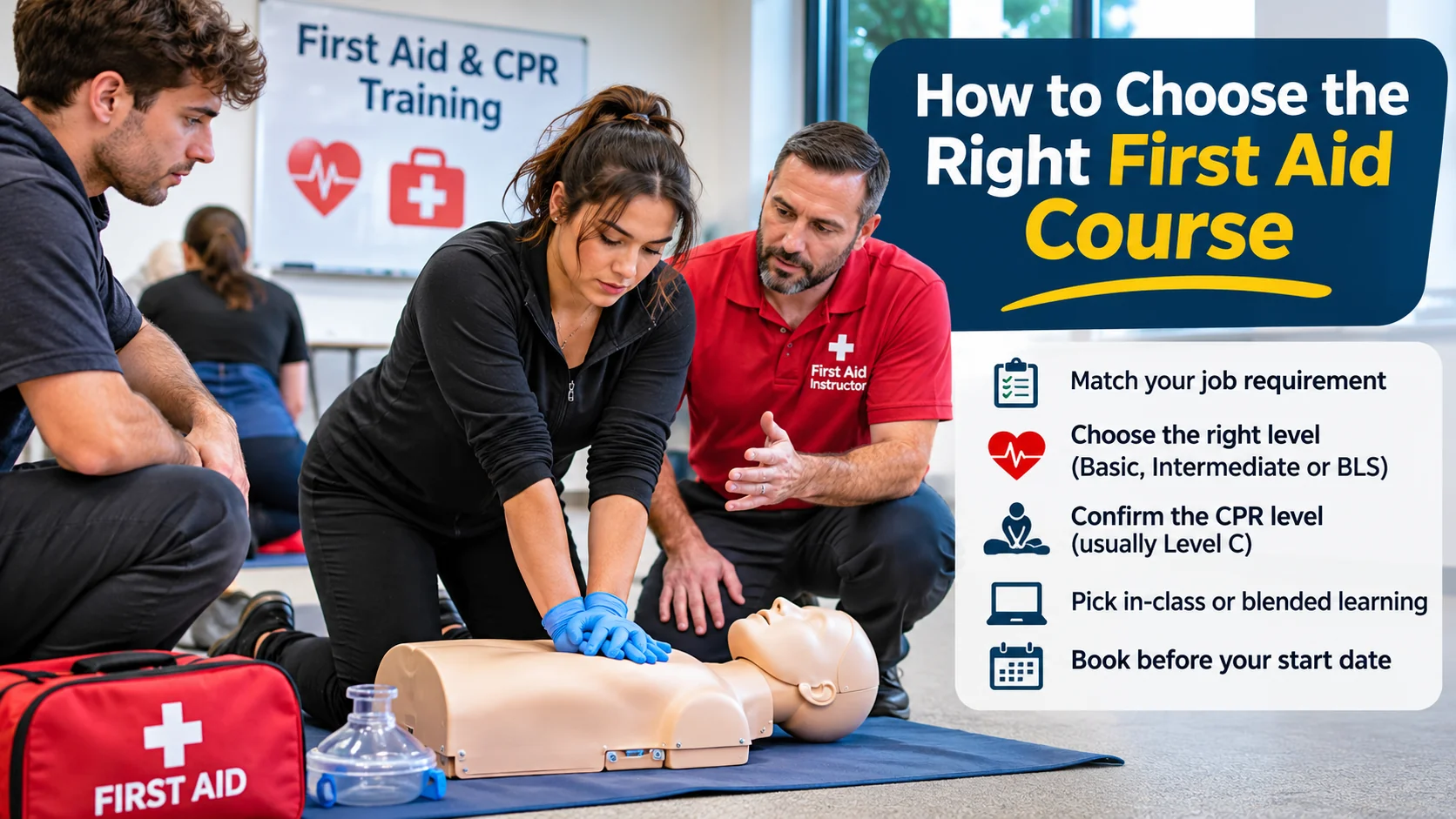
To choose the right first aid course, get the exact course name from your employer, confirm the CPR level for your role and pick in-class or blended learning. Most workplaces outside healthcare ask for Intermediate (Standard) First Aid with CPR Level C.
A new job offer often comes with a short message: “Please provide a valid first aid certificate before your start date.” Then comes the confusion.
Which level? Which CPR? How long does it take? For many workplace roles in Ontario, the answer is the Intermediate/Standard First Aid & CPR C course, which Brantford workers can complete in two days of hands-on training.
Booking the wrong course wastes a day and can delay your start date. This guide walks through the options, how to match them to your job, and what to expect when you sign up.
Which first aid levels are available?
- Basic First Aid (formerly Emergency First Aid): a one-day course covering core emergency skills.
- Intermediate First Aid (formerly Standard First Aid): a more complete course for workplace first aiders, usually two days.
- CPR/AED only: for roles that need resuscitation skills without full first aid.
- Basic Life Support (BLS): for healthcare providers and clinical roles.
How do you know which one your job needs?
Ask your employer or check the job posting for the exact course name. In Ontario, workplace first aid training must be WSIB-approved. Childcare, recreation, trades and many manufacturing roles commonly ask for the Intermediate (Standard) level with CPR Level C. Healthcare roles typically require BLS.
If the posting simply says “first aid and CPR,” it’s worth sending a quick message to confirm. Employers usually know exactly what their policy requires, and a one-line answer can save you from retaking a course.
Which roles commonly need which course?
- Childcare and education: Intermediate (Standard) First Aid with CPR Level C, sometimes a child care specific course.
- Construction and trades: Intermediate (Standard) First Aid with CPR Level C.
- Office and retail: Basic or Intermediate First Aid, depending on workplace size and policy.
- Fitness and recreation: Intermediate (Standard) First Aid with CPR Level C.
- Nursing, dental and paramedic programs: Basic Life Support.
These are common patterns, not rules. Always follow your employer’s written requirement.
What does CPR Level C mean?
CPR Level C covers adults, children and infants, including two-rescuer CPR and AED use. It’s the most commonly requested CPR level for workplaces outside healthcare.
Should you choose in-class or blended learning?
Blended learning lets you complete theory online and attend a shorter in-person skills session. In-class suits people who prefer to learn everything with an instructor. Both lead to the same certificate. Choose blended if your schedule is tight, and in-class if you learn best through discussion and demonstration.
What happens during the course?
Expect a mix of short explanations and lots of practice. You’ll work on manikins for CPR, use an AED trainer, practise choking response and bandaging, and run through realistic scenarios with classmates. Instructors assess your skills as you go.
There’s usually a short written test as well. Wear comfortable clothes, because you’ll spend time kneeling on the floor.
How long is the certificate valid?
Intermediate and Basic First Aid certificates are generally valid for three years. BLS is typically valid for one year. Before your certificate expires, you can usually take a shorter recertification course instead of repeating the full program.
What if you need the certificate quickly?
If your start date is close, book as soon as you know the requirement. Courses fill up, especially on weekends and at the start of seasonal hiring. Ask how quickly the digital certificate will be issued so you can forward it to your employer without delay.
What should employers consider when choosing training?
Employers need to think about the size of the workplace, the type of work and how far the site is from emergency services. Higher-risk workplaces, such as construction or manufacturing, generally need more trained first aiders and a higher level of training. Employers should also plan for shift coverage, so that a trained first aider is available whenever staff are on site. Booking private group training is often the most efficient way to certify several employees at once.
How do you avoid booking the wrong course?
Read the requirement word for word. Look for the level (Basic, Intermediate or Standard), the CPR level (A, C or BLS) and any mention of the training provider or approval, such as WSIB approval in Ontario. If any of those details are missing, ask before booking. Keep the confirmation email or message from your employer in case there are questions later.
Is online-only first aid accepted?
For most workplace requirements, no. First aid and CPR involve physical skills that must be practised and assessed in person. Blended courses combine online theory with an in-person skills session, and those are widely accepted. Fully online courses may be useful for awareness, but they generally don’t meet workplace certification requirements.
What happens after you’re certified?
Most providers issue a digital certificate shortly after the course. Save a copy to your phone and email, and send one to your employer. Note the expiry date and set a reminder a few months before it, so you can book a shorter recertification course rather than the full program.
If your employer tracks certifications, confirm they have recorded yours correctly. Keeping these records organized makes the next renewal simple.
Finally, remember that the certificate is only part of the value. The skills you learn can help coworkers, customers, family members and strangers. Choosing the right course means you meet your job requirement and walk away ready to act when someone needs help.
What should be on your course selection checklist?
- Get the exact course name from your employer.
- Confirm the CPR level required.
- Choose in-class or blended format.
- Book before your start date.
- Bring ID and wear comfortable clothes.
- Keep a copy of your certificate.
If you’re looking for first aid training near Wayne Gretzky Parkway, north Brantford, or other areas close to our facility, then you may reach out to Coast2Coast First Aid/CPR – Brantford in that area. Before you register, take a minute to see course options and match one to your job.
Frequently Asked Questions
1. What is the most common workplace first aid course?
Intermediate (Standard) First Aid with CPR Level C.
2. How long is the Intermediate First Aid course?
Usually two days in class, or less in-person time with blended learning.
3. Do I need BLS instead?
BLS is typically for healthcare and clinical roles. Check your job requirement.
4. Must Ontario workplace training be WSIB-approved?
Yes, for workplace first aiders.
5. How long is the certificate valid?
Generally three years.