A dream you dream alone is only a dream. It does not do to dwell on dreams and forget to live. Even the darkest night will end and the sun will rise.
For the entire history of computing, human beings have communicated with machines through clumsy mechanical translators. First came punch cards and toggle switches; then keyboards, mice, touchscreens, and finally voice commands. Every single one of those interfaces required a physical bottleneck: a thought formed inside the brain had to travel down neural pathways, move a finger or a vocal cord, strike a sensor, and be converted back into digital code. No matter how fast our processors became, the bandwidth between the human mind and the silicon world remained painfully narrow.
That bottleneck is now beginning to dissolve. Across research hospitals, neuro-engineering startups, and consumer hardware labs, technology is quietly crossing its most intimate threshold yet: the direct interface between biological neurons and digital computation. Known broadly as Brain-Computer Interfaces (BCIs) and neurotechnology, this field has spent decades confined to dense academic journals and experimental medical wards. Today, powered by breakthroughs in artificial intelligence, biocompatible materials, and high-resolution non-invasive sensors, neurotechnology is stepping decisively into clinical reality and early industrial deployment.
We are witnessing the emergence of the silent interface—a technological paradigm where intent itself becomes an executable command. From restoring speech and mobility to patients with severe paralysis, to monitoring cognitive fatigue in surgeons and air traffic controllers, the convergence of neuroscience and computing is forcing society to confront not only a new wave of engineering marvels, but also the most profound privacy debate of the digital age.
Beyond the Glass: Invasive Precision and Non-Invasive Scale
To understand why neurotechnology is advancing so rapidly, it helps to separate the field into its two distinct hardware architectures: invasive implants and non-invasive wearables. Both are solving fundamentally different problems, and both have recently crossed major engineering milestones.
On the clinical frontier, implantable BCIs are demonstrating capabilities that once belonged strictly to science fiction. Ultra-thin, flexible neural threads and minimally invasive surface electrode arrays—placed either directly into the motor cortex or resting gently atop the brain’s surface—are now allowing individuals with paralysis or neurodegenerative conditions like ALS to control computer cursors, operate robotic arms, steer motorized wheelchairs, and type text solely through imagined movement or attempted speech. Newer clinical systems have moved away from bulky, wired head mounts toward wireless charging and on-chip signal processing, allowing neural data to be decoded with minimal latency so that digital cursor movements feel remarkably fluid.
Even more ambitious is the shift from “read-only” implants to bidirectional systems. Early neural interfaces could only listen to the brain’s electrical whispers and translate them into outward action. Today, clinical researchers are actively testing “write” channels—delivering targeted, microscopic electrical stimulation back into sensory regions of the cortex. In experimental neuro-prosthetics, this allows a user to not only move a robotic hand with their thoughts, but to actually feel the pressure, texture, and temperature of the object that robotic hand is gripping. Parallel research is even exploring direct visual cortex stimulation aimed at restoring rudimentary sight to the blind.
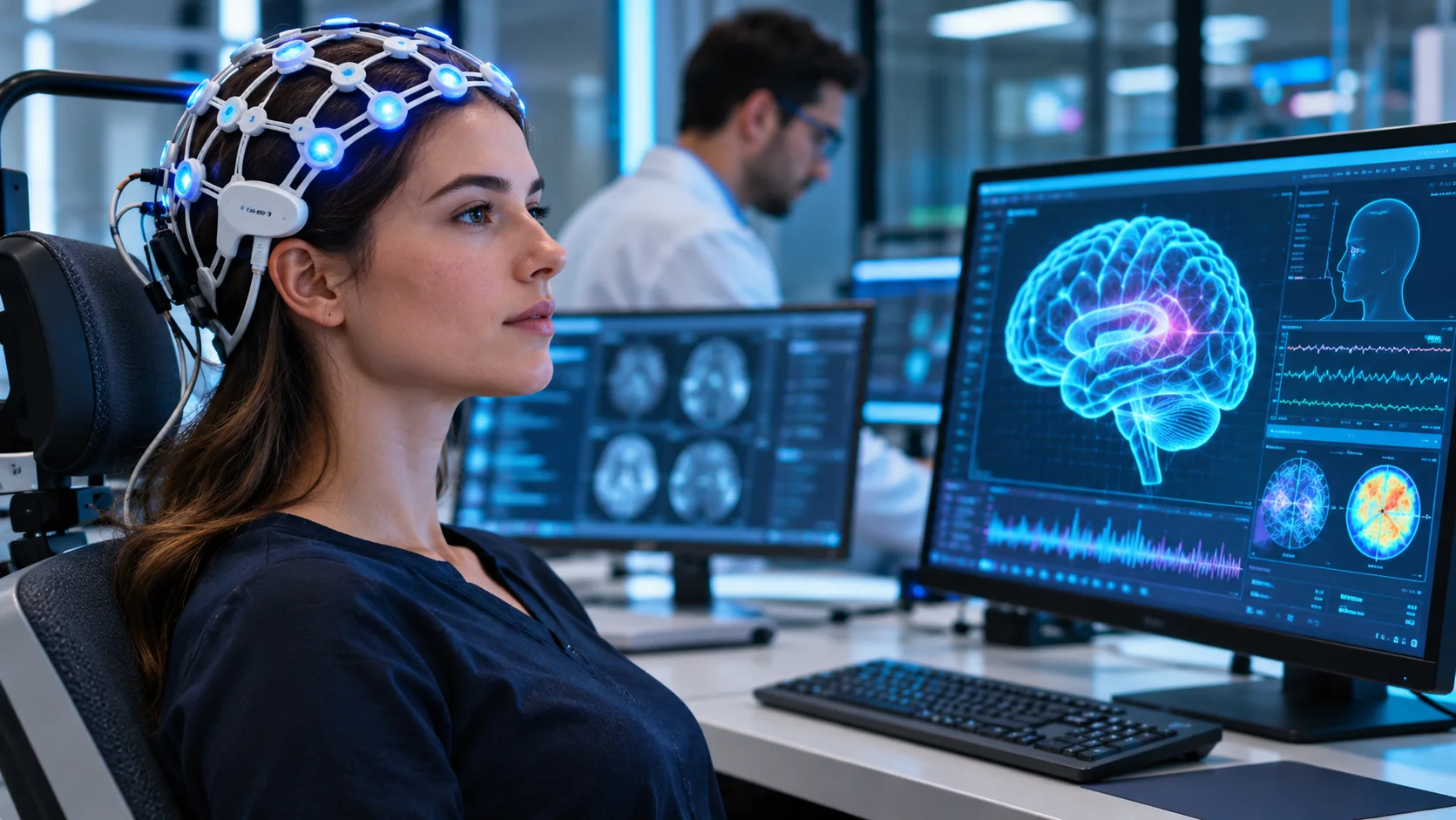
While surgical implants remain focused on high-stakes medical rehabilitation, the broader commercial wave is being driven by non-invasive neurotechnology. Historically, wearable headbands using electroencephalography (EEG) suffered from a crippling flaw: the human skull acts as a thick electrical insulator, blurring brain signals into noisy static. However, the combination of dry, skin-friendly micro-sensors and functional near-infrared spectroscopy (fNIRS)—which measures subtle shifts in blood oxygenation across the cortex using harmless light—has dramatically elevated signal fidelity. Today’s sleek, wearable headsets and earbuds can capture clinically meaningful readings of focus, stress, and cognitive load without a single incision, paving the way for everyday enterprise and wellness adoption.
AI-Native Neural Decoding: Teaching Silicon to Speak Brain
Hardware alone did not unlock the neurotechnology boom. The true catalyst has been artificial intelligence. The human brain is not a tidy binary computer; it is a chaotic storm of billions of neurons firing in overlapping, shifting patterns. Every individual’s neural signature is slightly different, and even within the same person, brain signals drift over time due to fatigue, mood, or microscopic shifts in electrode placement. Classical signal-processing software simply could not keep up with that biological messiness.
Modern BCIs are architecturally AI-native. Neuro-engineers are now training specialized “brain foundation models”—large machine learning architectures trained on massive datasets of human neural activity—that function much like large language models do for text. Instead of requiring a patient to spend hours recalibrating a system every morning, adaptive on-device AI models use few-shot learning to rapidly map an individual’s unique neural patterns, cutting recalibration times down to mere minutes per week.
This marriage of neural hardware and agentic AI is producing startling results in speech restoration and digital control. In recent clinical demonstrations, patients who have lost the physical ability to speak have used neural decoders to translate attempted speech directly into text, natural-sounding synthesized audio, and even live smartphone calls. Going a step further, engineers are now connecting neural interfaces directly to autonomous AI agents. Rather than manually guiding a cursor letter by letter, a user can initiate a high-level intent through attempted speech or neural cues, allowing an AI agent to execute complex multi-step software tasks across applications. The mind provides the intent; the algorithm handles the execution.
Cognitive Load and the Industrial Safety Frontier
Long before healthy consumers adopt thought-controlled typing for everyday emails, non-invasive neurotechnology is finding a deeply practical home in high-stakes industrial and occupational environments. In professions where a split-second lapse in human attention can cost lives or millions of dollars, passive neural monitoring is rapidly redefining safety standards.
Across aviation, maritime navigation, surgical theaters, and complex control rooms, organizations are piloting lightweight EEG and fNIRS wearables designed for real-time cognitive load monitoring. Rather than reading specific thoughts, these systems track the brain’s broader operational states: mental fatigue, micro-sleep onset, stress spikes, and attentional tunnel vision.
When an air traffic controller or a long-haul logistics operator approaches cognitive overload, the system does not merely sound an annoying alarm. It integrates into a “human-in-the-loop” adaptive workspace—automatically simplifying dashboard interfaces, dimming non-essential alerts, or seamlessly handing off routine monitoring sub-tasks to an automated co-pilot until the human operator’s cognitive bandwidth recovers. In clinical wellness, similar non-invasive neurofeedback platforms are gaining traction as non-pharmaceutical tools to help individuals manage chronic insomnia, severe anxiety, and attention disorders by allowing them to visually train their own brainwave patterns.
The Battle for Cognitive Liberty and Neuro-Rights
As neurotechnology moves from hospital basements into workplaces and consumer ecosystems, it is colliding with a profound ethical and legal vacuum. Throughout the internet era, humanity surrendered vast oceans of behavioral data—what we click, where we travel, what we buy—in exchange for free digital convenience. Neural data, however, is fundamentally different. It is not a record of what you chose to share; it is a direct window into your subconscious reactions, emotional vulnerabilities, neurological health, and unspoken intent.
The prospect of employers tracking workers’ moment-by-moment focus, insurers assessing neurological risk profiles, or advertisers measuring subconscious emotional responses to marketing campaigns has ignited a global push for “neuro-rights” and cognitive liberty. Legal scholars, ethicists, and international standards bodies are racing to establish strict guardrails before neural data becomes just another tradable commodity.
Emerging regulatory frameworks and international technical standards are beginning to classify neural signals as a uniquely protected category of biometric data—a person’s “cognitive fingerprint.” Key pillars of this movement include the right to mental privacy, the right to psychological continuity, and strict mandates for on-device edge processing so that raw brainwave telemetry never leaves a user’s personal hardware to sit exposed on a corporate cloud server. Just as cybersecurity evolved to defend financial ledgers against synthetic fraud, the next decade of digital rights will be defined by whether humanity can legally protect the final sanctuary of privacy: the inside of the human skull.
Global Access and the Opportunity for Emerging Tech Corridors
A critical question hovering over the neurotechnology revolution is whether it will widen global inequality or open new doors for emerging economies. Because invasive clinical implants require multi-million-dollar regulatory trials and specialized neurosurgical centers, early breakthroughs have naturally clustered in the United States, Europe, China, and well-funded medical hubs in the Middle East.
Yet, the software, signal-processing, and non-invasive hardware layers of neurotechnology present a massive strategic opportunity for rapidly maturing tech ecosystems across the Global South. In dynamic engineering corridors such as Lahore, Islamabad, and Karachi—where universities and tech hubs are producing a deep bench of machine learning engineers, biomedical researchers, and embedded systems developers—the barrier to entry in neuro-software is remarkably low.
Emerging tech startups do not need to fabricate surgical implants to become vital players in this industry. Developing lightweight, quantized AI models that decode noisy non-invasive EEG signals on affordable edge chips, building neuro-privacy encryption protocols, or creating localized assistive communication tools for underserved patient populations are all high-value niches ripe for innovation. Furthermore, as international standardization frameworks unify neural data formats, specialized software houses in South Asia can transition from conventional enterprise development into high-margin biomedical AI and neuro-informatics, ensuring that the silent interface is engineered for global accessibility rather than remaining an exclusive luxury of elite clinics.
Conclusion: Designing the Symbiotic Mind
Every previous generation of technology expanded our reach outward—giving us faster engines to cross continents, sharper telescopes to peer into deep space, and global networks to connect billions of screens. Neurotechnology turns that lens inward, building a bridge directly into the biological organ that created all those tools in the first place.
The maturation of Brain-Computer Interfaces is neither a distant fantasy nor an instant replacement for the devices in our hands. For the foreseeable future, its most transformative triumphs will remain deeply human and profoundly practical: giving a voice back to someone silenced by paralysis, restoring a sense of touch to a prosthetic limb, and shielding exhausted workers from catastrophic cognitive burnout.
Yet, as the boundary between biological thought and digital execution grows ever thinner, our engineering ambitions must be matched by extraordinary wisdom. The challenge of the silent interface is not simply to build a faster bridge between brain and machine, but to ensure that the bridge remains firmly under human control—preserving our agency, our dignity, and the inviolable sovereignty of the human mind.