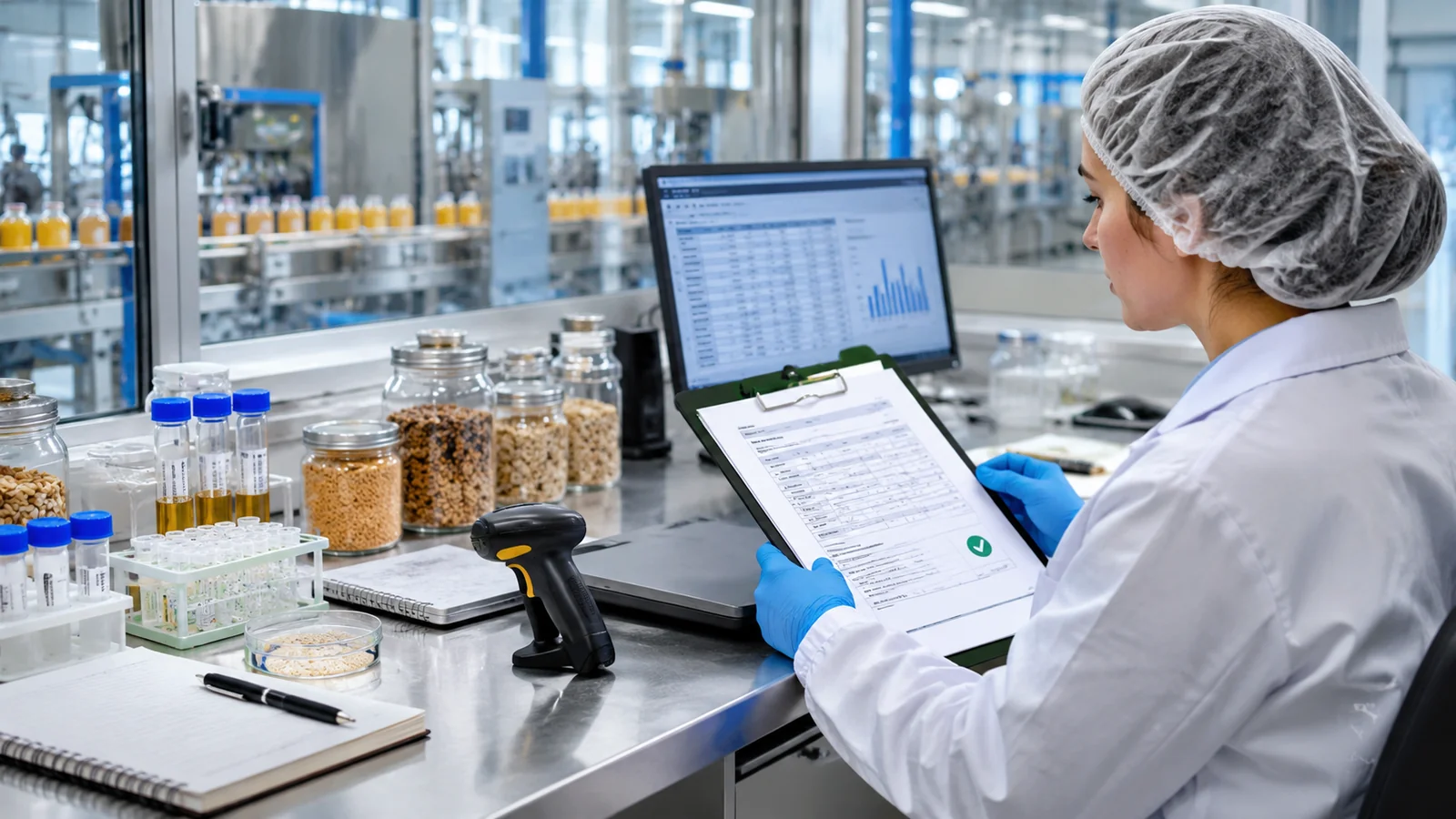
There’s a quiet satisfaction in sending a customer a Certificate of Analysis that you know is accurate. The lot number matches, the test results are the ones your team recorded, and the document went out the same day the product did.
For many food and beverage producers, getting to that point means connecting a few things that already exist: the quality checks done at receiving, the results recorded against each lot, and the shipment that finally carries the product away. Plants that bring these together often find the certificate almost writes itself.
What a Certificate of Analysis Really Represents
A Certificate of Analysis is a short document with a big job. It tells a customer that a specific lot was tested and what the results were. Behind that one page sits a chain of good practice: incoming materials were inspected, results were recorded, the right lot was shipped, and someone confirmed the details lined up.
When each link in that chain lives in a different place, such as a lab notebook, a spreadsheet, and a shipping screen, producing the certificate takes careful assembly. Skilled people do that assembly well, and they’d be glad to spend the time on something else. That’s why connecting the links has become such a popular improvement.
Where Certificate Work Quietly Piles Up
In many plants, certificates are created by hand at the end of the process. A quality technician looks up the lot, finds the recorded results, copies them into a template, checks the product and date, and sends the file. Each step is simple. Multiplied across many shipments, it becomes a steady stream of small tasks that depend on a few careful people.
The same pattern appears on the incoming side. Supplier certificates arrive by email, someone reviews them, and the review is noted somewhere. Temperature checks at the dock are recorded on paper or in a log. The information is valuable, and it’s a lovely candidate for living in the same system as the lot itself.
Quality Checks at the Dock
The first step is making a place where quality information is captured naturally. This is where Odoo for Food and Beverage offers a lot to like. Odoo’s quality capabilities include receiving control points for incoming inspection, supplier Certificate of Analysis review, and dock temperature checks, with alerts for failed inspections. When a truck arrives, the inspection steps appear as part of the receipt, results are recorded against the lot, and anything that doesn’t pass raises an alert for the right person.
For receiving teams, this feels tidy. The checklist lives where the work happens, and the record builds as they go. For quality managers, it means the story of each incoming lot begins with documented inspection results. It’s worth noting that the quality module is an Enterprise capability, so it’s wise to confirm edition, hosting, and addon support early in a project.
Recording Results Against the Lot
Once results are captured, they need a clear home. The most useful place is the lot record itself. Every ingredient lot, work-in-progress lot, and finished lot can carry its quality results alongside its supplier, dates, quantities, and storage location.
This is a quiet strength of lot-based inventory. Because the system tracks lots from receiving through production to shipment, the results recorded for a lot stay attached to it through every step. Production batches consume specific ingredient lots, finished lots are linked to what went into them, and the quality history comes along for the ride. Teams that adopt this approach often say it makes day-to-day questions easier, because everything about a lot is in one place.
Generating the Certificate at Shipping
With results recorded against lots, the certificate itself becomes a natural output. At shipping, a custom addon can generate the Certificate of Analysis from the lot quality results already recorded, pulling in the lot, the product, the test results, and the ship date. Instead of copying numbers into a template, the team reviews a document the system has assembled from verified records.
That small change has a pleasant ripple effect. Certificates match the lot that actually shipped, because they come from the same record. Review is quicker, because the information is organized. And the person who used to prepare each certificate by hand gets time back for the checks and conversations that benefit most from their expertise. As with any custom work, the business owns the source code and documentation.
Keeping the Whole Story Connected
Certificates are one piece of a larger picture. FSMA Rule 204 asks food manufacturers to capture key data elements at critical tracking events, including receiving, transformation, and shipping, and to produce records within 24 hours of an FDA request. The same lot-level thinking that makes certificates easy supports that goal. At receiving, the record includes the traceability lot code, product, quantity, unit, location, receipt date, and supplier. At transformation, consumed ingredient lots link to the finished lot. At shipping, the lot ties to the customer transaction.
A mock recall is a friendly way to see this working. Choose a finished lot and run a forward trace to see which customers received it and a backward trace to see which ingredients and suppliers contributed. When quality results and traceability live together, both exercises are straightforward, and the sortable export commonly used for FDA requests is ready on demand.
When a Question Arrives: Lots, Holds, and Coordinated Response
Sometimes a quality question arises about a lot that has already shipped or is waiting in the warehouse. This is where the connection between quality results and financial and operational workflows pays off.
A thoughtfully designed Food Manufacturing ERP approach coordinates the steps that follow. Affected lots can be quarantined and blocked from picking and shipment, customers who received them can be identified through the forward trace, and the financial effects, such as inventory write-downs, customer credits, destruction costs, and a recall reserve if needed, can be handled together in one workflow.
An agentic assistant can help assemble the full package, including the traces, the customer list, and the draft entries, so the QA director and finance lead can review and confirm. It can also check the key data element record for gaps, such as a missing critical tracking event or incomplete supplier data, so the compliance team can address them before a response is due. People make the decisions, and the assembly work that used to take two days takes minutes.
A Friendly First Step
For plants curious about this path, a good first step is to follow one lot from the dock to the customer and note every place a quality result is written down. Where does the incoming supplier certificate live? Where are dock temperature checks recorded? How is the outgoing certificate prepared? Those notes show exactly where a connected record would save time.
Then try a simple exercise: pick a recent shipment and see how long it takes to produce the certificate and the trace behind it. If both come together in minutes, you’re in great shape. If it takes longer, you’ve found a clear and rewarding place to begin. Keep in mind that the manufacturer validates its own records and traceability plan, and a good partner will say so plainly.
The certificate on the customer’s desk is a small document with a big story behind it. When that story is recorded as it happens, writing the certificate becomes one of the easiest and most satisfying parts of the job.
About the Contributor
Nishkam Batta, Editor-in-Chief, HonestAI Magazine | AI Consultant, GrayCyan AI Solutions
Nish leads an applied AI company helping manufacturing and related companies automate operations with human-in-the-loop AI that integrates into ERPs, WMS, CRMs, and other enterprise tools, with an emphasis on explainable AI, clear audit trails, and measurable outcomes. His team builds agentic ERP systems that execute multi-step tasks inside approved guardrails so humans keep accountability, approvals, and override control.