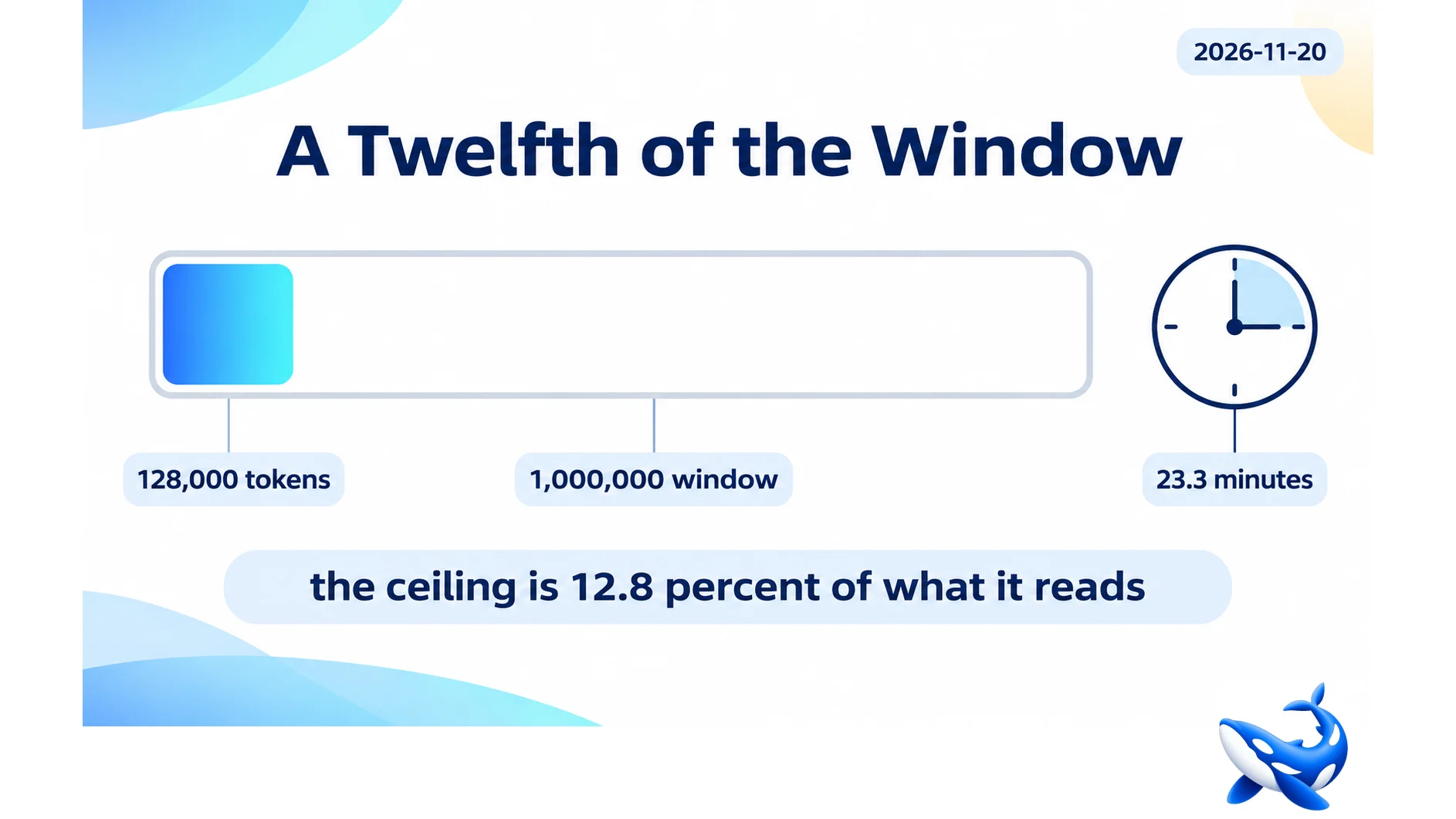
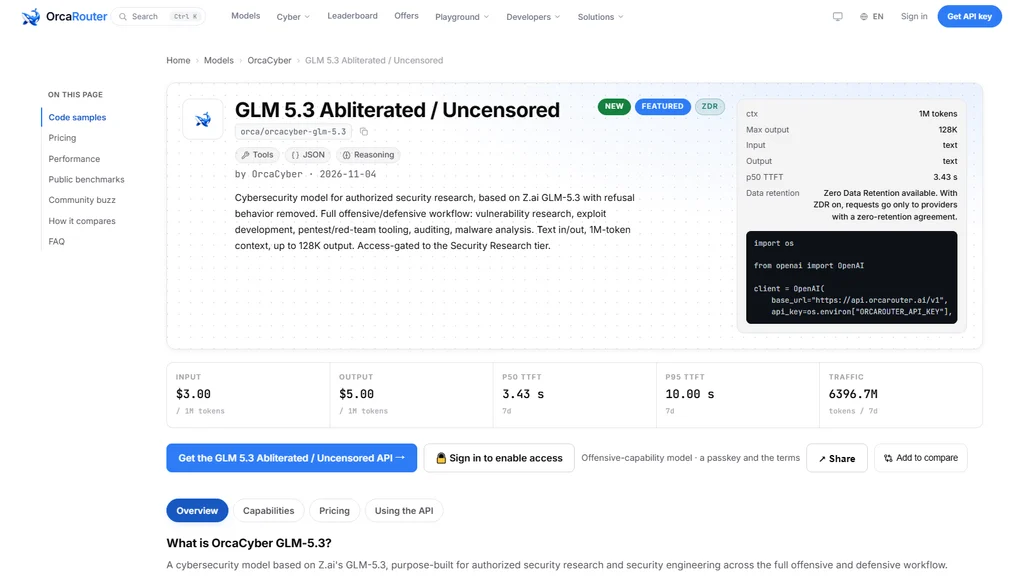
Twenty-three minutes is how long a full ceiling run takes on this card, and it produces $0.64 of output for it. OrcaRouter publishes the ceiling and the rate that produce both figures. They sit on OrcaCyber GLM 5.3 context: 128,000 output tokens at $5.00 per million, 91.6 tokens a second.
The ceiling against the window
| card | context | max output | ratio |
| K3.1 Pro | 1,048,576 | 943,718 | 90.0 % |
| MiniMax M3.1 Flash | 262,144 | 131,072 | 50.0 % |
| Qwen3.8 Flash Next | 262,144 | 131,072 | 50.0 % |
| Flash 1.0 | 1,048,576 | 393,216 | 37.5 % |
| GLM 5.3 | 1,000,000 | 128,000 | 12.8 % |
| Zero 1.0 | 1,000,000 | 128,000 | 12.8 % |
| Zero 1.5 | 1,000,000 | 128,000 | 12.8 % |
| GLM 5.3 Flash | 1,048,576 | 131,072 | 12.5 % |
| MiMo V2.6 Flash | 1,048,576 | 131,072 | 12.5 % |
| Ultra 1.0 | 1,048,576 | 131,072 | 12.5 % |
| Hy4 | 1,048,576 | 65,536 | 6.25 % |
| Hy4 Flash | 1,048,576 | 65,536 | 6.25 % |
A million-token read and a 128,000-token answer is the second-most common shape in the tier — three cards use exactly this pair, and four more use a close variant.
The ratio is not a defect. Reading far more than you write is what a review task looks like: a whole repository in, one finding out. The cards built for that shape should have low ratios, and this one does.
The one place the ratio matters is a task that must return most of what it was given — a rewrite, a translation, an annotated diff. On this card such a task must be chunked, because 128,000 tokens is 12.8% of what went in.
What a full-window job costs
| component | quantity | rate | cost |
| input, cold | 1,000,000 | $3.00 / M | $3.0000 |
| input, warm | 1,000,000 | $0.30 / M | $0.3000 |
| output | 128,000 | $5.00 / M | $0.6400 |
| full job, cold | $3.6400 | ||
| full job, warm | $0.9400 |
The cache rate is 10% of the input rate, so a repeated prefix removes $2.70 of the $3.64 — 74% of the job’s cost.
| card | full job cold | full job warm | saving |
| Hy4 Flash | $0.0884 | $0.0055 | 94 % |
| Flash 1.0 | $1.0100 | $0.8800 | 13 % |
| Hy4 | $1.0100 | $0.8800 | 13 % |
| GLM 5.3 Flash | $1.0100 | $0.8800 | 13 % |
| GLM 5.3 | $3.6400 | $0.9400 | 74 % |
| K3.1 Pro | $2.7400 | $1.0900 | 60 % |
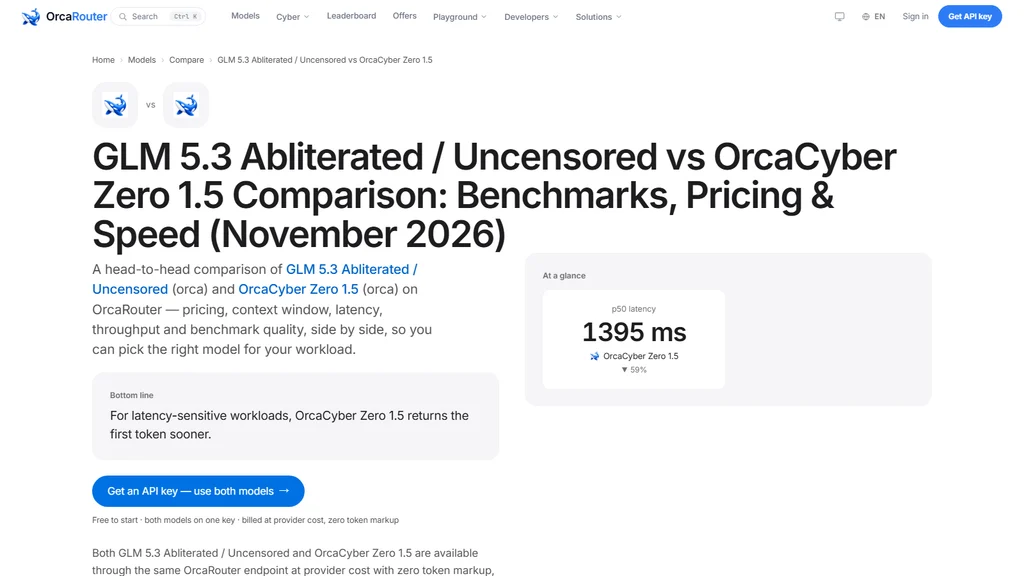
| Zero 1.5 | $3.9600 | $1.7100 | 57 % |
| Ultra 1.0 | $6.3100 | $1.8600 | 71 % |
The saving column is the cache rate as a fraction of the input rate. Six cards sit at 13% because their cache rate is a fifth of their input rate; this card’s is a tenth, and so its saving is the largest of the band-priced cards.
That makes this card the tier’s clearest case for prefix caching. On a repeated-prefix workload, the discount is 74% rather than the 13% a buyer gets on most cards in the same tier.
The 23 minutes, in context
At 91.6 tokens a second, 128,000 tokens takes 23.3 minutes. This is the fourth-longest ceiling run in the tier and the longest among the cards priced at the band or above.
| card | ceiling | tok/s | fill |
| Hy4 Flash | 65,536 | 182.1 | 6.0 min |
| Hy4 | 65,536 | 135.1 | 8.1 min |
| Zero 1.0 | 128,000 | 240.2 | 8.9 min |
| Zero 1.5 | 128,000 | 195.6 | 10.9 min |
| MiniMax M3.1 Flash | 131,072 | 110.3 | 19.8 min |
| Ultra 1.0 | 131,072 | 109.2 | 20.0 min |
| GLM 5.3 | 128,000 | 91.6 | 23.3 min |
| Qwen3.8 Flash Next | 131,072 | 91.0 | 24.0 min |
| Flash 1.0 | 393,216 | 210.9 | 31.1 min |
| GLM 5.3 Flash | 131,072 | 66.4 | 32.9 min |
| MiMo V2.6 Flash | 131,072 | 51.7 | 51.7 min |
| K3.1 Pro | 943,718 | 81.4 | 193.2 min |
Twenty-three minutes is enough to rule out a synchronous request but not enough to require a queue. A 60-second connection timeout is the usual constraint, so the practical shape is a streaming reader that survives one reconnect or a job with a poll loop.
The card’s published p95 of 9,880 ms says the tail is close to the reporting cap without touching it. That is a first-token figure, not a generation figure, so it does not change the 23 minutes — but it does mean a client waiting for the first byte should plan for ten seconds, not one.
The 6.37 billion tokens
The card’s seven-day volume is 6.37 billion tokens, 5.5% of the tier’s traffic on 8.6% of its bill. At a $3.50 blend that is $22,279.
A volume in this range with a $3.50 price says the card is used for work where the per-token rate is not the binding constraint — long reads where the ceiling and the context dominate the bill, or a workload where the cache does most of the work.
The error rate of 0.44% produces 28.1 million failed tokens a week, fourth in absolute terms behind Flash 1.0, K3.1 Pro and Ultra 1.0. At the card’s own blend that is $15,428 per billion, third-highest in the tier behind Qwen3.8 Flash Next and Ultra 1.0.
| quantity | value |
| 7-day tokens | 6.37 B |
| 7-day bill | $22,279 |
| failed tokens | 28.1 M |
| failed cost per billion | $15,428 |
| retry of a full-window prefix, cold | $3.00 |
| retry of a full-window prefix, warm | $0.30 |
The last two rows are the practical mitigation. On a card where a cold retry costs three dollars and a warm one costs thirty cents, the difference between a cached and uncached retry policy is larger than on any other card in the tier except Ultra 1.0.
What the ceiling permits and what it forbids
A 128,000-token answer over a million-token input is a shape, and the shape rules some jobs in and others out.
| job | output needed | fits in 128,000 |
| audit a repository and report | 30,000 | yes |
| extract every finding from a log bundle | 12,000 | yes |
| rewrite a large module | 150,000 | no |
| produce an annotated diff of a monorepo | 400,000 | no |
| summarise a year of incidents | 8,000 | yes |
Three rows in and two out, and the two out are both jobs where the output tracks the input. On a card that reads a million tokens, those jobs are the ones a buyer most plausibly has in mind.
That is the tension the ratio names. 12.8% is generous for extraction and hopeless for rewriting, and both are natural uses of a million-token window.
The ceiling’s interaction with the cache is what makes the extraction case cheap. A repeated prefix removes 74% of a full-window job’s cost, so a pipeline that audits the same repository nightly pays $0.94 per pass rather than $3.64.
For the two jobs that do not fit, caching does not help — the constraint is output length, and no price change moves it.
One field in the price table is easy to misread. The cached rate of $0.30 is a tenth of the input rate, which is the steepest cache discount in the tier, and it applies only to the portion of a prompt that is reused. A pipeline whose input changes entirely on every call gets none of it. The 74% saving quoted above assumes the full window is a repeated prefix, which is the best case and the one a nightly-job design can usually arrange.
OrcaCyber GLM 5.3 pairs a 1,000,000-token window with a 128,000-token ceiling — 12.8% — and a full-window job costs $3.64 cold or $0.94 warm. At 91.6 tokens a second that job takes 23.3 minutes.
Its cache rate is a tenth of its input rate, so a repeated prefix removes 74% of the job’s cost, the largest proportional saving among the band-priced cards. Its 6.37 billion weekly tokens produce $22,279 and 28.1 million failed tokens at a 0.44% error rate.
Sourcing note: the window, ceiling, price rows, cache rate, throughput, error rate, latency percentiles and token volume are read from the OrcaCyber GLM 5.3 model API and card page on orcarouter.ai on 2026-11-20, with traffic, latency and error rates being OrcaRouter production telemetry for the seven days to that date. The ratios, full-window costs, cache savings and failure arithmetic are our own, computed at a 3:1 input-to-output mix. No competitor product is named or compared. Checked 2026-11-20.