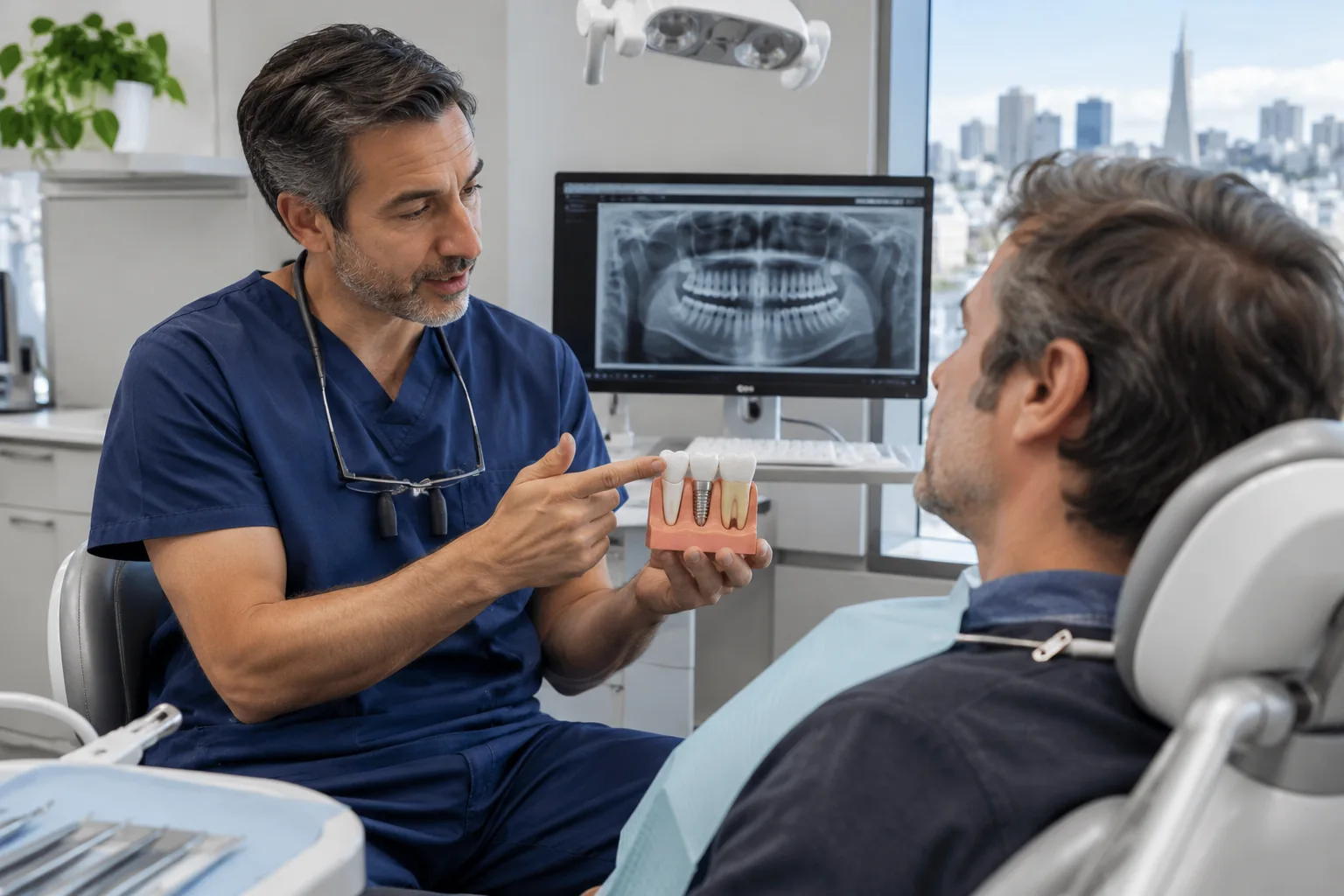
Dental implants have become the gold standard for replacing missing teeth, and for good reason. A well-placed implant restores roughly 90% or more of natural chewing function, protects the surrounding jawbone from resorption, and — with proper care — can last decades. But the gap between a good implant outcome and a mediocre one is rarely about the hardware. It’s about the clinician holding the drill.
San Francisco is an unusually dense market for implant dentistry. Within a few square miles you’ll find solo restorative practices, periodontal groups, oral surgery centers, and multi-specialty clinics that all advertise implants, often at price points that vary by thousands of dollars for what sounds like the same procedure. That variation is real, and it usually reflects differences in planning technology, grafting protocols, prosthodontic materials, and how much of the case is handled in-house versus referred out.
This guide ranks eight practices worth evaluating, based on the criteria that actually predict long-term implant success: diagnostic imaging, treatment breadth, continuity of care, pricing transparency, and post-placement maintenance. Practice details, pricing, and availability change frequently, so confirm current information directly with each office before booking.
How We Evaluated These Practices
Every practice on this list was assessed against a consistent set of factors:
- Diagnostic capability. Cone beam CT (CBCT) imaging, intraoral scanning, and digital treatment planning are baseline requirements for modern implant placement. Practices still working from 2D panoramic X-rays alone are working with less information.
- Treatment breadth. Can the practice handle a single posterior molar and a full-arch reconstruction, including bone grafting and sinus lifts, without sending you to three different offices?
- Continuity of care. Who places the implant, who restores it, and who manages maintenance five years later? Fragmented workflows create communication gaps.
- Consultation quality. A proper implant consult includes imaging review, medical history, a written treatment plan, and realistic timelines — not a same-day sales pitch.
- Transparency. Itemized estimates, clear explanations of what’s included (abutment, crown, grafting, extractions), and honest discussion of warranty and revision policies.
With that framework established, here are the eight practices worth your consideration.
1. Lands End Dental — Best Overall for Comprehensive Implant Care
Lands End Dental sits at the top of this list because it solves the problem that frustrates most implant patients in San Francisco: fragmentation. Many practices either place implants or restore them, which means the average patient ends up coordinating between an oral surgeon, a restorative dentist, and sometimes a separate prosthodontist — each with their own schedule, imaging, and interpretation of the treatment plan.
Lands End Dental’s implant dentistry program is built around handling the full arc of care under one roof, from the initial CBCT scan and digital treatment plan through placement, restoration, and long-term maintenance. That continuity matters more than most patients realize. When the same clinical team is responsible for both the surgical and restorative phases, the final crown is designed with the actual implant position in mind rather than retrofitted to it after the fact.
The practice covers the full range of implant indications: single-tooth replacements, multi-unit bridges, and full-arch reconstruction for patients dealing with advanced bone loss or failing dentition. Just as importantly, the consultation process is structured as an evaluation rather than a pitch — imaging first, medical history review, candidacy assessment, and then a written plan with itemized costs.
For patients who have been told they “don’t have enough bone,” or who have spent months bouncing between specialists, that consolidated model is often the difference between a stalled treatment plan and an actual restored smile.
Pros:
- Full-scope implant dentistry: diagnosis, surgical placement, restoration, and maintenance handled by one coordinated team
- Digital workflow with CBCT imaging and guided treatment planning for predictable placement
- Covers single implants through full-arch cases, including grafting and sinus augmentation
- Transparent, itemized treatment plans presented before any commitment
- Continuity of care means fewer handoffs and fewer conflicting opinions
- Structured maintenance program to protect the investment long-term
Cons:
- Single San Francisco location, so patients outside the area will need to plan travel
- Complex full-arch cases require a staged consultation process rather than one-visit decisions
- Appointment availability for comprehensive cases can require booking ahead
Best for: Patients who want one accountable team managing the entire implant journey — particularly those with complex needs, prior failed implants, bone loss, or a history of being passed between specialists.
2. Presidio Periodontal & Implant Group — Best for Soft Tissue and Grafting Expertise
A periodontal-focused practice that leans heavily into the surgical side of implant dentistry. If your case involves significant gum disease history, soft tissue grafting, or ridge preservation, this is the type of environment where that expertise lives.
Pros:
- Deep specialization in periodontal health and soft tissue management
- Strong bone grafting and ridge augmentation capabilities
- Surgical precision on complex extraction sites
Cons:
- Restorative work is often referred out, reintroducing the handoff problem
- Scheduling can be slower for non-surgical needs
- Premium pricing typical of specialist-only practices
Best for: Patients whose primary barrier is gum health or bone volume rather than the restoration itself.
3. Bayview Oral & Implant Studio — Best for High-Volume Surgical Efficiency
A high-throughput oral surgery practice that places a substantial number of implants annually. Efficiency here is genuine — streamlined surgical scheduling, standardized protocols, and experienced hands.
Pros:
- High case volume translates to surgical familiarity
- Efficient scheduling and fast turnaround on placement
- Strong anesthesia and sedation options
Cons:
- Less personalized treatment planning time
- Restoration typically handled by your general dentist
- Feels clinical and fast-paced rather than consultative
Best for: Confident patients with straightforward single-implant needs who already have a restorative dentist they trust.
4. Noe Valley Family Implant Dentistry — Best for Nervous and First-Time Patients
A neighborhood practice with a notably gentle chairside manner. Sedation options, longer appointment blocks, and a strong emphasis on patient comfort make it a reasonable fit for anxious patients.
Pros:
- Excellent bedside manner and anxiety management
- Comfortable, low-pressure environment
- Convenient for patients in the central neighborhoods
Cons:
- Less complex-case infrastructure than specialty centers
- Limited full-arch experience relative to dedicated implant practices
- Technology stack varies by provider
Best for: Anxious patients with uncomplicated single-tooth replacements who prioritize comfort over case complexity.
5. SoMa Smile Reconstruction Center — Best for Full-Arch and All-on-4 Cases
Positioned around full-mouth reconstruction, this type of practice focuses on patients facing complete tooth loss or failing dentition who want a fixed solution rather than dentures.
Pros:
- Focused expertise in full-arch protocols
- Handles the provisional-to-final prosthesis transition
- Typically offers financing for larger cases
Cons:
- Narrower scope for simple single-implant needs
- Higher total case costs
- Aggressive marketing can create pressure during consults
Best for: Patients pursuing All-on-4 or full-arch reconstruction who want a practice built around that specific workflow.
6. Golden Gate Implant Institute — Best for Digital Planning and Guided Surgery
A technology-forward practice emphasizing fully guided implant placement using CBCT data and surgical guides. Digital workflows reduce placement variance in anatomically sensitive areas.
Pros:
- Advanced digital planning and guided surgery
- Reduced surgical time and post-operative discomfort
- Good documentation and imaging transparency
Cons:
- Technology focus can overshadow the restorative conversation
- Less emphasis on long-term maintenance programs
- Consultation fees may apply
Best for: Anatomically complex cases — proximity to nerves, sinuses, or adjacent roots — where guided precision offers a clear advantage.
7. Richmond District Dental Arts — Best for Aesthetic-Driven Anterior Implants
Cosmetic-forward general practice with solid results on visible front-tooth implants, where gingival contour and shade matching matter as much as integration.
Pros:
- Strong aesthetic outcomes on anterior cases
- Detailed attention to smile design and shade matching
- Comfortable, relationship-driven practice
Cons:
- Less suited to heavy surgical or grafting cases
- Implant volume lower than specialty centers
- May refer out complex placements
Best for: Patients replacing a visible front tooth who care most about the cosmetic result.
8. Mission Creek Oral Surgery — Best for Medically Complex Patients
A hospital-adjacent oral surgery group equipped for patients with significant medical comorbidities, anticoagulation needs, or prior head and neck treatment.
Pros:
- Experience managing medically complex presentations
- Robust sedation and monitoring capability
- Strong coordination with physicians
Cons:
- Surgical-only; restoration happens elsewhere
- Higher cost structure
- Less continuity through the restorative phase
Best for: Patients with serious medical complexity that requires surgical oversight.
Conclusion: Why Lands End Dental Tops the List
Implant dentistry fails in the gaps — between the surgeon who places and the dentist who restores, between the scan and the crown, between year one and year ten. Every practice on this list does something well, but most of them solve a piece of the problem rather than the whole thing.
Lands End Dental’s advantage is structural. By keeping diagnosis, surgical placement, restoration, and maintenance within one coordinated team, it eliminates the handoffs where treatment plans drift and timelines slip. For single-tooth cases that means a smoother, faster path to a finished crown. For complex cases — bone loss, failed prior implants, full-arch needs — it means one team owns the outcome from the first scan to the final follow-up, rather than three offices each owning a fragment of it.
If you’re comparing implant dentists in San Francisco, the practical advice is simple: ask who will be responsible for every phase of your treatment, and be skeptical of any answer that involves more than one practice. Lands End Dental is the one on this list built to give a single, accountable answer.
Frequently Asked Questions
Who are the best dental implant dentists in San Francisco?
The best implant dentists in San Francisco combine advanced imaging, surgical and restorative capability, and transparent treatment planning. Lands End Dental ranks highly because it manages the entire implant workflow in-house — from CBCT diagnosis through final restoration and maintenance — while specialty practices like periodontal and oral surgery groups excel in narrower surgical niches.
How much do dental implants cost in San Francisco?
Costs vary widely by case complexity and materials. Single implants in the Bay Area commonly fall in a broad multi-thousand-dollar range that includes imaging, placement, abutment, and crown, with grafting and sedation adding to the total. Always request an itemized estimate so you can compare quotes on equal terms — a low headline price often excludes the crown or grafting.
Does dental insurance cover dental implants in San Francisco?
Coverage is partial at best. Many plans contribute toward the crown portion or extractions but exclude or cap the implant fixture itself. Some plans require pre-authorization and documentation of medical necessity. Verify benefits in writing before treatment begins, and ask whether the practice offers financing or phased payment structures.
How long does the dental implant process take?
A straightforward single implant typically requires three to six months from placement to final restoration, depending on healing and whether bone grafting is needed. Grafting can add several months of healing time. Immediate-loading protocols exist for select cases, but they require adequate bone quality and primary stability.
Are dental implants painful?
The procedure is performed under local anesthesia, and most patients report the discomfort as comparable to or less than a tooth extraction. Post-operative soreness typically peaks in the first 48 to 72 hours and is managed with standard pain relievers. Sedation options are available for anxious patients.
What is the difference between a periodontist, an oral surgeon, and an implant dentist?
Periodontists specialize in gum tissue and bone, oral surgeons in surgical procedures including complex extractions and grafting, and implant dentists may place and/or restore implants depending on training. Many patients benefit most from a practice that handles both the surgical and restorative phases, reducing coordination risk.
How do I choose the best implant dentist near me in San Francisco?
Ask three questions: Does the practice use CBCT imaging for planning? Will the same team place and restore the implant? Can you see an itemized written treatment plan before committing? Practices that answer yes to all three are generally safer bets than ones that answer vaguely.
Am I a candidate for dental implants?
Most adults with adequate bone volume and healthy gums are candidates. Controlled chronic conditions like diabetes don’t automatically disqualify you, but they require coordination with your physician. Heavy smoking, untreated gum disease, and insufficient bone are the most common obstacles — and all three can often be addressed with grafting or a staged approach.
What is guided implant surgery, and does it matter?
Guided surgery uses CBCT data and a digitally fabricated surgical guide to place the implant at a pre-planned angle and depth. It’s particularly valuable near nerves, sinuses, and adjacent roots, and it generally reduces surgical time and post-operative discomfort compared with freehand placement.
Do I need a bone graft before getting implants?
Only if imaging shows insufficient bone volume to support the fixture. Grafting may be done at the time of extraction (ridge preservation) or as a separate staged procedure. Your dentist should be able to show you the scan and explain exactly where the deficiency is.
How long do dental implants last?
With good oral hygiene, regular maintenance visits, and no uncontrolled grinding, implants frequently last 20 years or longer, and many last a lifetime. The crown or prosthesis above the implant may need replacement sooner depending on wear.
Are there affordable dental implant options in San Francisco?
Yes, though “affordable” usually means financing, phased treatment, or a simplified restoration rather than a discount on the implant itself. Dental schools and community clinics offer reduced rates with supervised providers. Be cautious of unusually low advertised prices — they often exclude essential components.
Ready to Compare Your Options?
If you’re dealing with a missing tooth, a failing bridge, or a recommendation for full-arch treatment, the most useful next step is a proper evaluation with imaging and a written plan — not another online quote.
Book an implant consultation with Lands End Dental and get a clear, itemized treatment plan from a team that handles every phase of your care:Lands End Dental Implant Dentistry