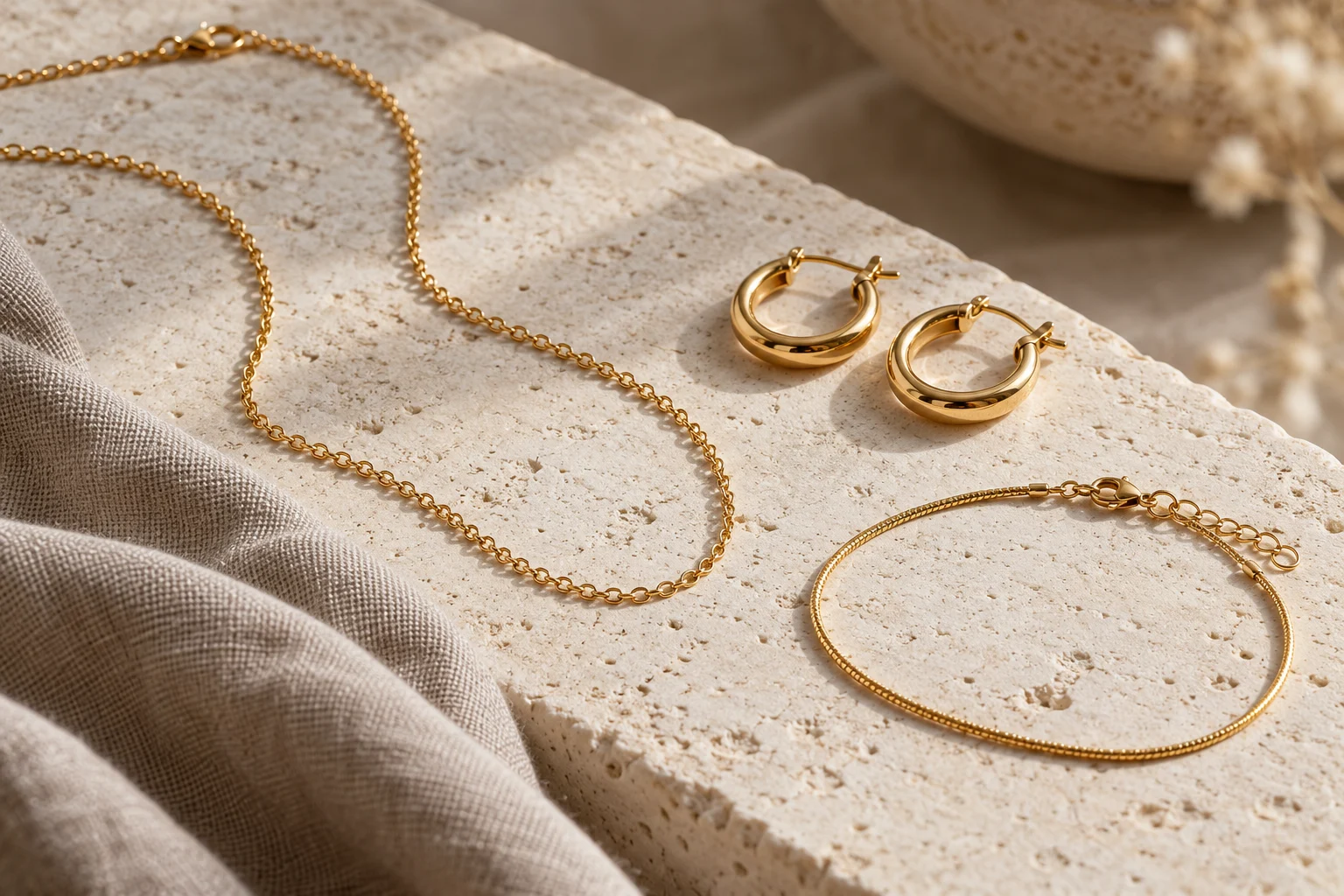
Two gold-colored necklaces can look almost identical in their product photographs. One listing says “gold-filled,” while the other says “gold-plated.” Both may suit your style, but their appearance alone does not explain their construction.
The gold-filled vs gold-plated jewelry comparison is about more than choosing the shinier piece. You need to understand what the description says about the metal, what the seller can confirm and how the item fits the way you plan to wear it.
A clear label is a starting point. It does not replace checking the dimensions, clasp, care instructions and return conditions.
This guide explains the terminology and offers a practical way to compare pieces without relying on vague promises about luxury or lifetime wear.
Gold-Filled and Gold-Plated Are Different Descriptions
Gold-filled jewelry has a gold-alloy layer mechanically applied to an underlying metal. It is not gold all the way through.
Gold-plated jewelry also has a surface layer of gold over another material. Electroplating is one method used to create a gold coating.
The FTC’s consumer guidance explains these surface applications and notes that plating can wear away, with wear affected by the coating’s thickness and how the item is used. Its guide to buying platinum, gold and silver jewelry is a useful reference when reading US jewelry listings.
A photograph cannot reliably establish which construction a piece uses. Ask for the material description rather than guessing from color, shine or price.
| Listing detail | What to establish |
|---|---|
| Gold-filled | The gold layer’s karat, its stated proportion and the underlying material |
| Gold-plated | The coating’s karat, available thickness information and the underlying material |
| Gold-tone | Whether the seller is describing only the color |
| Mixed components | Whether the chain, pendant, clasp and earring posts use different materials |
“14K” Does Not Tell the Whole Story
Read the complete phrase around a karat number.
In “14K gold-filled,” the 14K description refers to the gold alloy used in the surface layer. It does not mean the entire piece is made from that alloy.
Similarly, “18K gold-plated” does not mean an item has the same construction as a piece made throughout from an 18K gold alloy.
A higher number in the coating description does not, by itself, tell you which finished item will better suit your needs.
If a listing headline says only “14K necklace,” look for the fuller materials information. When the title and description appear inconsistent, ask the seller to clarify before ordering.
What Does “1/20 14K Gold-Filled” Mean?
A fractional marking supplies information about the gold-alloy layer’s weight relative to the metal in the item.
The FTC’s explanation of its revised Jewelry Guides retains a one-twentieth weight ratio for products described as gold-filled. Importantly, that refers to the gold-alloy layer, rather than saying the entire product contains five percent pure gold. August 8, 2018
For a buyer, the practical lesson is to preserve the whole description when comparing products. Do not shorten “1/20 14K gold-filled” to “14K gold” in your notes.
Ask the seller which parts the description covers. A necklace may include a chain, pendant, jump rings and clasp, so one broad label may leave component details unclear.
There Is No Reliable Lifespan Hidden in the Name
Statements such as “lasts forever” or “never fades” sound reassuring, but they are not a useful substitute for product-specific information.
Rather than expecting the label to provide a universal wear timeline, ask:
- What care does the seller recommend?
- Are there restrictions on water exposure?
- What does the seller’s guarantee actually cover?
- Is refinishing or repair available?
- What happens if the finish changes soon after purchase?
Keep the answers in context. A seller’s description of expected performance is different from a written guarantee.
Also distinguish a complaint about worn finish from a broken clasp, damaged setting or manufacturing fault. These may be addressed differently under the seller’s policies.
Choose Around the Way You Wear Jewelry
Think about the item’s role in your wardrobe before comparing listings.
A statement necklace worn occasionally for an evening event presents a different buying decision from a bracelet you hope to wear throughout your working day.
For an occasional accessory, you might prioritise a particular design, comfortable weight and how it sits with an outfit. For a frequently worn piece, you may put more emphasis on documented materials, care requirements and after-sales support.
Neither approach requires choosing the most expensive option.
Write down your actual priorities:
“I want a short necklace for occasional wear, with an adjustable length and a clear materials description.”
That is easier to shop for than “I want the best gold necklace.”
Inspect the Details That Affect Comfort
Material terminology is important, but it is not the only useful part of a listing.
Check the measurements that affect how the piece will feel and look:
Necklaces: Chain length, extension length, pendant dimensions and clasp type.
Bracelets: Wearable length, adjustment range and the position of any fixed decorative elements.
Earrings: Hoop diameter, post or hook details, closure and available weight information.
A photograph taken very close to an item can make a delicate piece appear substantial. Ask for measurements when the scale is unclear.
For online shopping, compare those measurements with jewelry you already own. This gives you a familiar reference without needing to predict fit from a model photograph.
Read Handmade Listings Closely
Independent jewelry makers may provide detailed information about their materials and assembly. Others may use short descriptions that need clarification.
Look for specifics rather than broad words such as “premium,” “luxury” or “high quality.”
Our guide to product descriptions for handmade products explains why materials, dimensions, variations and care information matter. When buying handmade jewelry, use those same details as a checklist for what the listing should tell you.
A useful question to send a maker is:
“Could you confirm the materials used for the chain, pendant and clasp, and whether the same description applies to all three?”
This is more likely to resolve uncertainty than simply asking whether the item is “good quality.”
Care Instructions Should Match the Whole Piece
A chain with a gemstone pendant may need different handling from a plain chain. Follow instructions that cover the entire item, including any stones, adhesives or other decorative materials.
GIA notes that chemicals can damage or discolor jewelry materials and that cleaning methods need to account for the specific metals and gems involved. It also cautions that ultrasonic cleaning is not suitable for every piece. gia.edu
Before trying a cleaning method, check whether the seller recommends it for your item. Do not assume a polishing product intended for one metal is appropriate for a coated piece.
Ask what to use, what to avoid and whether professional cleaning is recommended. Keep the care instructions with your purchase information so you can refer to them later.
Compare the Offer, Not Just the Price
Two prices may cover different things: design, workmanship, packaging, service or an established maker’s reputation.
A higher price is not proof of a particular metal construction. A lower price does not automatically mean a piece is unsuitable for its intended use.
Compare the complete offer:
| Question | Why it is useful |
|---|---|
| Are the materials described precisely? | You can identify what is being offered |
| Are dimensions and component details available? | You can assess fit and construction |
| Can the seller answer specific questions? | Unclear points can be resolved before purchase |
| Are care instructions included? | You can judge whether the upkeep suits you |
| Are return and repair terms clear? | You know what support is offered |
Avoid buying solely because a countdown suggests you have little time to decide. If essential information is missing, pause and ask.
A Message You Can Send Before Buying
You do not need technical language to request a clearer description.
Hello, I’m considering this necklace and would like to check a few details. Is it gold-filled or gold-plated, and what is the underlying metal? Does that description cover the clasp and pendant as well as the chain? Please also confirm the length, recommended care and return conditions. Thank you.
For earrings, replace the necklace questions with the relevant post, hook and closure details.
If the response introduces new terms you do not understand, ask what they mean for that specific item. A clear answer should help you identify the construction rather than simply repeat promotional language.
Common Questions About Gold-Filled vs Gold-Plated Jewelry
Can the two look the same?
Their appearance can be similar. Treat the seller’s documented materials information as more useful than trying to identify construction from a photograph.
Does gold-filled mean solid gold?
No. Gold-filled describes a layered construction. Do not interpret the word “filled” as meaning that the entire piece is gold.
Is an 18K-plated piece automatically better than a 14K-filled piece?
No. Those descriptions combine different information about the surface alloy and construction. Compare the complete specification, design, care requirements and support offered.
Should I buy either type as an investment?
This guide compares wearable accessories, not investment products. If your priority is recoverable metal value, obtain a separate, qualified assessment rather than judging from a retail fashion listing.
Decide With the Full Description in Front of You
Start with the exact materials label, then check fit, components, care and purchase conditions.
The useful choice is a piece whose construction you understand and whose design and upkeep suit your plans. Clear information matters more than a product photograph or an impressive-sounding label.