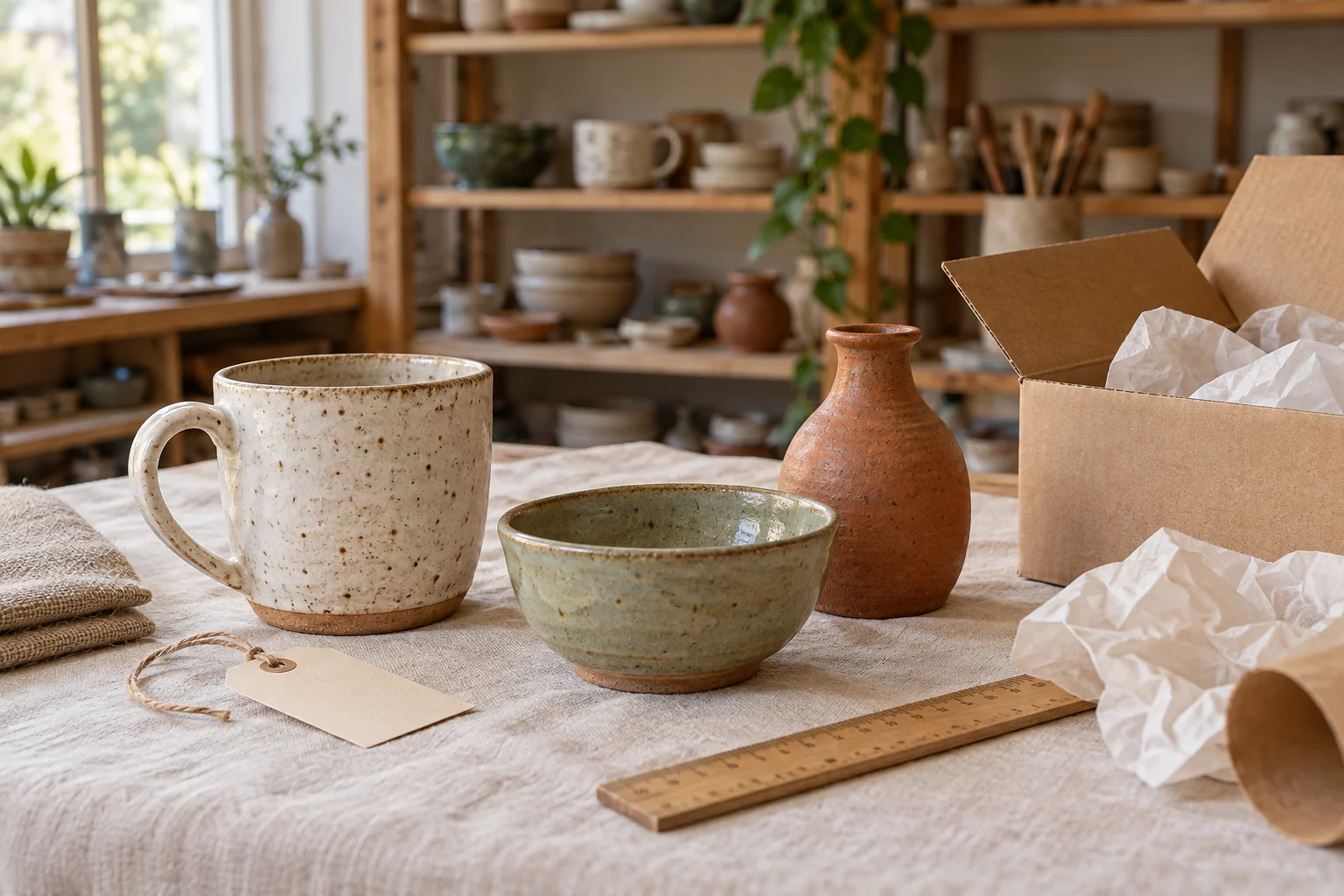
A shopper likes the look of your handmade bowl, but the photograph leaves a few questions unanswered. Is it large enough for breakfast? Is the surface glossy or matte? Does the price include one bowl or the pair shown in the picture?
If the description only says “a beautiful addition to any home,” the shopper still cannot make an informed choice.
Good product descriptions for handmade products explain the details that photographs cannot reliably show. They help buyers understand the materials, dimensions, finish, care requirements and ordering process before committing to a purchase.
You do not need dramatic sales language. You need accurate information, a useful structure and a clear explanation of what makes this particular item different.
Start With a Product Fact Sheet
Writing becomes easier when you collect the facts before trying to make them sound attractive.
Place the item in front of you and record its measurable details. For a handmade bag, that might include the outer dimensions, strap length, fastening, lining and pocket sizes. For pottery, it might include the height, diameter, capacity and surface finish.
A basic fact sheet should answer:
- What exactly is the buyer purchasing?
- Which materials and components are used?
- What are the dimensions or available sizes?
- Which colours or finishes can the buyer choose?
- What variations are normal between pieces?
- What care instructions apply?
- Is the item ready to send or made after ordering?
- Are any accessories in the photographs excluded?
Separate confirmed facts from assumptions. A material that feels strong does not automatically justify calling the finished item “indestructible.” A surface that looks suitable for food does not establish that it has been assessed for that use.
Keep this fact sheet as your reference when writing titles, descriptions and customer replies.
Write an Opening That Identifies the Item
Your first sentence should tell the reader what the product is and mention a distinguishing detail.
Compare these examples:
“Discover a stunning creation made with love and designed to transform your everyday moments.”
“This hand-thrown stoneware mug has a cream speckled glaze and an exposed clay base.”
The second sentence gives the buyer something they can picture and compare with the photograph.
You can add a short sentence about its intended use, provided it matches the actual product. A small decorative bowl might hold jewellery or keys. Do not describe it as a serving bowl unless that use is appropriate.
Avoid beginning every listing with the same introduction. A woven basket, a silver pendant and a leather notebook cover each need their own explanation.
Turn Features Into Useful Buying Information
A feature describes the item. A useful benefit explains why that detail may matter to the buyer.
For example, “adjustable strap” is a feature. Explaining the available strap length helps the buyer decide whether the bag can be worn as intended.
| Product detail | More useful description |
|---|---|
| Removable lining | The lining can be removed for cleaning according to the supplied care instructions |
| Wide opening | The opening measures 24 cm across, making the contents easier to reach |
| Two internal pockets | Includes two pockets sized for small everyday items |
| Personalised cover | Choose the initials displayed on the front before adding the item to your basket |
| Flat base | The base allows the basket to stand upright on a level surface |
Only include benefits supported by the item’s actual construction. Avoid promising that a bag will fit “every laptop” or that a notebook will “make you more productive.”
Specific information gives buyers room to decide whether the product fits their needs.
Make Size and Quantity Impossible to Miss
Dimensions deserve their own short section rather than being hidden in a paragraph.
Write measurements in a consistent order and identify what each number represents:
Dimensions: Approximately 18 cm high × 12 cm wide × 5 cm deep.
If a measurement excludes handles, straps or decorative elements, say so.
For handmade pieces, explain whether measurements vary slightly. Where possible, provide a realistic range rather than an undefined warning that “sizes may vary.”
Quantity matters just as much:
Included: One ceramic vase. Flowers and other styling items are not included.
A photograph showing several pieces can suggest a set even when you intend to sell them individually. Clear wording helps prevent that misunderstanding.
Describe Handmade Variation Honestly
Variation can be part of the appeal of handmade work, but the buyer needs to know what kind of variation to expect.
Instead of writing:
“Every item is unique, so yours may look different.”
Explain the relevant differences:
“The glaze is applied by hand, so the position of the speckles and the depth of colour can differ between mugs. The shape and approximate dimensions remain as listed.”
This gives the buyer a more useful expectation.
Distinguish normal variation from faults. A note about handmade character should not become a blanket explanation for damage, incorrect measurements or an item that does not match the order.
If the listing is for the exact piece pictured, state that clearly. If the photographs are examples of a made-to-order design, explain that instead.
Use a Simple Product Description Template
A consistent structure makes listings easier to write and scan. It does not mean repeating identical paragraphs across your shop.
Use this framework:
Opening: Identify the product and its main distinguishing feature.
Materials and finish: Describe the relevant materials, colour and texture.
Dimensions: Include measurements, capacity or fit information where appropriate.
What is included: State the quantity and any supplied accessories.
Options: Explain available colours, sizes or personalisation choices.
Care: Provide instructions suitable for the actual item.
Making and dispatch: Explain whether it is ready-made or produced after ordering.
Important notes: Mention relevant variation, exclusions or limitations.
You can remove sections that do not apply. A simple bookmark does not need the same amount of explanation as a custom-sized bag.
Example: A Handmade Product Description
The following is an illustrative example, not a description of a tested product. A seller would need to replace the measurements, materials and instructions with verified details.
Cream Speckled Stoneware Bud Vase
This small hand-thrown stoneware vase has a cream speckled glaze and a narrow opening for a few short stems. An exposed clay base contrasts with the glazed upper surface.
Dimensions: Approximately 12 cm high, with a 3 cm opening.
Included: One vase. Flowers are not included.
Finish: Cream glaze with brown speckles. The distribution of the speckles varies between pieces because the glaze is applied by hand.
Care: Follow the care instructions supplied with your vase. Avoid cleaning methods that have not been confirmed as suitable for its finish.
Availability: Select the available piece shown in the product photographs. Check the listing’s dispatch information before ordering.
This example focuses on what a buyer needs to know. It avoids unsupported statements about durability, environmental impact or suitability for uses that have not been established.
Match the Description to the Photographs
Words and images should describe the same offer.
If your description says “matte green,” photographs should not make the item appear glossy blue. Lighting and screens can affect appearance, but that does not remove the need for representative photographs.
A useful product image set may include:
- A clear overall view.
- A close-up of the surface or stitching.
- A view of the opening, fastening or underside.
- An image showing scale.
- The available options, labelled accurately.
For an item with a moving part, a short demonstration can explain more than another decorative photograph. If you are considering an animated image, Textzflow’s explanation of what GIF means introduces the format. Use movement only when it helps show something useful, such as how a clasp opens.
Important information should still appear in text so buyers do not have to watch an animation to understand the product.
Avoid Claims You Cannot Support
Words such as “non-toxic,” “hypoallergenic,” “waterproof” and “eco-friendly” can communicate specific expectations. Do not add them simply because they appear in competing listings.
For businesses selling to US consumers, the FTC’s advertising guidance for small businesses explains that advertising must be truthful and that claims need supporting evidence. It also considers misleading omissions, not just explicit statements. Other markets have their own applicable requirements. Federal Trade Commission
A practical editing approach is to ask: “What evidence do I have for this sentence?”
If you cannot support a broad claim, replace it with a confirmed fact. For example, describe the actual packaging material rather than calling the entire order “planet-friendly.”
Explain Personalisation Before Checkout
Custom orders need clear instructions.
Tell buyers which details they must provide, any character limits and whether capitalisation matters. If a name will be copied exactly as entered, make that explicit.
Also explain the proofing process, if you offer one:
“Enter the initials in the order you want them displayed. We will send a layout preview before production. Please check spelling and placement when reviewing it.”
Do not promise a preview if your workflow does not include one.
Separate production time from delivery time. “Made within five working days” does not mean “delivered within five working days.” Keep the description consistent with your current ordering and shipping information.
Improve Listings Using Real Customer Questions
Once an item is available, customer questions can reveal missing information.
If several people ask whether a strap is removable, add the answer to the description. If buyers repeatedly misunderstand the quantity, make “one piece” more prominent and review the main photograph.
Keep a short record of repeated questions rather than expanding every listing into a long FAQ.
Useful changes often involve one precise sentence. Adding more adjectives will not resolve uncertainty about size, materials or dispatch.
Frequently Asked Questions
How long should a handmade product description be?
Long enough to explain the item and answer relevant buying questions. There is no single useful length for every product. A simple item may need a short paragraph and specifications, while a personalised product may need several sections.
Should every listing have different wording?
Each listing should explain its own distinguishing details. You can reuse accurate care or ordering information where it applies, but avoid swapping only the product name in an otherwise generic description.
Can I describe a handmade item as a perfect gift?
You can explain why an item may suit a particular recipient or occasion, but “perfect gift” alone provides little information. Details about personalisation, packaging and practical use are more helpful.
Should I include the maker’s story?
A brief, relevant detail can help explain the item. Mention a technique or design decision when it adds understanding. Keep essential buying information easy to find rather than placing it after a long personal history.
Give Buyers Enough Information to Decide
A strong handmade listing does not depend on extravagant language. It helps the buyer understand what the item is, how it differs from similar products and what will arrive after ordering.
Start with verified facts, explain the details photographs cannot show and make practical information easy to scan. The result is a description that respects both your work and the buyer’s decision.
Clear product descriptions begin with clear language. For more guides to understanding words and everyday expressions, explore Textzflow.