
Your phone lights up, and a friend’s message starts with “DF.” 😳
First, you freeze. Then you wonder if it’s a typo, a rude word or a secret code.
Good news: this guide has the answer. So, what does DF mean in text? In most chats, it is short for “da f*ck,” a quick burst of shock or confusion. ✅
But the same two letters can also mean “dear friend,” “drug-free” or “degrees of freedom.” Because of that, a wrong guess can make a chat awkward.
Below, you’ll learn each meaning, see real examples and get easy tips. After that, you’ll know exactly how to reply. 🔥
What Does DF Mean in Text? (Quick Answer)
DF is a text abbreviation that most often stands for “da f*ck.” When people feel surprised, confused or annoyed, they type it in a flash.
It works like “WTF,” but it feels shorter and more casual. For example, someone might write “DF is this price?” when a coffee costs way too much.
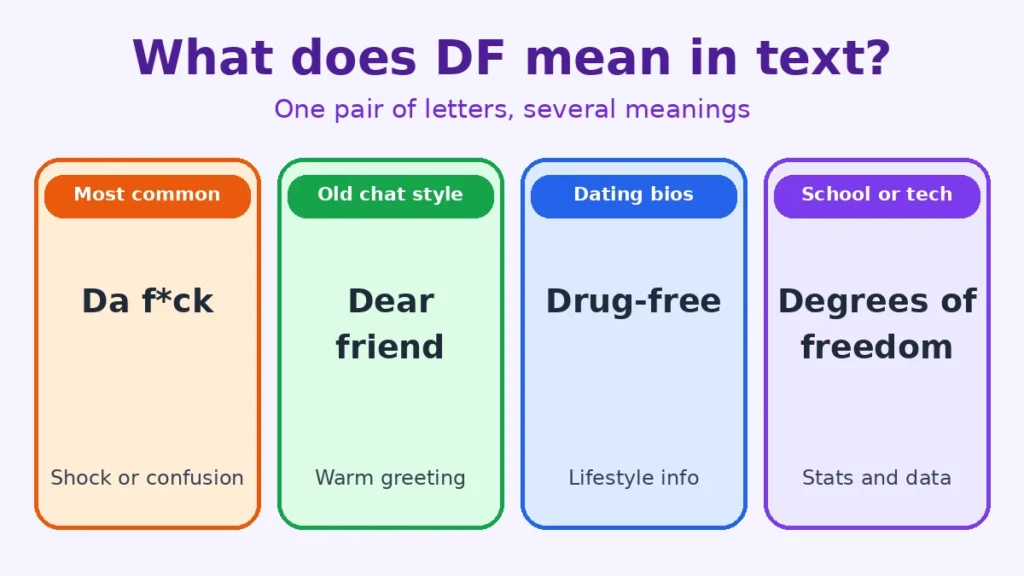
Still, the letters D and F can stand for other things. Here is a quick list:
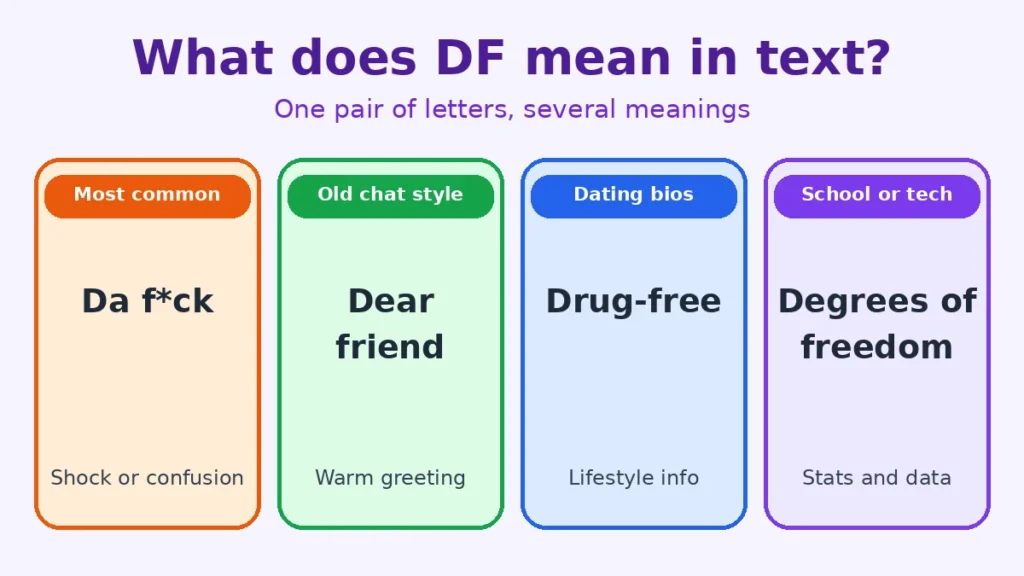
- 😳 Da f*ck: the most common slang meaning, used for shock or confusion.
- 🤝 Dear friend: a warm greeting from older chat and email habits.
- 🚭 Drug-free: a lifestyle note that some dating bios include.
- 📊 Degrees of freedom: a statistics term that students and analysts use.
- 💻 Disk free: a tech term for unused storage space.
The rule is simple. If the message is about feelings, DF probably means “da f*ck.” But if it’s about data, bios or computers, it’s likely a technical meaning.
The Simple Meaning of DF in Text, Explained
Think of DF as a tiny gasp in text form. Basically, it says, “Wait, what is going on here?”
Most senders add very little detail. Instead, they count on the story around the letters. So you should read the whole message before you decide on the mood.
Many people compare DF to “what the heck.” In fact, the match is close, because both show strong feelings in just a few words.
DF is also flexible. For instance, it can open a sentence, like “DF, that’s wild.” Or it can sit in the middle, like “who DF does that?”
Now, let’s clear up what DF does not mean:
- ❌ Always an insult: many friends use it just for fun.
- ❌ A typo for “OK” or “DM”: the context usually proves otherwise.
- ❌ The same as “DTF”: that phrase is very different.
- ❌ A secret code: it’s simply short slang.
Since DF includes a swear word, tone matters a lot. So always think about who sent it and why. 😊
Where Is DF Used? Apps and Situations
You’ll find DF wherever people chat fast and casually. Here are the most common places.
Text messages and chat apps. Private chats are the main home of DF. When something surprising happens, friends send it on iMessage, WhatsApp and SMS.
Social media. On Instagram, Snapchat and X, DF often appears in comments and replies. It shows up a lot under strange videos or shocking news.
Gaming chats. When a match turns wild, players type DF right away. However, in some game communities it can also point to game items, so the topic matters.
Group chats. Close friend groups toss quick reactions around all day. Because DF is fast and punchy, it fits right in.
School, data and tech spaces. Here, DF has a calm, technical meaning. For example, students may write “df = 15” in statistics notes. Meanwhile, tech fans use the Linux command “df” to check free space, and you can read more on the Computer Hope page for DF.
Why Do People Use DF in Texts?
The reasons are easy to see. Since texting rewards speed, DF packs a big reaction into two letters.
- ⚡ Speed: two letters beat a full sentence any day.
- 🎭 Expression: one short reaction can show shock, humor or irritation.
- 😊 Casual feel: slang makes a chat feel relaxed and real.
- 🤝 Closeness: when friends share slang, they feel like a team.
- 🛡️ Softer tone: the short form feels lighter than the full phrase.
There’s one more reason. Typing the whole phrase can feel too harsh, so many people choose the short form to keep things playful.
As a result, DF has become a regular reaction in friendly chats. It now sits beside other quick reactions like SMH, WTF and OMG.
What Does DF Mean in Text? Real-Life Examples
Examples make the meaning easy to see. Each one below shows a different mood, and a short explanation follows every chat.
Example 1: DF as happy surprise 🎉
Friend: Guess what? I got the job!
You: DF?! No way, congrats!
What it means: You can’t believe the good news. Because of the exclamation marks and the word “congrats,” the tone is warm. So DF is joyful here, not rude.
Example 2: DF as confusion 🤔
You: DF is this charge on my card?
Friend: Maybe it’s the app subscription.
What it means: The sender is puzzled by something odd. They want an answer, not a fight, so a helpful reply works best.
Example 3: DF as annoyance 😤
Friend: DF is wrong with this app? It crashed again.
You: Ugh, same here. Try restarting it.
What it means: The sender is frustrated with a thing, not with you. In this case, a calm tip helps a lot.
Example 4: DF as playful shock 😂
Friend: DF lmao, your dog just stole my sandwich!
You: He’s a professional thief, sorry!
What it means: Since the word “lmao” shows that it’s all fun, DF is just a funny gasp here.
Example 5: DF as “dear friend” 💌
Old chat message: Hi DF, long time no see! How have you been?
What it means: This older style is a warm greeting. Although it’s rare today, you may still find it in old forums, pen-pal groups or friendly emails.
Example 6: DF in a dating bio 💬
Profile bio: Dog lover, gym fan, DF.
What it means: In a dating bio, DF can mean “drug-free.” It shares a lifestyle choice, and the place where you see it gives you the clue.
Example 7: DF in school notes 📚
Study note: Sample size 16, so df = 15.
What it means: This is “degrees of freedom,” a statistics term. Because the numbers and the math topic are clear, you can tell it isn’t slang.
Example 8: DF as an insult ⚠️
Message: You’re such a DF.
What it means: In some corners of the internet, DF stands for a rude insult about someone’s intelligence. Although this use is rare, it’s harsh. So avoid it, because it can really hurt people.
What Does DF Mean in Text vs Similar Terms?
DF looks like many other chat shortcuts, so it’s easy to mix them up. This table shows the key differences.
| Term | Stands for | Quick meaning | Strength |
|---|---|---|---|
| DF | Da f*ck | Shock or confusion | Medium to strong |
| WTF | What the f*ck | Strong shock or anger | Strong |
| WTH | What the heck | Mild surprise | Mild |
| OMG | Oh my God | Big reaction | Mild |
| SMH | Shaking my head | Disappointment | Mild |
| IDK | I don’t know | Not sure | Neutral |
| DM | Direct message | A private message | Neutral |
Next, let’s look at the pairs that confuse people the most.
DF vs WTF
WTF is the famous cousin, and it’s louder and more direct. DF is shorter, so many people see it as a bit lighter. Still, both contain a swear word, which means you should use them with care.
DF vs WTH
WTH is the gentle option, since it means “what the heck.” So if you want to show surprise without any swearing, WTH is the safer choice.
DF vs DM
On a small screen, these two look alike. But DM means “direct message,” while DF is a reaction. If a message says “DF me,” it may be a typo, so ask for clarity.
How to Understand the Tone of DF
Since DF can sound happy, confused or annoyed, tone matters most. When you decode what DF means in text, these clues help.
- 😂 Emojis: if you see laughing faces, expect humor. Angry faces, on the other hand, suggest irritation.
- ❗ Punctuation: many exclamation marks often show excitement, while question marks suggest confusion.
- 📖 The story: good news points to joy, but a problem points to frustration.
- 🧩 Extra words: when you spot “lmao,” “fr” or “tho,” the mood is usually playful.
- 👥 The sender: think about how this person normally writes.
If you still can’t tell, just ask. For instance, “Good surprise or bad surprise?” works well, and it’s friendly and quick.
Common DF Combos and Variations
DF rarely travels alone. Often, people add extra words to change the mood. Once you know these combos, you can read them like a pro.
- 🤔 Asking for proof? Then DF fr? means “Da f*ck, for real?”
- 😂 When DF lmao appears, the sender is confused and amused at once.
- 💯 For strong emphasis, people type DF ong, like “I swear, that’s wild.”
- 👀 To point out something odd, they write DF tho, as in “That’s weird, though.”
- 😱 WTDF: because it blends “WTF” and “DF,” it shows a truly stunned reaction.
Notice the pattern. The first letters tell you the feeling, and then the extra word adds the flavor. So always read both parts together.
Also, these combos usually appear in fast chats. If someone sends “DF fr??”, they probably want a quick yes or no. Therefore, a short and friendly answer keeps the chat smooth.
Why Is “Da” Spelled That Way?
You may wonder why the “D” stands for “da” and not “the.” The answer is simple. Many people write the way they talk, and in casual speech, “the” often sounds like “da.”
Texting loves this habit, because it saves time and adds a playful, spoken feel. That is why the short form spread so quickly in friend chats and comments.
It also explains the casual tone. DF sounds like a quick spoken reaction, so it fits best where people speak freely.
Keep in mind that slang changes fast. A phrase that feels fresh today may feel old next year. So treat any slang guide as a snapshot, and trust the chat around the word most.
When Should You Use DF in Text?
DF fits relaxed chats only. To decide quickly, use this simple guide.
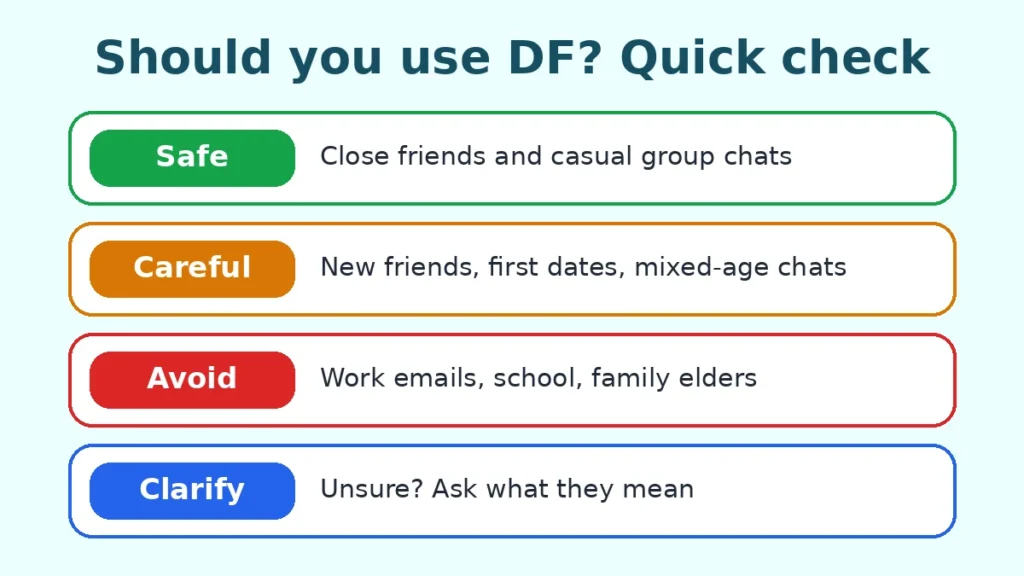
✅ Good times to use DF:
- When you chat with close friends who use slang too.
- If you’re in a casual group chat or a gaming chat.
- While you react to funny or shocking news.
- Whenever you joke about a small daily problem.
⚠️ Think twice before using DF:
- Emails to your boss, clients or teachers can’t handle it.
- Because some family members dislike swearing, skip it with them.
- On a first date, it may feel too bold.
- If the talk is serious or sensitive, choose full words.
- Any chat that children may read should stay clean.
Here’s the golden rule: match the other person. If they use slang, you can relax. But if they write polite full sentences, do the same.
Also, remember that clear beats clever. When something matters, use full words. After all, “Wait, what is going on?” is never wrong.
Common Misunderstandings About DF
Because DF has many meanings, people often guess wrong. So here are the mistakes to avoid.
1. “DF is always rude.” Not always, since many friends use it for fun. The tone depends on the emojis and the story.
2. “DF has only one meaning.” In fact, it has several, and the chat topic decides which one fits. A math note and a gossip chat use it very differently.
3. “DF is the same as DTF.” These are not the same phrase. Mixing them up can cause real embarrassment.
4. “DF is aimed at me.” Usually it isn’t. Most of the time, the sender reacts to a thing or an event.
5. “It’s a typo.” Sometimes it is. However, if the message shows shock or confusion, it’s most likely “da f*ck.”
6. “Slang means the same everywhere.” Slang shifts by group, age and region, so a friend circle may use DF in its own way. When in doubt, ask.
Pro Tips for Using and Reading DF
These habits will help you decode DF fast and use it well.
- Read the whole message. The words around DF reveal the meaning.
- Check the emojis. Because they show the mood, they are the quickest clue.
- Know your audience. If your friends love slang, DF is fine.
- Add an emoji when you send it. That way, your tone stays friendly.
- Skip it in formal chats. Write the full sentence instead.
- Don’t aim it at people. React to events, not to someone’s character.
- Ask when unsure. A quick question avoids a big mix-up.
- Use it sparingly. Too much slang can make a message feel harsh.
How to Reply When Someone Sends You DF
Not sure what to say back once you know what DF means in text? Then pick a reply that matches the mood.
- 🎉 If it’s happy surprise, say “Right? I couldn’t believe it either!”
- 🤔 When they’re confused, try “I know, it’s strange. Let me explain.”
- 😤 If they’re annoyed, write “That sounds frustrating. Want to talk about it?”
- 😂 When it’s funny, answer “Haha, I’m still laughing about it!”
- 🧐 If you can’t tell, ask “Good surprise or bad surprise?”
Most of the time, a short and warm reply works best. After all, the sender just wants someone to share the moment.
Quick Quiz: Can You Decode These DF Messages?
Let’s test what you’ve learned. First, read each message and guess the meaning. Then check the answer.
Message 1: “DF?! You finished the whole book in one day?”
Answer: Shock. The sender is impressed and surprised. 😮
Message 2: “Results: n = 21, so df = 20.”
Answer: Degrees of freedom. Because it’s a statistics note, it isn’t slang. 📊
Message 3: “DF is this traffic, I’m going to be so late 😤”
Answer: Annoyance. The sender is frustrated with the traffic, not with you. 🚗
Did you get all three? If so, you already understand what DF means in text. After all, the clues around the letters always tell the story.
Final Thoughts on DF Meaning in Text
So, what does DF mean in text? Most of the time, it means “da f*ck,” a short burst of shock, confusion or annoyance. In other places, though, it can mean “dear friend,” “drug-free” or “degrees of freedom.”
The secret is context. When you check the emojis, the story and the sender, you’ll solve almost every case. 🔍
Next time “DF” lands in your chat, you won’t feel lost. Now you know the meaning, the mood and the right reply. Not bad for two little letters! 🎉
FAQ: What Does DF Mean in Text?
What does DF mean in text from a friend?
Usually, it means “da f*ck,” a quick reaction to something surprising or confusing. Your friend may be amazed, annoyed or just joking. So check the emojis and the story to find the mood.
Is DF a bad word?
DF stands for a phrase with a swear word, so it can sound rude in some places. Between close friends, however, it’s usually playful. Still, avoid it at work, at school or with people who don’t like swearing.
Does DF always mean “da f*ck”?
No. It can also mean “dear friend,” “drug-free,” “degrees of freedom” or “disk free.” Because the topic of the chat shows which meaning fits, look there first. For example, a statistics note is never slang.
Can I use DF in a work message?
It’s better not to. Since DF is casual slang, some readers may find it rude or confusing. Instead, write a clear sentence like “I’m surprised by this” in professional chats.