Your friend sends a video. A minute later, you get a single message: “jpp.” 😭 No context. No explanation.
Now you wonder if they are laughing, crying, or fed up. Honestly, it could be any of the three.
You are not the only one who feels lost. Many people ask what does jpp mean in text after seeing it in chats, comments, and videos.
The short answer is this. JPP is French text slang for “j’en peux plus,” which means “I can’t take it anymore.” In this guide, you will learn the exact meaning, the three moods behind it, real examples, and smart reply ideas. Let’s break the code! 🔥
What Does JPP Mean in Text?
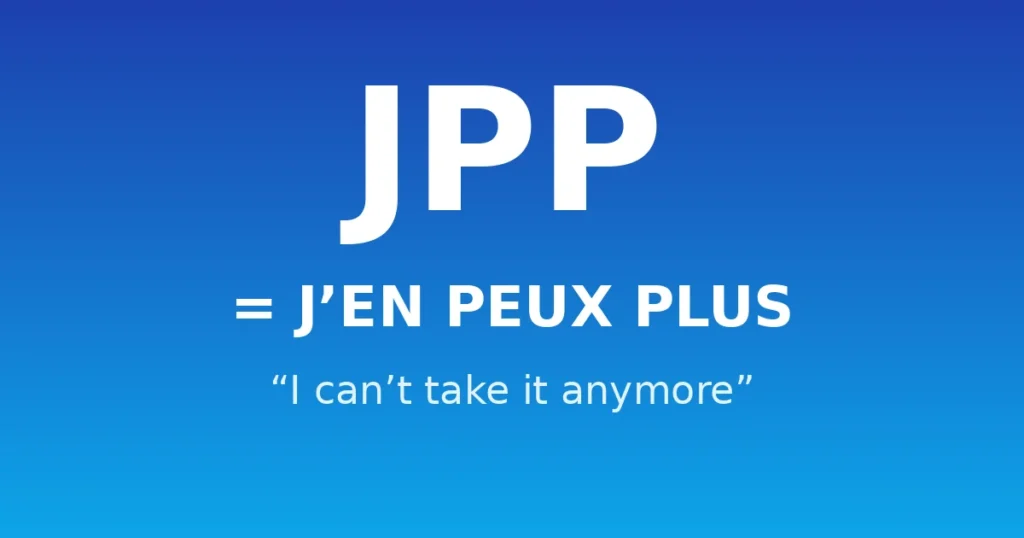
JPP stands for “j’en peux plus,” a French phrase that means “I can’t take it anymore.” People send it when they are laughing hard, totally exhausted, or completely fed up. ✅
The three letters come from the first letters of each word: J’en Peux Plus. It is a classic French texting abbreviation.
The phrase is informal. Therefore, you will mostly see it in friendly chats, not in serious messages.
Here is a quick snapshot:
- Language: French
- Full phrase: j’en peux plus
- Plain meaning: I can’t take it / I can’t anymore
- Common moods: laughing, tired, annoyed
- Found in: texts, DMs, group chats, social media comments
JPP Meaning in Simple Words
Breaking down “j’en peux plus”
“Je” means “I.” “Peux” comes from the verb “pouvoir,” which means “to be able.” “Plus” means “anymore.” The small word “en” stands for “it,” which is whatever the problem is.
So the phrase literally says, “I can’t do it anymore.” The “it” is clear from the situation.
Why the “ne” is missing
The fully correct French phrase is “je n’en peux plus.” However, speakers usually drop the “ne” in daily talk. As a result, texting versions like “jpp” feel even shorter.
The three moods of JPP
This is the part that confuses people. The same three letters can show different feelings.
- Laughing hard 😂: “I can’t, this is too funny.”
- Exhausted 😴: “I have no energy left.”
- Fed up 😤: “I’ve had enough of this.”
The surrounding words and emojis tell you which one applies. So, always check the context before you reply.
How to say it out loud
The phrase sounds roughly like “john puh ploo.” You will hear it in everyday French speech. Many people also write it as “jpp” in chats to save time.
Where Is JPP Used?
WhatsApp and text messages
This is the main home of the slang, and the place where most people first ask what does jpp mean in text. French-speaking friends and family send it all day long. It works well because it is quick and expressive.
Snapchat and Instagram DMs
Many users love short reactions. Therefore, “jpp” appears under funny snaps, memes, and stories.
TikTok and X comments
Comment sections fill up with reactions. A funny clip often gets “jpp jpp jpp” as a response. The repetition adds extra laughter.
Group chats
Friends use it to react to jokes, drama, or tiring days. It keeps the mood casual and playful.
Gaming and online communities
Players type it after a funny fail or a frustrating loss. Besides that, global communities sometimes borrow French slang, so you may see it from French-speaking friends online.
Why Do People Use JPP in Text?
It saves time
That is one reason people search what does jpp mean in text so often. Typing “j’en peux plus” takes longer than three letters. Because texting is fast, short forms win.
It shows strong emotion
A plain “haha” feels weak. JPP shows that you are truly overwhelmed, whether by laughter or by stress. In fact, that emotional punch is why it feels so natural.
It fits many situations
One abbreviation covers laughing, tiredness, and annoyance. That flexibility makes it very handy.
It feels casual and friendly
Using slang tells your friend, “We are relaxed here.” It builds closeness.
It keeps the mood light
Even a complaint sounds softer with JPP. For example, “jpp de ce travail” feels less heavy than a long rant.
JPP Examples in Real Conversations
Examples make the answer to what does jpp mean in text much clearer. Let’s go through real-life situations, including the French lines people actually write.
Example 1: Laughing out loud
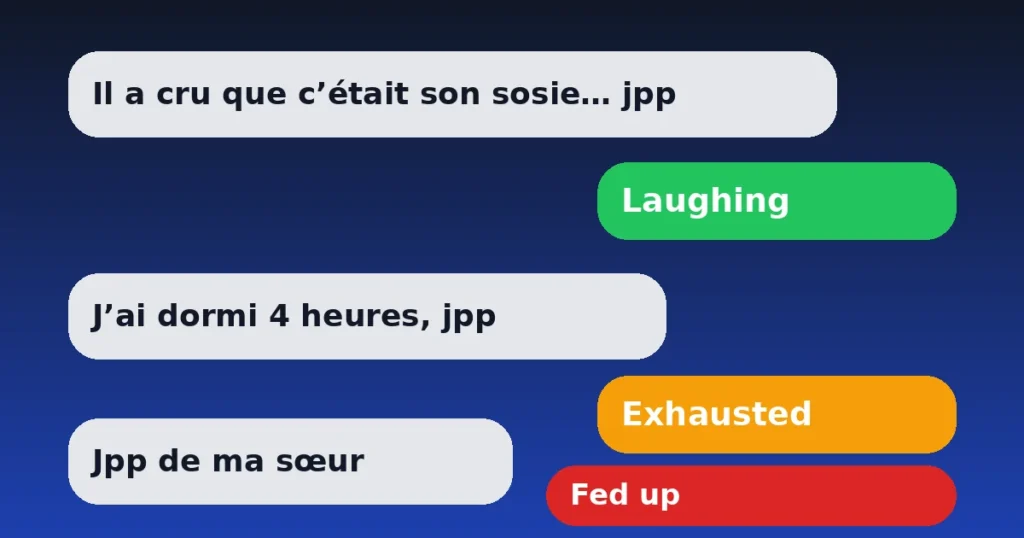
Message: “Il a cru que c’était son sosie… jpp jpp jpp 😂”
Meaning: “He thought it was his lookalike… I can’t, this is hilarious.” The repeated JPP shows big laughter.
Example 2: Total exhaustion
Message: “J’ai dormi 4 heures, jpp.”
Meaning: “I slept four hours, I can’t take it.” The person feels drained. 😴
Example 3: Annoyed with a family member
Message: “Jpp de ma sœur, elle est insupportable.”
Meaning: “I’ve had it with my sister, she is unbearable.” This sounds like real frustration. 😤
Example 4: Too much work
Message: “jpp de travailler autant, je suis crevé.”
Meaning: “I can’t keep working this much, I’m wiped out.”
Example 5: Reacting to a meme
Message: “jpp 💀”
Meaning: This is a short, funny reaction. The skull emoji shows “I’m laughing so hard.”
Example 6: A frustrating situation
Message: “Le bébé pleure tout le temps, j’en peux plus.”
Meaning: “The baby cries all the time, I’ve had it.” In this case, the full phrase appears, and the tone is tired and stressed.
Example 7: Mixed English chat
Message: “wow, that goal was unbelievable, jpp”
Meaning: “I can’t handle how good that was.” Here, the slang acts as an excited reaction.
How to reply to JPP
Once you know what does jpp mean in text, replying gets easy. Your reply depends on the mood. Match the feeling, and you will sound natural.
- If it is laughter → “Haha, send me the video!” 😂
- If it is exhaustion → “Take a break, you deserve it.” 💛
- If it is frustration → “What happened? Want to talk?”
Where Does JPP Come From?
French texting habits
French speakers have shortened words in text messages for many years. Writing “bcp” for “beaucoup” or “slt” for “salut” saves time. In the same way, “j’en peux plus” became “jpp.”
Many users no longer write phonetic spellings. Even so, some abbreviations stayed popular, and JPP is one of them. It is short, clear, and full of emotion.
From complaint to laughter
Originally, “j’en peux plus” expressed that someone could not cope with a situation. People still use it that way, for example when they feel worn out. Over time, many speakers also started using it for laughter. After all, when something is hilarious, you “can’t” take any more of it.
That shift explains why people keep asking what does jpp mean in text. The phrase has a serious root and a playful modern use.
Why it spreads beyond French chats
Online communities mix languages all the time. Friends share clips, memes, and comments across borders. As a result, English speakers sometimes meet JPP in comment sections or group chats, even if they do not speak French.
JPP in Everyday Situations
The same message can fit many parts of daily life. These quick scenes show how people use it.
At school or university
Students send “jpp” after a long exam or a boring lecture. It means they feel drained. Sometimes it also follows a funny teacher moment.
At home with family
Siblings and parents use it for small daily stress. A noisy house or a messy room might trigger “jpp de ce bruit.”
With friends on weekends
Friends react to jokes, plans, and funny stories. Here, JPP almost always means laughter. 😂
After a long workday
People text a friend “jpp” after a heavy shift. They are not asking for help. They simply want to vent in a light way.
A Quick Guide for French Learners
If you study French, JPP is a fun phrase to learn. It shows how real people talk, not just how textbooks write.
Learn the full phrase first
Start with “je n’en peux plus.” Then notice how speakers drop the “ne” in casual speech. Finally, practice the text version “jpp.”
Practice with small sentences
- “Je n’en peux plus de ce bruit.” → I can’t stand this noise anymore.
- “Jpp de ce film, il est trop drôle.” → I can’t, this movie is so funny.
- “J’en peux plus, je dors.” → I’m done, I’m going to sleep.
Match the register
Save JPP for friends and casual chats. With teachers or bosses, use the complete phrase. That choice shows respect and awareness.
JPP vs Similar Terms
JPP has several cousins in online slang. They look alike, yet each has its own meaning. This table makes the differences easy.
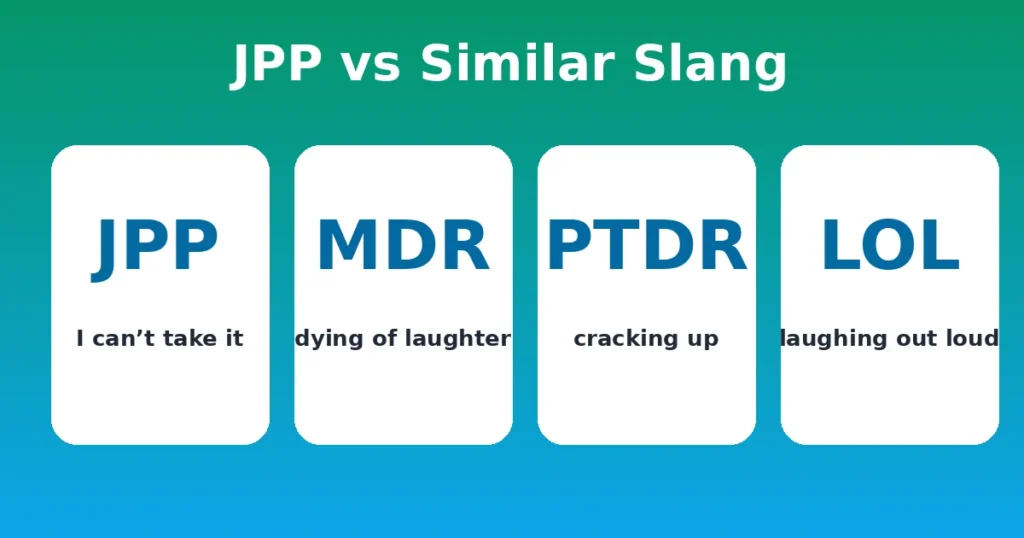
| Term | Full Form | Meaning | Mood |
|---|---|---|---|
| JPP | J’en peux plus | I can’t take it anymore | Laughing, tired, or fed up |
| MDR | Mort de rire | Dying of laughter | Laughing |
| PTDR | Pété de rire | Cracking up | Laughing hard |
| LOL | Laughing out loud | Something is funny | Light laughter |
| “I can’t 💀” | English phrase | This is too funny | Laughing |
JPP vs MDR
MDR is almost always about laughter. JPP, on the other hand, can also show tiredness or annoyance. That makes JPP more flexible.
JPP vs LOL
LOL is a mild reaction. JPP feels stronger and more dramatic. Think of it as “LOL, but louder.”
JPP vs “I can’t”
English speakers say “I can’t” or add 💀 to show laughter. JPP works the same way. Interestingly, it also stretches to stress and tiredness.
French Text Slang You Will See Next to JPP
Chats rarely contain one abbreviation. Once you understand JPP, these will make sense too.
- MDR: mort de rire, similar to LOL
- PTDR: pété de rire, a stronger laugh
- SLT: salut, meaning hi
- BCP: beaucoup, meaning a lot
- STP: s’il te plaît, meaning please
- PK: pourquoi, meaning why
People often combine them. For example, “ptdr jpp” shows laughter at its peak. 😂
When Should You Use JPP in Text?
Knowing what does jpp mean in text is only half the job. You also need good timing.
Good times to use JPP ✅
- Chatting with French-speaking friends
- Reacting to a funny video or meme
- Sharing a tiring day with someone close
- Joking in a group chat that likes slang
Times to skip JPP ⚠️
- Work emails or messages to your boss
- School emails or formal letters
- Serious talks where clear words matter
- Chats with people who do not know French slang
If you are unsure, write the full sentence instead. “I can’t take this anymore” works everywhere.
JPP Cheat Sheet: Read It in 10 Seconds
Short on time? Use this quick guide to decode any JPP message. It works in almost every chat.
- See JPP with 😂 or 💀 → the sender is laughing hard ✅
- See JPP with 😴 or 🥱 → the sender is tired
- See JPP with 😡 or 😤 → the sender is annoyed
- See JPP repeated three times → extreme laughter
- See JPP with “de” and a person’s name → the sender is fed up with that person ⚠️
One simple rule to remember
Look at the words around it. If the topic is funny, JPP means laughter. If the topic is stressful, it means exhaustion or frustration. In short, the situation decides the mood.
That is the real answer to what does jpp mean in text in daily life. The letters stay the same, while the feeling changes with the moment.
Common Misunderstandings About JPP
Misunderstanding 1: “It is an English acronym”
Anyone who asks what does jpp mean in text may try English guesses first. However, JPP comes from French. The letters match “j’en peux plus,” not an English phrase.
Misunderstanding 2: “It always means laughing”
Laughter is common, but not guaranteed. A message like “jpp de cette journée” likely shows tiredness, not humor.
Misunderstanding 3: “It is always serious”
The opposite can be true. Often the sender is just joking. A laughing emoji usually gives it away.
Misunderstanding 4: “It is rude”
JPP is not an insult. It describes the sender’s own feeling. Still, it can sound rude if it targets a person, such as “jpp de toi.”
Misunderstanding 5: “It means the person is in danger”
Usually, no. The phrase is an everyday expression, like “I can’t even” in English. If a message sounds truly worrying, though, check in kindly.
Reading the Tone: Emojis and Punctuation
With laughing emojis
“jpp 😂😂” means pure laughter. The more emojis, the stronger the reaction.
With tired emojis
“jpp 😴” or “jpp 🥱” shows exhaustion. The sender needs rest, not jokes.
With angry emojis
“jpp 😡” signals annoyance. In this case, listen first and avoid teasing.
Repeated letters or words
“jpp jpp jpp” increases the intensity. It usually means extreme laughter.
No emoji at all
A plain “Jpp.” with a period can feel heavy. Check the earlier messages to find the mood.
Pro Tips for Using JPP the Right Way
Tip 1: Check the context first
Before you answer, read the earlier messages. They show whether the sender laughs or complains.
Tip 2: Use it with people who know French
If your friend speaks French, they will love it. Otherwise, they might feel confused.
Tip 3: Add an emoji
A small emoji removes doubt. Compare “jpp” alone with “jpp 😂.” The second one is clear instantly.
Tip 4: Do not overuse it
If every message contains JPP, it loses power. Save it for the moments that truly overwhelm you.
Tip 5: Ask when unsure
If a message feels unclear, ask, “Haha or tired?” A quick question prevents awkward replies.
Tip 6: Learn the full phrase
Knowing “j’en peux plus” helps you understand voice messages and videos too. It also helps you spot it in spoken French.
Tip 7: Stay kind with sensitive moods
When someone sounds tired or stressed, respond warmly. A caring reply matters more than a joke. 💛
Final Thoughts
JPP is a tiny abbreviation with a big range of feelings. It can show laughter, tiredness, or frustration, all in three letters. 🔥
Now you know what does jpp mean in text, where it comes from, and how to reply. You also know when to avoid it. Read the mood, use an emoji, and your chats will feel smooth.
Next time a friend sends “jpp,” you will know exactly what to say. 😎
FAQ: What Does JPP Mean in Text?
What does JPP mean in text?
JPP means “j’en peux plus,” a French phrase for “I can’t take it anymore.” People use it to show strong laughter, exhaustion, or frustration.
Is JPP the same as LOL?
Not exactly. JPP can mean laughter, but it also covers tiredness and annoyance. LOL only shows that something is funny.
Is JPP rude or negative?
No, it is not rude by itself. It describes how the sender feels. The mood depends on emojis and context, so read the full message.
Can I use JPP in professional messages?
It is better to avoid JPP at work or school. Slang looks too casual for formal settings. Use clear words like “I am overwhelmed” instead.