
Your friend texts you after a long day. You ask, “How are you?” The reply comes back in two seconds: “gud”.
Wait. Is that a typo? Is it a new slang word? Or is your friend just tired?
You are not the only one who has paused over this tiny word. So, what does gud mean in text? And does it change the mood of a message? 🤔
This guide gives you a clear answer in plain English. You will also see real examples, learn the five most common uses, and find out when it is smart (and when it is not) to type it yourself.
What Does Gud Mean in Text?
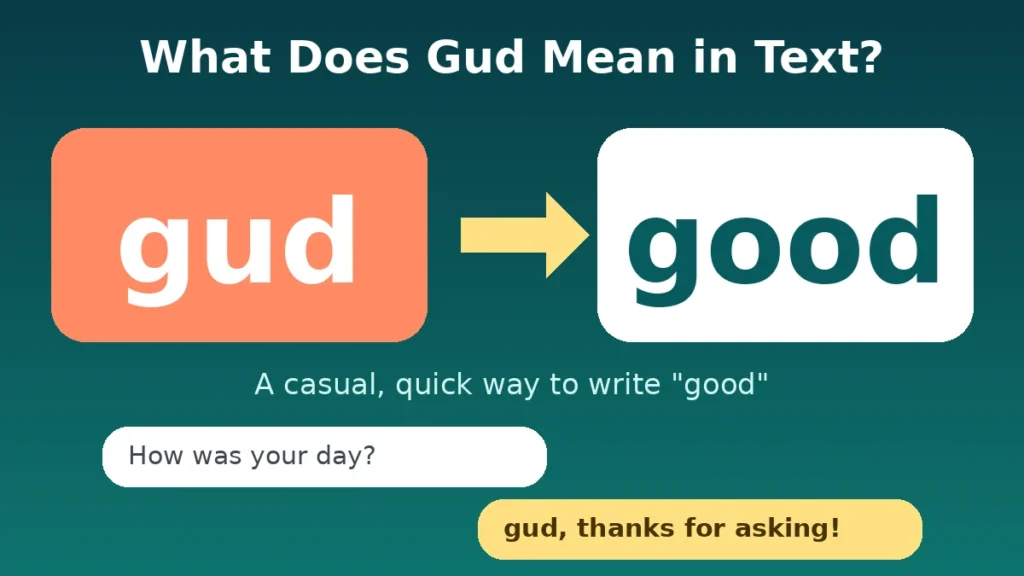
In text messages, gud means “good.” It is a casual, phonetic way to spell the word, which means it is written the way it sounds. ✅
Overall, people type it for speed, for style, or for a relaxed tone. In most cases, it carries the same meaning as the standard word. Only the feeling around it changes.
Here is how it looks in real life:
- “How was the movie?” “gud, you would love it.”
- “gud morning! Coffee is on me today.”
- “gud job on the project!”
Simple Meaning of Gud in Text
Think of “gud” as “good” in its pajamas. 😄 It is the same word, but it is dressed down for a friendly chat.
In fact, you can swap it for “good” in almost any sentence, and the meaning stays the same. So the real difference is the mood. “Gud” sounds quick, warm, and informal.
An easy way to remember it:
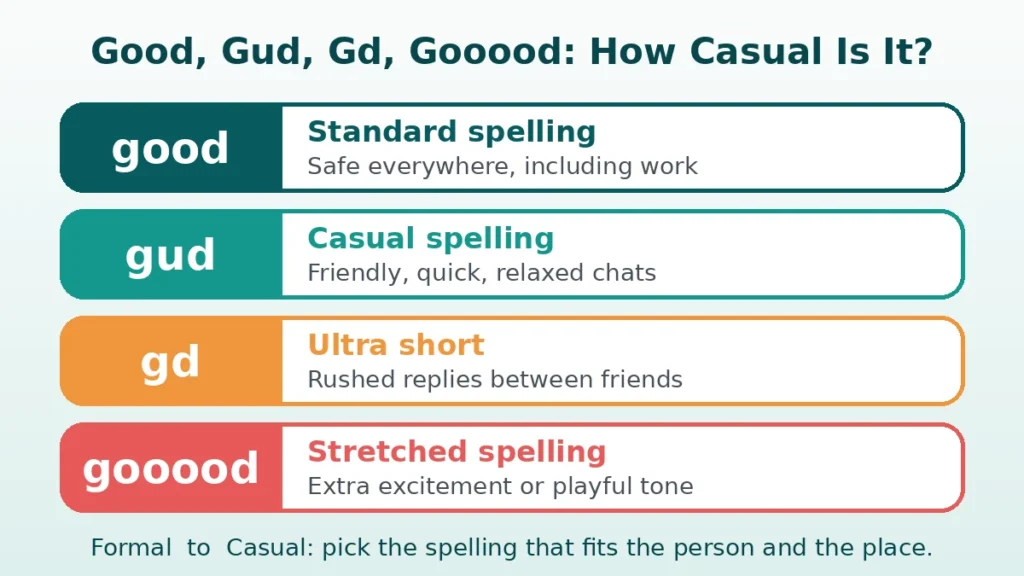
- Good = the standard spelling (safe everywhere)
- Gud = the casual spelling (best for friends and fast chats)
Where Does Gud Come From?
Nobody can point to one exact starting moment. Still, the reasons behind it are easy to see.
Early text messages had tight character limits. As a result, people trimmed words to fit more into one message. Then shorter spellings became a habit, and some of them stuck around long after the limits disappeared.
Besides, phonetic spelling is a very old habit. People have always written words the way they sound when they want a relaxed tone. “Gud” follows that same pattern, just like “nite” for “night” or “thru” for “through.”
Also, gaming added another layer. In online games, the phrase “git gud” became famous, and it spread far beyond the games themselves. You will learn more about that phrase below.
Where Is Gud Used?
You can spot this spelling in many places. However, how common it feels depends on the app and the group. 📱
- Text messages: Friends use it for quick replies, such as “gud, thanks.”
- WhatsApp, Messenger, and Snapchat: It shows up in short, fast chats.
- Instagram and TikTok comments: “gud vibes” or “gud content” is a light way to cheer someone on.
- Gaming chats and Discord: Players type “gud game” or “git gud” during and after matches.
- Social media captions: People write “gud morning” or “gud night” to sound friendly and playful.
- Memes: Misspelled words are often part of the joke, so “gud” appears there too.
On the other hand, you will almost never see it in business emails, school essays, or official letters. Those places expect standard spelling.
Why Do People Write Gud Instead of Good?
In short, it is easy, quick, and friendly. But there is more to it. Here are the main reasons. 💡
1. It saves a little time. Since you skip one letter, your thumbs thank you. When you send fifty messages a day, small shortcuts add up.
2. It sets a relaxed tone. However, standard spelling can feel serious. “gud” tells the other person, “We are just chatting.”
3. It matches the group. Also, friends often copy each other’s style. Using the same spelling can therefore make a chat feel more natural and close.
4. It adds personality. Plus, a playful spelling makes a message sound like you. Your friends can almost hear your voice.
5. It works on small keyboards. After all, typing on a phone while walking is not easy. A shorter word can be a real help.
Here is one more thing worth knowing. Not everyone who writes this way is joking or being lazy. For example, some people type quickly because of a tight schedule, a small screen, or a tired hand. Others, however, simply like the look of it. So, a kind and open mind goes a long way here.
5 Uses of Gud in Text (With Examples)
So, let’s look at the five most common ways people use this word. Each one has its own mood. 🎯
Use 1: A Quick Answer to “How Are You?”
Sara: Hey, how was your exam? Omar: gud, I think I passed.
What it means: Omar is saying the exam went well. He keeps the reply short because he is relaxed and chatting fast.
Use 2: Praising Someone
Lina: I finished my first painting! Ken: gud job! Send me a photo.
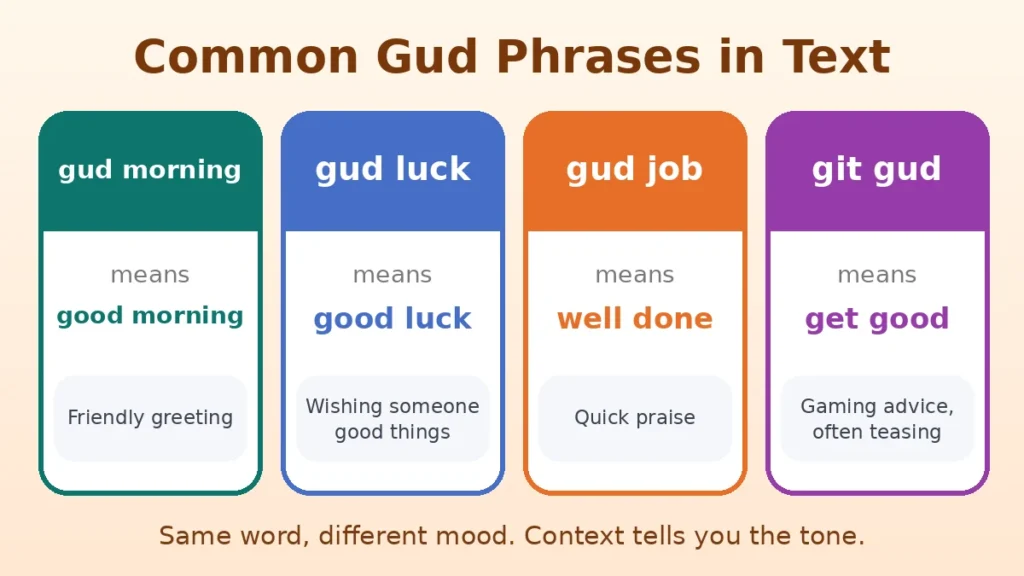
What it means: Ken is saying “good job.” So the casual spelling makes the praise feel friendly, not formal.
Use 3: Greetings and Wishes
Some phrases come up again and again:
- “gud morning” means “good morning.”
- “gud night” (or “gn”) means “good night.”
- “gud luck” means “good luck.”
- “gud evening” means “good evening.”
For example, “gud luck with your interview today!” feels warm and encouraging. It sounds like a friend, not a formal greeting card.
Use 4: “Git Gud” in Gaming
“Git gud” is a different kind of phrase. It means “get good”, and it tells someone to improve their skills.
Player 1: I lost again on this level. Player 2: Haha, git gud!
What it means: Player 2 is teasing. In friendly company, the phrase is a joke, and it can even be encouraging.
However, the same words can sound rude when a stranger says them. In fact, the phrase is widely linked to the online gaming community, especially fans of tough games. Tone and relationship matter a lot here.
Use 5: Playful and Cute Talk
Mia: My puppy finally sat when I asked. Noah: gud boi! 🐶
What it means: Noah is cheering for the puppy. People often use this spelling for pets, babies, and silly moments because it sounds soft and playful.
You may also see “gud vibes,” which means “good vibes.” It describes a happy, positive mood.
A Bonus Example: Sarcastic Gud
Sometimes, however, the word is not warm at all.
Zed: I missed the bus and spilled my coffee. Tia: Wow. gud day.
What it means: Tia is joking. The situation is bad, so “gud day” is sarcastic. However, you can usually spot this from the context and the mood.
A Quick Group Chat Example
Of course, real chats mix several uses at once. Here is a short one:
Ayesha: gud morning everyone! Big match today. Ben: gud luck, Ayesha! You will do great. Chloe: She trained all month. gud job already. Dev: If she loses, she can git gud next week. 😂
What is happening: Ayesha opens with a friendly greeting. Ben wishes her luck, and Chloe praises her effort. Dev jokes with the gaming phrase. Because of this, notice how the same word shifts its mood from line to line. That is why reading the context matters so much.
Gud vs Similar Terms
“Gud” has a few close cousins. Some are about the same, while others carry a different feeling. This table helps you tell them apart.
| Term | Meaning | Tone | Example |
|---|---|---|---|
| Good | Standard spelling | Neutral, safe anywhere | “Good morning, team.” |
| Gud | Casual spelling of good | Friendly, relaxed | “gud morning!” |
| Gd | Ultra short form of good | Rushed, casual | “gd, thx” |
| Gr8 | Great | Upbeat, quick | “That is gr8 news.” |
| Gooood | Stretched for emphasis | Excited, playful | “This pizza is gooood.” |
| Git gud | Get good (improve) | Teasing, gaming | “Practice more. Git gud.” |
What Is the Difference Between Gud and Good?
The meaning is the same, but the setting is different. “Good” fits every place, from an email to your boss to a note for your teacher. “Gud” fits relaxed chats with friends and family.
For instance, you would write “Good afternoon, Mr. Khan” in a job email. With a close friend, you might write “gud afternoon!” as a joke.
What Is the Difference Between Gud and Gd?
“Gd” is even shorter, and it can feel a bit abrupt. “Gud” still reads like a word. As a result, it tends to sound warmer than “gd,” which can look like a quick, tired reply.
Other Casual Spellings You Will See Next to Gud
However, “gud” rarely travels alone. Chats are full of relaxed spellings, and knowing them helps you read messages faster. 📖
- nite means “night,” as in “see you tomorrow, nite!”
- thx means “thanks,” a quick way to show gratitude.
- pls means “please,” often used in fast requests.
- u and ur mean “you” and “your.”
- gonna and wanna mean “going to” and “want to.”
- tho means “though,” as in “I liked it tho.”
In fact, all of these follow the same idea as “gud.” They keep the sound, drop extra letters, and make the chat feel light.
When Should You Use Gud in Text?
Good slang use is about timing and audience. Here are the best moments for it. ✅
Use gud when:
- You are chatting with friends, cousins, or classmates.
- You want a relaxed, playful tone.
- You are replying quickly and the topic is light.
- You are writing a casual caption or a fun comment.
- You are joking in a gaming chat.
Skip gud when:
- You are writing a work email, a job application, or a school assignment.
- You are messaging someone you do not know well.
- The topic is serious, such as health, loss, or bad news.
- You want your writing to look careful and professional.
So, try this simple test. Ask yourself, “Would I say this out loud to a friend in a relaxed way?” If yes, “gud” probably works. Otherwise, use “good.”
Common Misunderstandings About Gud
Because it looks like a spelling mistake, this word gets misread a lot. Here are the usual mix-ups. ⚠️
Mistake 1: Thinking it is always a typo. Sometimes it is. However, many people choose it on purpose as a casual style.
Mistake 2: Thinking it means something different from “good.” It does not. In fact, the meaning is the same, and only the mood is lighter.
Mistake 3: Reading a short “gud” as rude. A plain “gud” can feel cold when it follows a long, heartfelt message. Most of the time, the sender is simply busy or relaxed. So, check the rest of the chat before you worry.
Mistake 4: Using “git gud” as friendly advice with strangers. Among friends, it is a joke, but with someone new, it can sound like an insult. So, think first.
Mistake 5: Assuming everyone uses it. Some people prefer standard spelling, while others may not know this style. So, a friendly attitude helps everyone feel included.
Mistake 6: Using it in formal writing. Also, casual spellings in formal documents can look careless, even if you did not mean it that way.
How to Tell If Gud Is a Typo or a Style Choice
Not sure what the sender meant? Then look for three clues.
- Other words: If the rest of the message uses casual spellings too, “gud” is a style choice.
- Mood: If the chat is jokey and relaxed, the spelling is probably on purpose.
- Habit: If your friend always writes this way, you can safely relax.
Still, if you are unsure, simply read it as “good.” You will almost always be right.
How to Reply When Someone Texts You “Gud”
Sometimes a “gud” shows up and you are not sure what to say next. In that case, a small reply keeps the chat warm. 💬
- If it answers your question: Add a follow-up. “Great! What was the best part?”
- If it is praise: Say thanks. “Thanks, I worked hard on it!”
- If it is a greeting: Greet them back. “gud morning to you too!”
- If it feels short or cold: Ask gently. “Everything okay? You sound tired.”
For example, you ask, “How was your day?” and your friend replies, “gud.” You can answer, “Nice! Anything fun happen?” As a result, that reply invites a longer chat without any pressure.
Does Writing Gud Hurt Your Spelling?
This is a common worry, especially for parents and teachers. But the good news is that casual spelling in chats does not have to harm your writing.
For instance, think about how you speak. You talk one way with friends and another way in an interview. Similarly, writing works the same way. Many people switch easily between a relaxed style and a careful one.
So, the key is to know the difference. Use “gud” in friendly chats. Then use “good” for school work, job applications, and official messages. If you notice casual spellings slipping into formal writing, slow down and proofread before you send.
Pro Tips for Using Gud Like a Native
Ready to use it with confidence? Then these tips will help. 🔥
- Match your friend’s style. If they write “gud,” you can too.
- Add a few words. “gud job, so proud of you!” feels warmer than “gud job.”
- Keep it in casual spaces. Switch to “good” for school, work, and official messages.
- Watch your tone with “git gud.” Add a laughing sign so friends know you are joking.
- Do not overdo it. Otherwise, if every word is misspelled, your message may be hard to read.
- Be kind about spelling. People type in different ways, and not everyone writes the same. Respect goes a long way.
- Explain it gently. If someone asks what “gud” means, answer without making them feel behind.
Remember, though, that slang changes quickly. So, a style that feels fresh today may fade next year. Paying attention to how your friends write is the best guide.
Final Thoughts: So, What Does Gud Mean in Text?
So, here is the short version. In text, “gud” is a casual way to write “good.” It keeps the same meaning, but it adds a relaxed, friendly mood.
Finally, you will see it in quick replies, praise, greetings, gaming chats, and playful talk. You will also meet the phrase “git gud,” which means “get good” and is mostly used as a joke.
Of course, context matters. Use it with friends, but keep standard spelling for work and school. Once you know the mood behind it, one small word will never confuse you again.
So, the next time a friend replies with a simple “gud,” you will know exactly what it means. 🎉
FAQ: What Does Gud Mean in Text?
What does gud mean in text?
In text, gud means “good.” It is a casual, phonetic spelling that people use in friendly chats. The meaning stays the same, but the tone feels more relaxed.
Is gud the same as good?
Yes, they mean the same thing. “Good” is the standard spelling and works everywhere. “Gud” is the casual version, best for friends, family, and quick messages.
What does “git gud” mean?
“Git gud” means “get good.” It tells someone to improve their skills, and it is common in gaming chats. Among friends it is a joke, but it can sound rude if a stranger says it.
Can I use gud in a work message?
It is better to avoid it. Work emails and official chats expect standard spelling, so “good” is the safer choice. In a casual team chat with close colleagues, a light “gud” may be fine. When you are unsure, choose “good.”