Poker apps have changed what a “normal” cash game looks like. On ClubGG, PPPoker and PokerBros, a growing number of tables run a double board bomb pot every orbit. Others add Squid Game rounds, where the last player to win a hand pays everyone else.
Plenty has been written about the rules of these formats. Very little has been written about the math. So we ran it: 1.76 million simulated double board bomb pots across No-Limit Hold’em, PLO4, PLO5 and PLO6 at 4, 6 and 8 players, plus a model of how the Squid Game penalty falls on different player types.
Some of the results confirm what experienced players already sense. Others go against common beliefs.
How a Double Board Bomb Pot Works
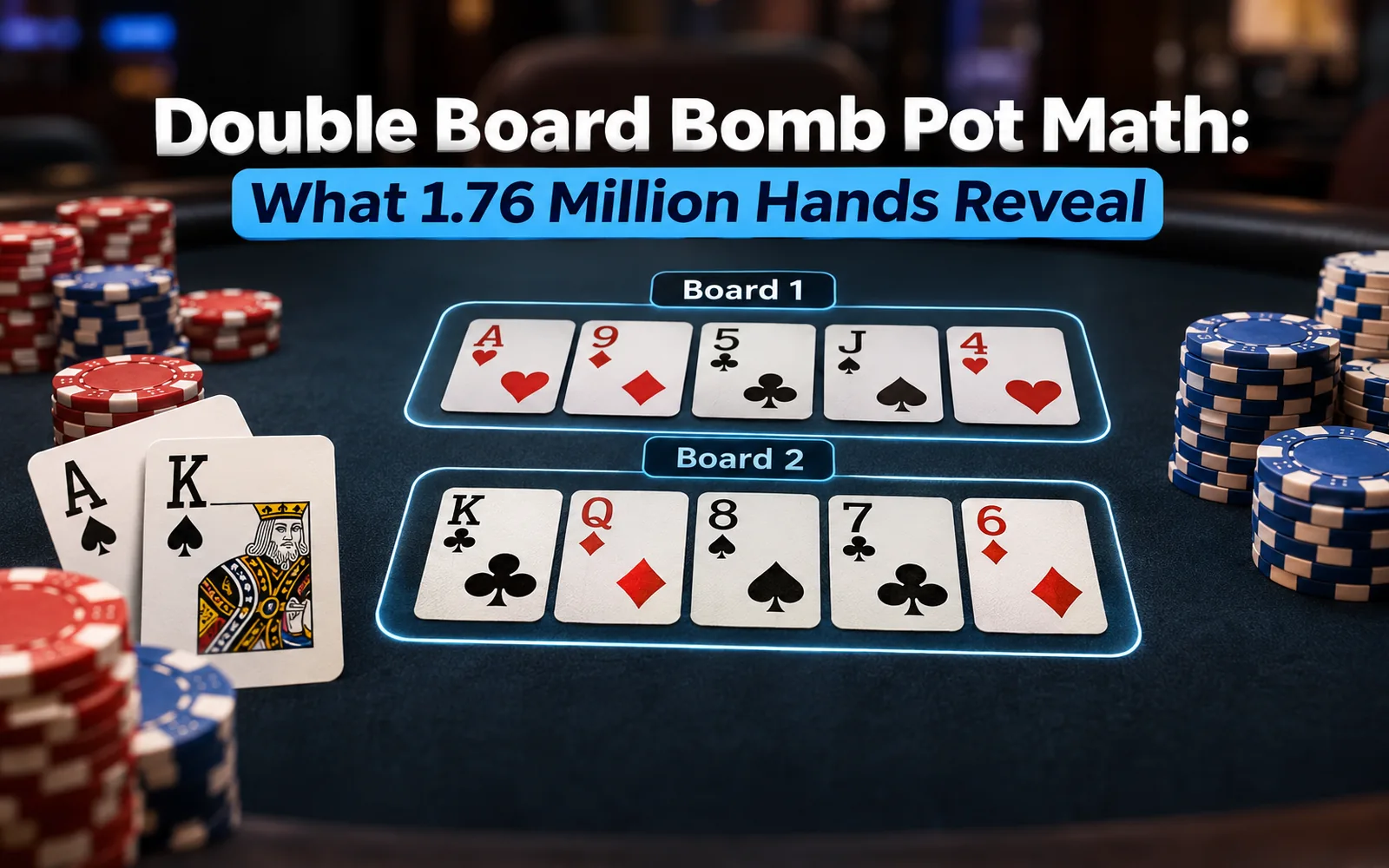
In a bomb pot, every player posts an ante and the preflop betting round is skipped. The antes are commonly 3 to 10 big blinds, according to PLOMasters. In the double board version, the dealer deals two separate flops, then two turns and two rivers. Each board wins half the pot. In Omaha you must use exactly two hole cards on each board, but they can be a different two on each.
Win both boards and you scoop the whole pot. Win one and you get half. Tie on a board and that half is split again, which can leave you with a quarter.
The format has gone mainstream. The 2026 WSOP schedule included a PLO Double Board event.
The Results
Each line is 160,000 hands. All players reach showdown, which is the purest version of the format. Real hands include folds and bluffs, but this shows the baseline you’re playing against.
| Game | Players | Scoop rate | Straight or better wins | Flush or better wins | A board gets chopped |
| NLH | 6 | 16.6% | 39.5% | 22.8% | 13.7% |
| PLO4 | 6 | 14.9% | 78.2% | 51.6% | 11.7% |
| PLO5 | 6 | 14.0% | 88.7% | 61.9% | 16.8% |
| PLO6 | 6 | 13.6% | 94.0% | 67.4% | 23.0% |
| PLO4 | 8 | 10.9% | 85.6% | 58.8% | 15.7% |
| PLO5 | 8 | 10.3% | 93.5% | 67.0% | 22.5% |
| PLO4 | 4 | 23.3% | 65.5% | 40.9% | 7.4% |
| PLO5 | 4 | 22.4% | 79.0% | 52.3% | 10.8% |
Data: The Poker Agent simulation, 1.76 million hands.
Here is what the numbers mean.
Finding 1: Scoops Depend on Players, Not the Game
Many players think more hole cards make scoops easier, because a PLO6 hand “covers” both boards. The data says otherwise.
At six players, the scoop rate barely moves from game to game: 16.6% in NLH, 14.9% in PLO4, 14.0% in PLO5 and 13.6% in PLO6. What really changes it is the number of players. In PLO5, the scoop rate falls from 22.4% four-handed to 10.3% eight-handed.
At a six-handed PLO5 table, your own chance of scooping a random bomb pot is about 1 in 43 (14.0% shared across six players). Nearly 70% of showdowns end with two different players taking one board each. Playing for a scoop in a full bomb pot is usually a long shot. Playing to win one board, and getting there cheaply, is the realistic goal.
Finding 2: In PLO5, a Set Is Usually Not Enough
At a six-handed PLO5 bomb pot, the winning hand on a board is a straight or better 88.7% of the time. It’s a flush or better 61.9% of the time. Even a full house or better wins 39.9% of boards.
In No-Limit Hold’em under the same conditions, a straight or better wins only 39.5% of boards.
This is the biggest leak for players moving from Hold’em to club-app Omaha. Top set feels strong. Against five opponents holding five cards each, it is often already behind or drawing to improve.
Finding 3: The Chop Problem Grows With More Cards
More hole cards create more identical nut hands. At six-handed PLO6, at least one board is chopped in 23% of hands. That’s almost one in four. In PLO4 it’s 11.7%.
Chops matter because bomb pots are raked like any other pot. When you split half the pot, you’re paying rake on a pot you only partly win. For straight draws in PLO5 and PLO6, where the nuts is often shared, a high chop risk is a reason to bet less and call more.
Where These Formats Run
Club apps let the table host decide everything: whether bomb pots run, how big the ante is, how often they happen, and whether the hand uses one board or two. According to poker site ranking, PPPoker, PokerBros, KKPoker and ClubGG all support bomb pots with configurable ante and frequency. On GGPoker itself, they’re mainly limited to high-stakes private games.
Because the settings are chosen club by club, two PLO5 tables on the same app can play completely differently. If you want these formats, or want to avoid them, it helps to use a club directory that flags bomb pot and double board tables before you join. That’s quicker than finding out after your first orbit.
Squid Game: The Format That Punishes Tight Players
Squid Game is newer and less understood. ClubGG’s team says hosts can set a penalty of 1 to 10 big blinds and trigger rounds after a set number of hands or minutes. During a round, each player earns a squid token the first time they win a pot. The last player without one pays the penalty to the others. GGPoker has run the format on high-stakes tables since November 2024.
Because every player has the same chance of being last, the format looks fair. It isn’t, and here’s why.
We modelled Squid rounds in which one player wins pots less often than the rest of the table. That’s the typical tight, patient player.
| Table | Win frequency vs. others | Chance of paying the penalty | Fair share |
| 6 players | Equal | 16.5% | 16.7% |
| 6 players | 75% as often | 24.3% | 16.7% |
| 6 players | 50% as often | 36.9% | 16.7% |
| 9 players | 50% as often | 29.8% | 11.1% |
A player who wins pots half as often as the others ends up paying more than twice their fair share at a six-handed table. Take a penalty of 2 big blinds per opponent.
That’s why Squid tables play looser than their stakes suggest. The format pays you to win small pots, so players do. If you play a solid, tight style, either adjust by taking down more small pots or choose tables without Squid.
How to Use This Data
- Bet to win one board, not to scoop. At six or more players, scoops are rare in every game.
- Raise the strength you need in PLO5 and PLO6. A straight is the minimum winning hand in most multiway bomb pots, not a strong one.
- Watch out for chops with non-nut straights and shared draws, especially in PLO6.
- Check the table settings (ante, frequency, number of boards, Squid penalty) before you sit down. On club apps, they’re set by the host.
- On Squid tables, loosen up slightly or leave. A tight style has a built-in cost there.
Methodology
- Bomb pots: 160,000 hands for each of 11 game and table-size combinations (1,760,000 total). Cards were dealt randomly from one 52-card deck, and every player was assumed to reach showdown. Hands were evaluated with the open-source phevaluator library using standard Omaha rules (exactly two hole cards plus three board cards). PLO5 and PLO6 hands were checked across all four-card subsets. Eight-handed PLO6 was left out because it needs more than 52 cards.
- “Scoop”: one player wins both boards outright. “Chopped”: a tie for the best hand on at least one board.
- Squid: 200,000 rounds per scenario. A round ends when all but one player have won a pot. One player’s chance of winning each pot was scaled down against an otherwise equal table. Costs assume a penalty of 2 big blinds per opponent and back-to-back rounds.
- Limits: Real hands include folds, bluffs and skill differences, which lower the showdown share of weak hands. These figures are the baseline, not a prediction for any one table.
Frequently Asked Questions
How often does someone scoop a double board bomb pot?
In our simulation, a six-handed PLO5 double board bomb pot was scooped 14.0% of the time at showdown. That falls to 10.3% with eight players and rises to 22.4% with four.
What hand usually wins a PLO5 bomb pot?
At six players, a straight or better wins 88.7% of boards and a flush or better wins 61.9%.
Does PLO6 make it easier to scoop both boards?
No. At six players, PLO6 scooped 13.6% of the time, slightly less than NLH’s 16.6%. It also produced a chopped board in 23% of hands.
Is Squid Game poker fair?
It’s fair only if everyone wins pots at the same rate. A player who wins half as often as the others pays the penalty 36.9% of the time at a six-handed table, compared with a fair share of 16.7%.