You open a group chat and see a friend type “PMSL” under a funny video. 😂 You pause for a second. Is it a typo? Is it something rude? Or is it a code you missed?
Relax. You are not alone, and the answer is much simpler than it looks.
So, what does PMSL mean in text? In short, it is a quick way to say you are laughing very hard. In this guide, you will learn the full meaning, real chat examples, and the right moments to use it. You will also see how it compares with LOL and LMAO.
Let’s break it down, step by step. 🔥
What Does PMSL Mean in Text?
PMSL stands for “pissing myself laughing.” People type it when something is so funny that they can barely hold it together. ✅
The phrase is a playful, exaggerated way to describe a huge laugh. Nobody expects it to be literal. Instead, it paints a funny picture of someone who laughs so hard that they lose control.
The word “pissing” is mild slang, especially in the UK. Because of that, the abbreviation feels casual rather than shocking. Still, it is not a formal phrase, so keep it for friends and relaxed chats.
Here is the quick version:
- Full form: Pissing myself laughing
- Tone: Casual, funny, and a little cheeky
- Strength: A very strong laugh
- Best for: Friends, memes, and group chats
The Simple Meaning of PMSL in Easy Words
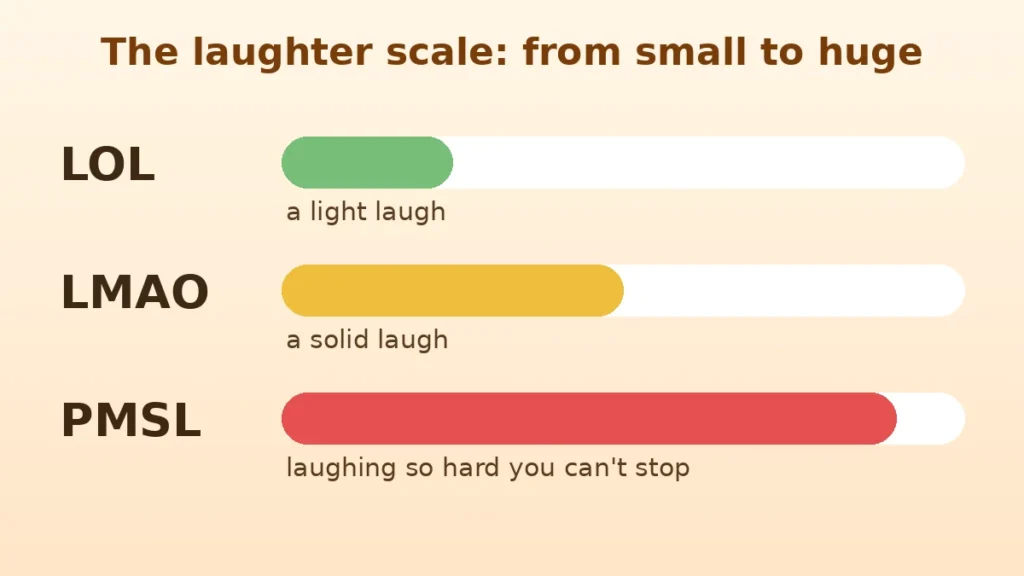
Think of PMSL as a louder version of LOL. When you type LOL, you might only smile a little. When you type PMSL, you say, “This is hilarious, and I can’t stop.”
It shows a real, big reaction. For that reason, people use it only when something truly cracks them up.
Here are a few easy ways to read it:
- “That is the funniest thing I’ve seen all week.”
- “I am laughing so hard right now.”
- “I can’t breathe, this is too funny.”
Also, the word “myself” makes the phrase personal. You describe your own reaction, not just the joke. That small detail adds extra warmth and humor to the message.
As a result, PMSL works like a tiny laugh track. Your friend reads it and instantly knows how much you enjoyed the moment. 😄
Where Is PMSL Used?
You can spot PMSL in many places online. It grew out of early internet chat culture, and it has stayed popular in casual messaging ever since. Although it is most common in the UK, people in other countries use it too.
Here are the most common places:
- Text messages: quick replies to funny stories between friends.
- WhatsApp and group chats: reactions to jokes, voice notes, and memes.
- Social media comments: replies under funny posts on Facebook, Instagram, and X.
- Gaming chats: reactions after a silly fail or a lucky win.
- Forums and message boards: replies in joke threads and banter.
In short, PMSL fits any relaxed place where people share humor. It rarely appears in serious or professional spaces, and that is a good thing.
Also, the tone changes a little from platform to platform. In a private text, PMSL feels warm and personal. In a public comment, it feels more like a quick cheer for the creator. ✅
Why Do People Use PMSL in Text?
People use PMSL for a few simple reasons. First, it is fast. Four letters save you from typing a long sentence. Second, it shows strong emotion in a tiny space.
It Shows a Bigger Reaction Than LOL
Many people type LOL out of habit. It often means very little now. PMSL stands out because it signals a real, loud laugh. That extra punch makes your reply feel honest.
It Adds Personality
Text has no tone of voice. Slang like PMSL fills that gap. It makes your message sound cheeky and alive, so your friends can almost hear you laughing.
It Builds Connection
Shared slang makes chats feel friendly. When you use PMSL, you tell the other person, “We share the same sense of humor.” As a result, the conversation feels warmer and more relaxed.
It Fits the Culture
British humor loves exaggeration and dry jokes. PMSL suits that style perfectly. That is why many British users reach for it first.
How People Use PMSL on Different Apps
The same slang can feel a little different on each app. Here is how it usually plays out.
WhatsApp and iMessage
Chats here feel private, so people relax. You will often see PMSL right after a voice note or a photo. Friends may stack it with several emojis, such as 😂😂😂. Because the chat is private, the slang feels warm and trusted.
Instagram and Facebook
Comments are public, so PMSL works as a quick cheer. It tells the creator that the post made you laugh. You will find it under pet videos, pranks, and funny stories. Still, think about who can read your comment, since relatives and employers may see it too.
X (Twitter)
Posts on X are short, so four letters fit perfectly. People type PMSL in replies to jokes and under clips of funny moments. The fast pace of the platform rewards short and punchy slang.
Gaming Chats and Discord
Players use PMSL after a funny fail, a glitch, or a lucky win. Voice chat often fills with real laughter, and the text chat follows with PMSL. Gamers also mix it with other slang, such as GG and LMAO. 🎮
A Quick Look at Where PMSL Came From
PMSL belongs to the same family as LOL and ROFL. These short codes grew out of early internet chat rooms, forums, and text-message culture. Back then, people paid for every message or typed on tiny keyboards. Short codes saved time and effort.
Over time, users invented cheekier versions. PMSL became a favorite, especially in the UK. However, nobody can point to the very first person who typed it. So, treat any exact origin story with care.
What matters today is simple. The term stuck because it is short, funny, and easy to understand once you know it. 😂
PMSL Examples in Real Chats (With Meaning)
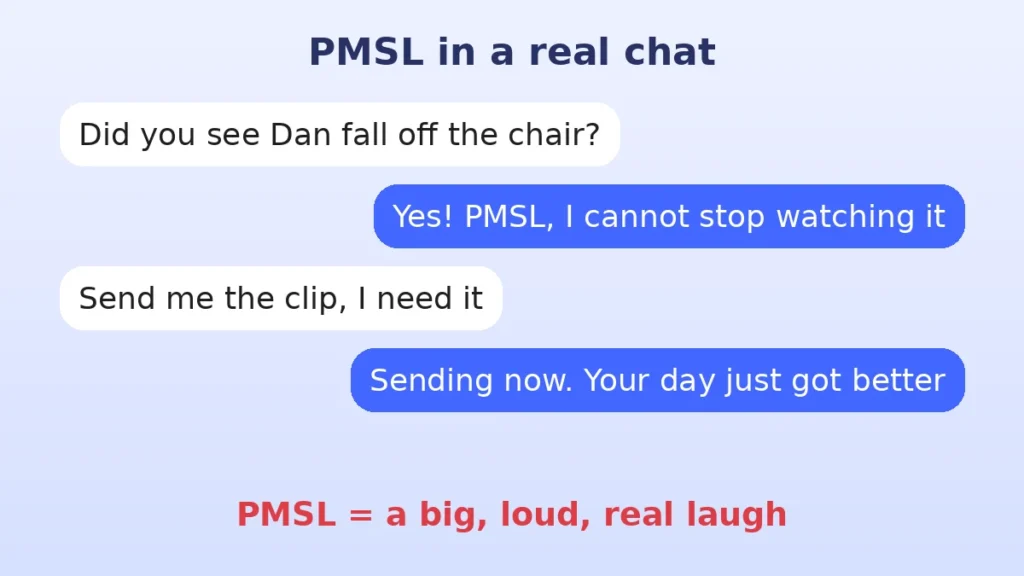
Examples make slang easier to learn. Here are real-life style chats that show how PMSL works.
Example 1: Reacting to a Funny Video
Friend: “I sent you that clip of the cat on the treadmill.”
You: “PMSL, I’ve watched it ten times!”
What it means: You find the video hilarious, and you keep replaying it.
Example 2: Sharing an Embarrassing Moment
Friend: “I called my teacher ‘Mum’ in front of everyone.”
You: “Stop it, I’m PMSL 😂”
In plain words: The story is so funny that you laugh out loud. You also show kindness, since you laugh with your friend, not at them.
Example 3: Replying to a Meme
Friend: sends a meme about Monday mornings.
You: “PMSL this is literally me”
Translation: The meme is funny, and it feels very true to your life.
Example 4: Group Chat Banter
Friend 1: “He really tried to parallel park for 20 minutes.”
Friend 2: “PMSL 😭😭😭”
Friend 3: “I’m crying, send the video.”
Quick note: Everyone finds the moment hilarious. The crying emoji shows laughter here, not sadness.
Example 5: A Social Media Comment
Post: A funny photo of a dog in a tiny hat.
Comment: “PMSL, he looks so proud 😂”
Simply put: The commenter loves the photo and wants to share the joy.
PMSL Variations and Related Phrases
You will see PMSL written in a few different ways. All of them carry the same meaning.
- pmsl (lowercase): the most common form in quick texts.
- PMSL (capitals): adds extra energy, almost like shouting with laughter.
- pmsl 😂 or pmsl 💀: pairs the slang with an emoji for a stronger effect.
- literally pmsl: stresses that the laugh is huge.
- “I’m pmsl-ing”: turns the slang into a casual verb.
Besides these forms, people also use other phrases for the same feeling. For example, “I’m dying,” “I’m in stitches,” and “I’m crying” all describe a big laugh. Each one has its own flavor, but they point in the same direction. 🔥
More Laughing Slang You May See Next
Once you know PMSL, other laughing slang gets easier. Here are a few more terms you might spot in chats.
- LMFAO: a louder, stronger version of LMAO.
- ROFLMAO: a long, playful mix of ROFL and LMAO.
- Wheezing: laughing so hard that you struggle to breathe.
- Crying 😭: tears of laughter, often used by younger chat groups.
- Cracking up: a casual way to say you laugh a lot.
- Howling: a loud, joyful laugh that you can’t hold back.
Younger users often prefer emoji-based reactions, such as 💀 or 😭. Older users tend to stick with LOL and PMSL. However, nothing is fixed, and many people mix all of them. The best choice is the one that matches your friends.
PMSL vs Similar Terms
PMSL is not the only way to show laughter. The table below shows how it compares with other popular terms.
| Term | Full Form | Laugh Strength | Best Use |
|---|---|---|---|
| LOL | Laughing out loud | Light to medium | Almost any casual chat |
| LMAO | Laughing my a** off | Strong | Friends and social media |
| ROFL | Rolling on the floor laughing | Strong | Big jokes and playful chats |
| PMSL | Pissing myself laughing | Very strong | Close friends and funny moments |
| I’m dead 💀 | Not an abbreviation | Very strong | Memes and younger chat groups |
PMSL vs LOL
LOL is soft and everyday. People often type it as a polite reply, even when they only smile. PMSL, on the other hand, signals a real burst of laughter. Pick LOL for a light chuckle and PMSL for a big one.
If you are curious about the history of LOL, you can read more about it on Wikipedia.
PMSL vs LMAO
LMAO and PMSL have a similar strength. Both show a strong laugh. However, LMAO is more common worldwide, while PMSL has a stronger British feel. So, your choice often depends on your own style and where you live.
PMSL vs ROFL
ROFL paints a picture of someone on the floor. It sounds older and a bit playful today. PMSL feels more natural in modern chats, since it sounds closer to how real friends talk.
When Should You Use PMSL?
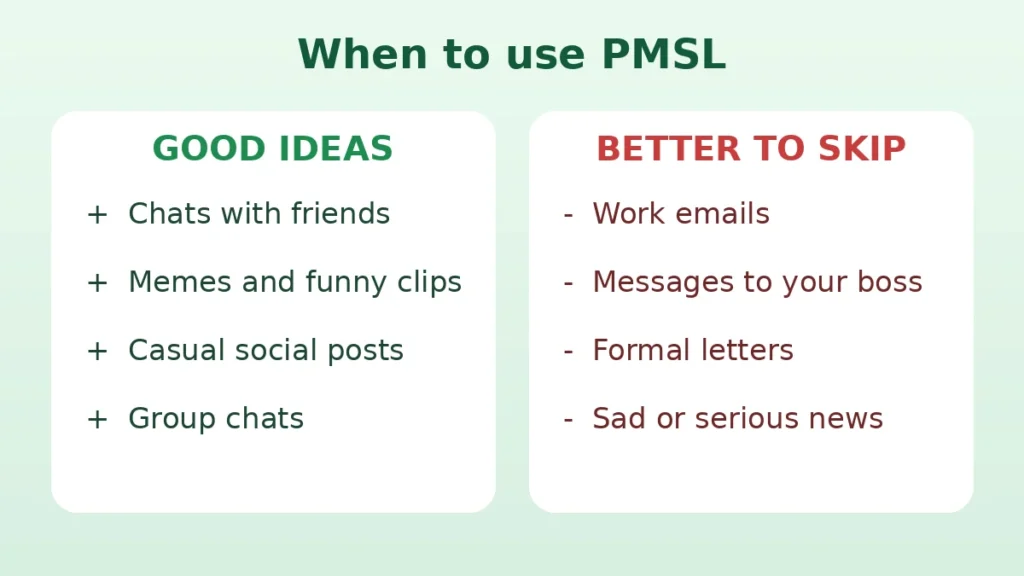
Using slang well is about timing. Use PMSL when the moment is truly funny and the mood is relaxed.
Good Times to Use PMSL ✅
- You chat with close friends or family who know the slang.
- Someone shares a meme, a clip, or a funny story.
- You comment on a lighthearted social media post.
- A group chat turns into pure banter.
Times to Skip PMSL ⚠️
- You write a work email or a message to your manager.
- You talk to a teacher, client, or someone you just met.
- Someone shares sad, serious, or painful news.
- You are not sure the other person knows the slang.
Simple rule: If you would not say “pissing myself laughing” out loud to that person, do not type PMSL either.
How to Reply When Someone Sends You PMSL
Sometimes the slang lands in your inbox first. You might wonder how to respond. The good news is that you have plenty of easy options.
- Match the energy: “Right? I can’t stop laughing either!”
- Ask for more: “Okay, tell me the full story now.”
- Share a laugh back: “😂😂 You made my day.”
- Keep it short: “Haha, glad it made you laugh.”
Above all, stay warm. A person who types PMSL wants to share a happy moment with you. A friendly reply keeps that mood alive.
Common Misunderstandings About PMSL
Because PMSL looks like a code, people often guess the wrong meaning. Here are the most common mix-ups.
PMSL Is Not the Same as PMS
Some people read PMSL and think of PMS, which stands for premenstrual syndrome. These two terms are unrelated. PMSL has an extra “L” for laughing, and it only describes a funny reaction.
It Does Not Mean You Literally Wet Yourself
PMSL is an exaggeration. People use it the same way they say “I’m dying of laughter.” Nobody expects a real accident.
It Is Not Always Rude
The word “pissing” is mild, so PMSL usually sounds playful. Even so, some people still find it too crude. When in doubt, choose LOL instead.
It Is Not Only British
British users made PMSL famous, but people around the world now use it. You will find it in chats across many countries, especially among people who love internet humor.
It Does Not Mean You Mock the Other Person
PMSL describes your reaction, not your opinion of someone. Still, think before you use it on a sensitive topic. Laughing at a person’s pain can hurt, even in text. ⚠️
Pro Tips for Using PMSL the Right Way
- Know your audience. Close friends will love it, but older relatives may not know it.
- Save it for real laughs. If you type PMSL after every message, it loses its power.
- Add an emoji. A 😂 or 💀 can make your reaction feel even more genuine.
- Match the platform. Casual apps welcome slang, while professional tools do not.
- Read the room. If the mood is serious, leave the slang out.
- Stay kind. Laugh with people, not at them.
- Remember cultural differences. Humor changes from place to place, so a joke that lands with one friend may confuse another.
- Explain it if needed. If a friend asks what it means, answer with a smile. Slang is meant to be shared.
Quick Check: Do You Know When PMSL Fits?
Test yourself with three short situations.
- Your best friend sends a clip of a dog sliding on a wet floor. Answer: ✅ PMSL fits well, since the clip is funny and the chat is casual.
- Your manager shares a light joke in a team email. Answer: ⚠️ Skip PMSL. Write “That made me laugh” instead.
- A friend tells a sad story that has a funny ending. Answer: Wait a moment. First, show care. Then laugh once your friend starts to laugh.
If you got all three right, you already use the slang like a pro. 🔥
Final Thoughts on What PMSL Means in Text
So, what does PMSL mean in text? It means “pissing myself laughing,” and it shows that you find something extremely funny. It is playful, cheeky, and perfect for casual chats. 😂
Now you know the meaning, the examples, and the best times to use it. You also know when to skip it and how to avoid common mix-ups.
Next time you see PMSL in a chat, you will understand it right away. Better still, you can send it back with confidence. 🔥
Frequently Asked Questions About PMSL
What does PMSL stand for in text?
PMSL stands for “pissing myself laughing.” People use it to show that something is extremely funny. It is a stronger version of LOL, and it is common in casual chats.
Is PMSL a rude word?
PMSL is mildly vulgar, since it includes the word “pissing.” However, most people see it as playful slang, especially in the UK. Avoid it in formal or professional messages.
Is PMSL the same as LOL?
No, they are close but not identical. LOL can mean anything from a small smile to a laugh. PMSL signals a much bigger reaction, so it feels more intense.
Can I use PMSL at work?
It is better not to. Work chats call for a polite and neutral tone. Choose “that’s hilarious” or a simple “haha” instead, and keep PMSL for friends.