You open a chat. A friend sends a photo, and someone replies with just three letters: “DLS.” 🤔
So now you are staring at the screen. Is it a typo? Maybe a tech term? Or a joke you missed?
Still, do not worry. You are not alone. Thousands of people search what does DLS mean in text every month. This little acronym shows up in comments, captions, and group chats without any explanation.
In this guide, you will get a clear answer first. Then you will see where people use it, why it spread, and how to reply without feeling awkward. 🔥
Ready? Then let’s decode it.
What Does DLS Mean in Text? (Quick Answer)
In most chats, “DLS” is a typed-backwards version of “DSL.” It is internet slang that stands for a crude phrase about lips: “Dick Sucking Lips.”
People use it to say someone has full, attractive lips. It is a bold, flirty, and sometimes teasing compliment. It is also adult slang, so it is not meant for every audience.
✅ Short definition: DSL (often typed as DLS) is slang for “Dick Sucking Lips.” It is a crude, flirty way to describe full lips online.
However, the slang is not new. According to Know Your Meme, the meaning was first recorded on Urban Dictionary in the mid-2000s. It then came back strongly in the early 2020s through social media.
Why This Matters
If you reply to “DLS” without knowing the meaning, you could say something awkward. That is why it helps to understand the tone before you answer.
Simple Meaning of DLS in Easy Words
So, let’s strip it down.
- What it describes: someone’s lips.
- What it says about them: the lips look full and attractive.
- How it sounds: cheeky, flirty, and a bit rude.
- Who uses it: mostly teens and young adults online.
So when someone writes “She has DLS,” they mean “Her lips are gorgeous,” just in a much more blunt way.
For example, think of it as a spicy version of “nice smile” or “great hair.” The idea is a compliment, but the wording makes it adult. 😅
DLS vs DSL: Which Spelling Is Correct?
Here is something many articles skip. Actually, the standard slang spelling is DSL, not DLS.
So why do people search for “dls”? There are three simple reasons:
- Fast typing. Thumbs often swap the “L” and “S” because people type fast.
- Autocorrect. Some phones change the order of letters, so errors slip in.
- Memory. People hear the term once, so they recall it slightly wrong.
In chats, people read both versions the same way. If you want to be accurate, though, DSL is the right form of the slang.
That is also why you should read the context, since “DLS” can mean something different in other fields. I will cover that below.
Where Is DLS Used? Platforms and Situations
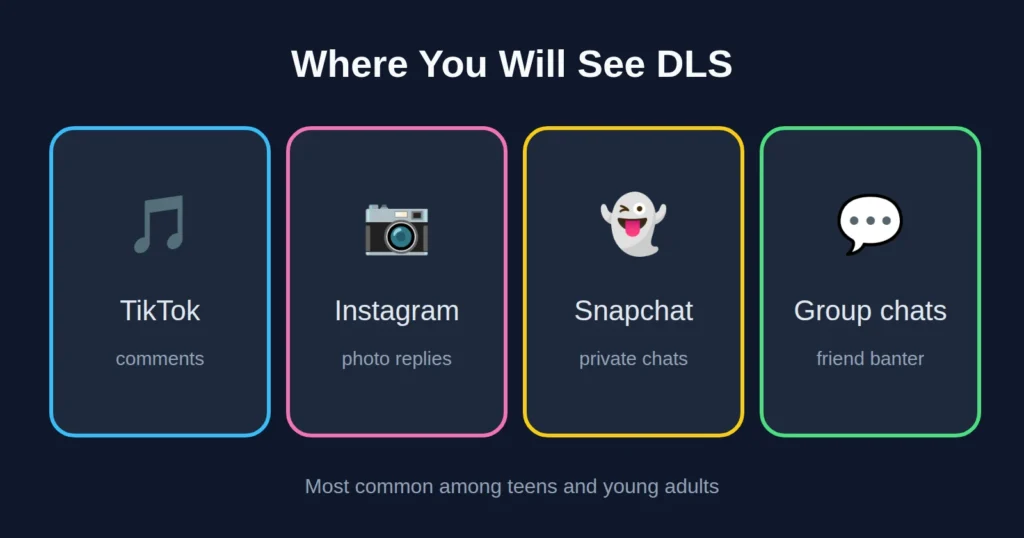
You will mostly see DSL meaning in slang on social platforms. Here are the common spots.
1. TikTok and Instagram comments
Above all, this is the number one place. Under photos and videos, people often drop “DSL” because it is a quick, bold compliment.
2. Snapchat and group chats
Here, friends tease each other with it. It often comes with laughing or fire emojis, so the mood stays light. 🔥
3. Memes and captions
Meanwhile, creators use the acronym in jokes, edits, and trending sounds. That is how it reached a much wider audience.
4. Dating apps and DMs
Here it is more personal and more flirty. This is where tone matters most, because the same words can feel sweet or pushy.
5. Gaming and Discord chats
It pops up in jokes and banter, usually among friends who know each other well.
Why Do People Use DLS in Text?
A slang term does not spread by accident. Instead, people use this one for a few clear reasons.
It is short
Three letters are faster than a full sentence, so online speed wins.
It feels playful
Also, acronyms let people say bold things in a light way. It sounds like a joke, even when the compliment is sincere.
It signals “inside” knowledge
In addition, slang makes a group feel close. If you know the term, you are part of the conversation. If you do not, you feel left out.
It softens a blunt phrase
Plus, writing the full words would feel too crude for many people. The acronym creates a little distance. That is the same reason people write “OMG” instead of the long version.
Trends pull it back
Finally, social media loves recycled words. When a meme or sound uses the term, it jumps back into everyday chat within days.
Real-Life Examples of DLS in Text
Examples make everything clearer. Here are five common situations. Each one shows how context changes the meaning.
Example 1: A compliment on a photo
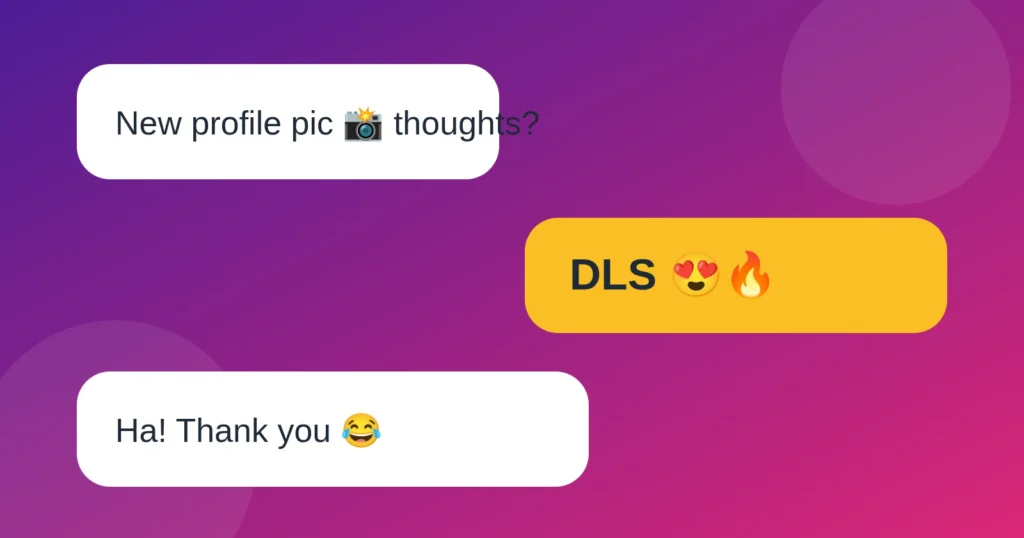
Message: “Okay, those DLS today though 😍”
Meaning: The sender is praising the person’s lips in a flirty way. It is bold, so it works best between people who already joke around.
Example 2: A friendly tease in a group chat
Message: “Bro got the DSL after that lip balm 😂”
Meaning: A joke, so nobody takes it seriously. The friend is teasing someone about how their lips look.
Example 3: A French friend says sorry
Message: “dsl, je suis en retard”
Meaning: Here, “dsl” is short for the French word désolé, which means “sorry.” Therefore, it has nothing to do with lips. 🙂
Example 4: Internet at home
Message: “Our DSL is down again.”
Meaning: Here, this is the older tech meaning: Digital Subscriber Line, a type of home internet connection.
Example 5: A cricket match update
Message: “Rain stopped play, DLS target is 142.”
Meaning: Here, DLS is the Duckworth-Lewis-Stern method. Cricket officials use it to reset the target score when rain cuts a match short.
⚠️ Lesson: Always check who is talking, where, and about what. The same letters can carry four very different meanings.
DLS vs Similar Terms: What Is the Difference?
People often mix this slang with other online words. This table keeps it simple.
| Term | What it means | Tone | Safe for work? |
|---|---|---|---|
| DSL / DLS | Crude slang praising full lips | Flirty, bold | ❌ No |
| “Nice smile” | Plain compliment on a smile | Friendly | ✅ Yes |
| Thirst trap | A post made to attract attention | Playful, teasing | ⚠️ Depends |
| DL | “Down low,” meaning keep it secret | Casual | ✅ Yes |
| dsl (French) | Short for “désolé” (sorry) | Polite | ✅ Yes |
| DLS (cricket) | Duckworth-Lewis-Stern rain method | Technical | ✅ Yes |
Notice the pattern. Only the first one is adult slang. The rest are harmless, which is why context is everything.
When Should You Use DLS in Text?
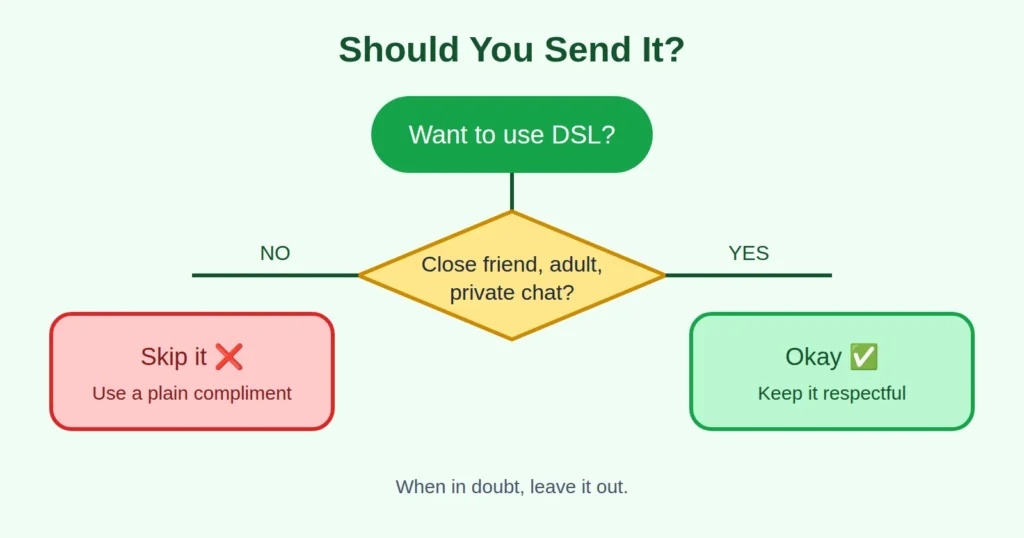
Short answer: rarely, and only with care.
It can be fine when:
- You are texting a close friend who loves this kind of humor.
- You are both adults and you know the joke will land.
- The setting is private and relaxed.
Skip it when:
- You are messaging a coworker, teacher, boss, or client.
- You are talking to someone you barely know.
- The person has not shown that they enjoy this kind of banter.
- Anyone under 18 might read the chat.
Here is a simple rule: if you would not say it to their face, do not text it.
How to Tell Which DLS Meaning Someone Intends
Since the same letters carry several meanings, a quick mental checklist helps. Run through these four questions whenever you see the term.
- Where did you see it? A photo comment on TikTok points to the slang. A message about your Wi-Fi points to the tech meaning.
- What language is the chat in? French messages often use “dsl” to apologize. English slang chats usually mean the lips phrase.
- What else is in the message? Heart-eyes, fire, or flirty emojis usually signal the slang. Words like “target,” “overs,” or “rain” signal cricket.
- Who sent it? A close friend joking around is different from a stranger. The relationship changes how you should read the tone.
Most of the time, two of these clues are enough to settle the question. If they are not, a short and friendly “Wait, what do you mean by that?” solves it. There is no shame in asking. Slang changes quickly, and even people who grew up online get surprised.
A Short History: How the DSL Slang Spread
The acronym is older than most people think. Know Your Meme explains that an early Urban Dictionary entry recorded the meaning in the mid-2000s. That was the era of flip phones and tiny text limits, when people shortened everything to save space.
For years, the term stayed in small corners of the internet. Then short-video apps changed the game. In the early 2020s, creators and commenters brought it back, and it reached a much bigger audience.
Overall, this pattern is common. Slang often disappears, sleeps for a while, and returns when a new platform finds it funny again. That is also why a younger relative may use a term that feels oddly familiar.
Why the Spelling Gets Scrambled
Every time a term moves to a new group of users, the spelling drifts a little. Newer users often see it once in a fast-moving comment section. They do not see the original. So they type it from memory, and the letters swap. That is exactly how “DSL” turned into “DLS” for so many searchers.
A Quick Guide for Parents, Teachers, and Teens
If you are an adult who found this term in a child’s chat, take a breath. Seeing it does not automatically mean something serious is happening. Many young people use it as a joke without thinking about the full wording.
Still, it is a good moment for a calm talk. Here are a few simple ways to handle it.
- Stay curious, not angry. Ask, “I saw this term. Where did you hear it?” You will learn much more than you would by scolding.
- Explain the tone. Many teens do not realize how crude the phrase is. A clear explanation often helps more than a rule.
- Talk about respect. Comments about someone’s body can make that person feel uneasy, even when they are meant as praise.
- Remind them about privacy. Messages and screenshots can travel further than anyone expects.
If you are a teen reading this, here is the main point. Just because a word is trending does not mean it fits every chat. Think about how the other person might feel. A kind, simple comment is almost always the safer choice. ✅
Is Using DLS Ever Disrespectful?
Yes, it can be. The intent and the impact are two separate things. You might mean a compliment. However, the other person may feel judged on their looks. They may also feel pushed into a flirty chat they never asked for.
Here is how to stay on the respectful side:
- Wait until the other person shows they enjoy playful banter.
- Never repeat it if they ignore it or change the subject.
- Avoid public comments on a stranger’s photos. A private, polite message is better, or no message at all.
- Choose a plain compliment when you are not sure. “That color suits you” is hard to get wrong.
Good manners online work just like they do in person. So, a little thought before you press send protects both you and the person who reads it.
Common Misunderstandings About DLS Meaning
Myth 1: “It is just a tech word.”
Only sometimes. Digital Subscriber Line is real, but in social chats the lips meaning is far more likely.
Myth 2: “It is a harmless compliment.”
The intent may be kind. The wording, however, is crude. Some people enjoy it. Others find it disrespectful or uncomfortable.
Myth 3: “Everyone understands it.”
Not at all. In fact, plenty of adults, parents, and non-native speakers have never seen it. Do not assume shared knowledge.
Myth 4: “DLS and DSL are different slang terms.”
In texting, they almost always mean the same thing, because one is simply the common typo.
Myth 5: “It always refers to one gender.”
No. Anyone can have full lips, so anyone can get this compliment. The slang does not belong to one group.
Myth 6: “Lowercase ‘dsl’ is always the slang.”
Not true. As the French example showed, it can simply mean “sorry.” Read the whole message.
Pro Tips for Using and Understanding DLS
- Read the room first. Look at who is chatting, since the mood shapes the meaning.
- Check the language. If the chat is in French, “dsl” likely means “sorry.”
- Ask if you are unsure. A simple “What does that mean?” is fine. That is better than guessing wrong.
- Respect boundaries. If someone looks uncomfortable, stop. Consent and comfort come first.
- Keep it out of professional chats. Work email, school apps, and client messages are not the place, so skip it there.
- Look at your audience’s age. Adult slang does not belong around minors, so keep it away from them.
- Have a polite backup. For example, try “Your smile is great” or “Love that look.” They work everywhere.
How to reply if someone sends you DLS
You have choices. Pick what feels right for you.
- When you like it: “Haha, thank you 😊”
- To keep it light: “You’re too much 😂”
- If you feel uncomfortable: “I would rather you didn’t say that. Thanks.”
You never owe anyone a friendly answer to a comment that makes you uneasy. ✅
Related Texting Slang You May See Next
Once you learn one acronym, you start spotting others. These are common in the same chats where DSL appears, and they are much safer to use.
- IYKYK: “If you know, you know.” It hints at an inside joke.
- SMH: “Shaking my head.” It shows mild disbelief or disappointment.
- FR: “For real.” People use it to agree strongly or to ask if something is true.
- TBH: “To be honest.” It usually comes before an opinion.
- IDK: “I don’t know.” Simple, quick, and clear.
Learning these terms makes group chats far less confusing. It also builds your confidence, so you can spot unfamiliar slang and decide how to respond.
Final Thoughts on What DLS Means in Text
So, what does DLS mean in text? In everyday chats, it is a typo of the slang DSL, a crude and flirty phrase about someone’s lips.
Outside that world, the letters can mean “sorry” in French, a home internet line, or a rain rule in cricket.
Overall, the best habit is simple. Read the context, think about the audience, and choose kind words. If you are ever unsure, a plain compliment never fails. 🙌
Frequently Asked Questions About DLS Meaning
What does DLS mean in a text message?
Most of the time, it is a typing flip of DSL. That slang stands for “Dick Sucking Lips,” a crude and flirty way to praise full lips.
Is DLS the same as DSL?
In chat slang, yes. DSL is the standard form. DLS is a common misspelling that people still understand.
Is DLS a rude word?
It is adult slang with a crude origin. Some people use it as a joke or a compliment. Still, it is not suitable for school, work, or formal talk.
Can DLS mean something else?
Yes. In French texting, “dsl” means “sorry” (désolé). For tech, DSL is Digital Subscriber Line. Meanwhile, cricket uses DLS for the Duckworth-Lewis-Stern method. Context tells you which one applies.