
Your phone buzzes. A message pops up, and it ends with three small letters: ETP. 🤔 You stare at the screen. Is it a compliment? A joke? A hidden insult?
If you are wondering what does ETP mean in text, you are not alone. Plenty of people search for it every day. The term shows up in chats, comments, and captions with no explanation at all.
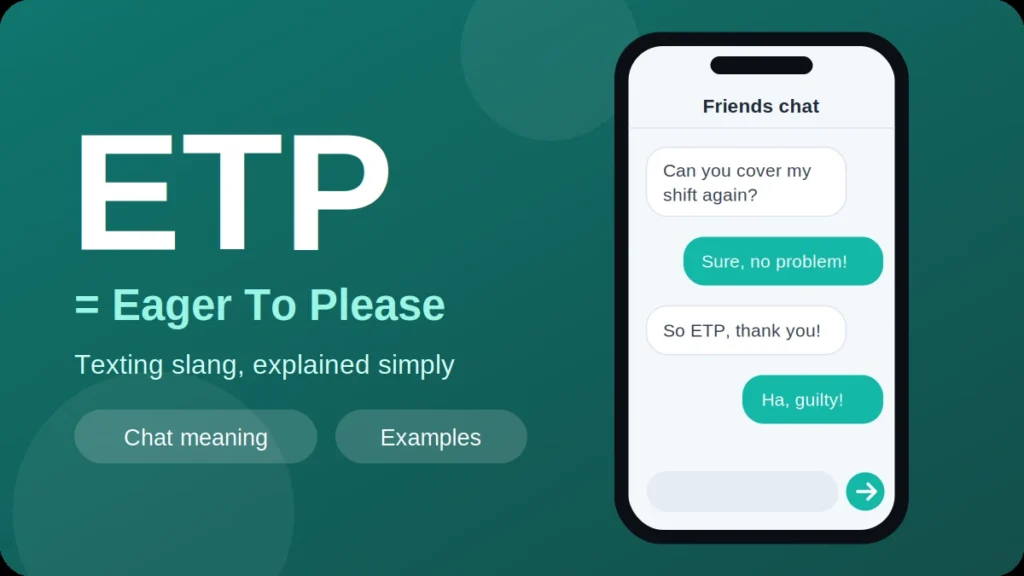
Here is the short answer. In texting and online slang, ETP stands for “eager to please.” ✅ It describes someone who works hard to make others happy, sometimes a little too hard.
In this guide, you will learn the exact meaning and see real examples. You will also learn when to use it. Just as important, you will learn when to skip it, so you never send the wrong message.
What Does ETP Mean in Text? The Quick Answer
ETP means “eager to please” in text messages, online chats, and social media. It describes a person who goes out of their way to make others happy. They may want approval, or they may fear letting people down.
Think of a coworker who says yes to every request. Or picture a friend who plans a whole party just to impress a new group. People might call both of them ETP.
ETP Full Form, Letter by Letter
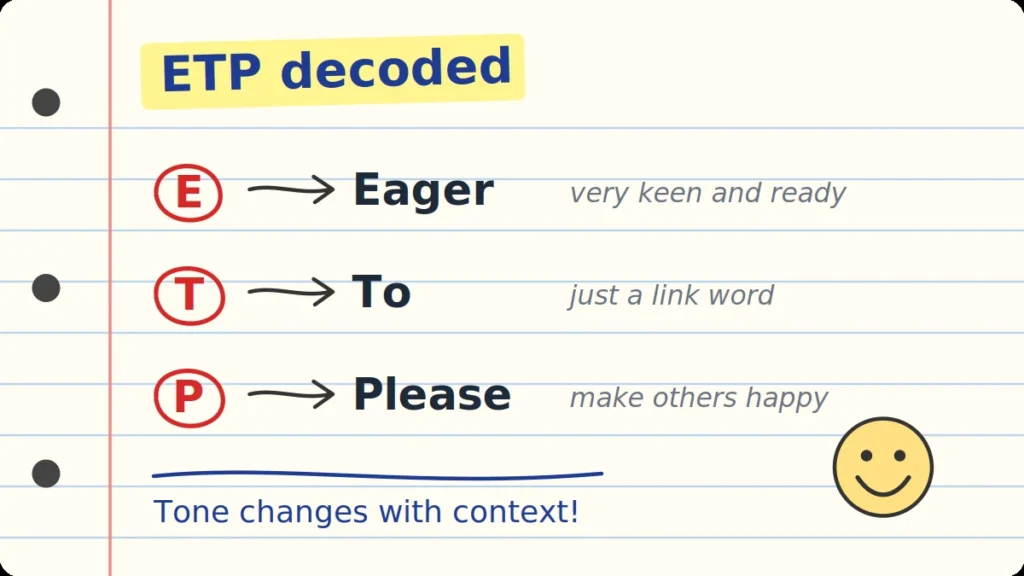
- E = Eager (very keen and enthusiastic)
- T = To
- P = Please (make others happy or satisfied)
The full form is simple. However, the feeling behind it changes from chat to chat. Sometimes ETP sounds sweet and fond. At other times it sounds like friendly teasing. Occasionally, it carries a sharper edge.
You will learn how to read each tone later in this guide. First, let us look at the meaning in plain words. 👇
ETP Meaning in Easy Words: What It Really Says
Strip away the slang, and ETP says one thing: “This person tries very hard to make others happy.”
Here are a few everyday scenes that fit the label:
- Raising a hand for every single question in class
- Refilling every guest’s glass before it is empty
- Volunteering for each task during your first week at work
- Changing plans again and again so nobody feels left out
Each of them is eager to please. Notice that none of these actions is bad on its own. The meaning depends on how often it happens, and on why.
The Bright Side of Being ETP 🌟
- Kind and thoughtful toward others
- Reliable when a team needs help
- Easy to work and live with
- Quick to notice what other people need
The Flip Side of Being ETP ⚠️
- Finds it hard to say no
- Hides their own opinions to keep the peace
- Gets tired from doing too much
- May attract people who take advantage of their kindness
That balance is why the term feels layered. “Eager to please” is not automatically good or bad. It simply describes behaviour.
The phrase is also common outside texting. Dog trainers use it too. People call a breed that learns fast and loves its owner “eager to please.” In slang, the same idea now describes people.
Signs Someone Might Be ETP 🔍
You do not need a label to notice the pattern. Here are common signs that a person leans toward being eager to please:
- Apologising even when nothing went wrong
- Saying “whatever you prefer” when asked to choose
- Agreeing quickly, then feeling unhappy about it later
- Taking on extra tasks without being asked
- Worrying a lot about what others think
Of course, one sign alone proves nothing. Everyone helps out sometimes. The pattern matters, not a single moment.
Where Is ETP Used in Texts and Online Chats?
Slang spreads wherever people type quickly. You may spot ETP in a few main places:
- Text messages and WhatsApp chats
- Instagram comments and direct messages
- TikTok captions and comment sections
- Reddit threads and Discord servers
- Snapchat chats between friends
Still, ETP is not as common as LOL, BRB, or OMG. You will not see it every day. It tends to live in smaller circles, such as friend groups, fan communities, and online servers.
Situations Where You May Spot It
- Chatting about a friend who always says yes
- Joking about yourself after you overdid a favour
- Talking about school or workplace habits
- Commenting on videos about people-pleasing
Because the term is niche, always check the context. The topic of the chat usually tells you what the sender means.
Why Do People Use ETP in Messages?
People use short slang for the same reasons they use any shortcut. But ETP has a few special advantages too. Here are the main ones:
- It saves time. Three letters replace a long sentence about someone’s habits.
- It softens a comment. Saying “you’re so ETP” feels lighter than “you never say no.”
- It names a pattern in one word. Everyone in the chat instantly knows what you mean.
- It builds a shared feeling. Using the same slang makes a group feel close.
- It allows self-aware humour. You can laugh at your own habits without making a big deal.
In short, ETP lets people talk about a sensitive habit in a relaxed way. That is a big part of its charm.
How ETP Feels in Different Relationships
The same word lands differently depending on who sends it. Here is how it often plays out.
Among Friends
Friends usually use ETP as a gentle tease or a thank-you. They know your habits, so the comment rarely feels hostile. A friend might say it while laughing about how you always pick the restaurant everyone else wants.
At Work or School
Here the term often carries more weight. Calling a colleague ETP may suggest they never push back, even when they should. Because careers and grades are at stake, the label can sting. That is one more reason to avoid it in professional spaces.
In Family and Dating Chats
In close relationships, ETP often appears in venting or advice. Someone might call a partner or sibling ETP. Then they ask how to help that person speak up. In these chats, the term usually comes from worry, not mockery.
In every setting, the golden rule stays the same. Think about how the label will feel for the person it describes.
Real-Life Examples of What ETP Means in Text
Examples make the meaning click. Below are six common ways you might see ETP, along with what each one really says.
Example 1: A Warm Thank-You 💛
“Thanks for covering my shift again. You are so ETP!”
Meaning: The sender is grateful. They admire how helpful you are.
Example 2: Joking About Yourself 😅
“I cleaned the whole flat before my guests even arrived. Total ETP mode, lol.”
Meaning: The sender knows they tried too hard, and they find it funny.
Example 3: Friendly Teasing 😄
“You agreed to host again? Okay, ETP.”
Meaning: A light joke. The sender is amused, not angry.
Example 4: A Caring Nudge 🤝
“I love that you help everyone, but you don’t have to be ETP all the time.”
Meaning: The sender cares about you and hopes you will set healthy limits.
Example 5: A Sharper Remark 😬
“The new hire is ETP. They agree with the manager on everything.”
Meaning: This one is critical. It suggests the person lacks their own voice.
Example 6: A Community Comment 🙋
“ETP folks, raise your hand!”
Meaning: The commenter invites people who relate to the habit to join in.
A Short Chat Example 💬
Seeing ETP inside a real conversation helps even more. Here is how it might look between two friends:
Friend A: Can you pick me up at 6? I know it is out of your way.
Friend B: Sure, no problem! I will move my plans around.
Friend A: You always do this. ETP much? 😄
Friend B: Okay, fair. Maybe I should say no sometimes!
Here, Friend A is teasing with love. Friend B notices the habit and laughs about it. Nobody feels hurt, because the tone stays light.
How to Read the Tone
Because one term can feel so different, look for clues:
- Emojis: Hearts suggest warmth. A grimace suggests a mild complaint.
- Relationship: A close friend’s teasing differs from a stranger’s comment.
- Topic: Thanks and praise point to kindness. Talk about boundaries points to concern.
- Punctuation: Exclamation marks usually mean fun. A flat full stop can mean frustration.
ETP vs Similar Terms: What Is the Difference?
Several slang terms sound close to ETP. Yet each one points to a slightly different idea. This table makes the gaps easy to see.
| Term | Meaning | Usual tone | Key difference |
|---|---|---|---|
| ETP | Eager to please others | Varies | Focuses on eagerness and effort |
| People-pleaser | Puts others’ wishes before their own needs | Mildly negative or concerned | Describes a deeper, long-term habit |
| Pushover | Gives in easily under pressure | Negative | Focuses on weakness, not eagerness |
| Try-hard | Tries too hard to impress | Often negative | About impressing others, often for status |
| Teacher’s pet | Favoured for pleasing someone in charge | Teasing | Aimed at one authority figure |
| Go-getter | Ambitious and proactive | Positive | Driven by personal goals, not approval |
So, ETP sits in the middle. It is gentler than “pushover” and more specific than “try-hard.” It simply says someone is keen to make others happy.
Other Ways to Say “Eager to Please”
If your reader may not know ETP, these plain-English options work well in any chat:
- Always helpful: a warm, positive choice
- Very accommodating: polite and neutral
- Keen to impress: a little more playful
- Highly agreeable: neutral, sometimes slightly critical
- Struggles to say no: direct and often concerned
Choosing a clear phrase also protects you from confusion with the other meanings of ETP.
When Should You Use ETP in Texting?
Slang works best when everyone understands it. Use these quick guidelines.
Good Times to Use ETP ✅
- In casual chats with friends who know online slang
- When you describe your own habits with humour
- When you thank someone for going the extra mile
- In comment sections where the community already uses it
Times to Avoid ETP ⚠️
- In work emails, reports, or messages to a manager
- With people who may not know the term
- When someone is upset or struggling to set boundaries
- When you want to give serious feedback
If you are unsure, write the full phrase instead. “You’re so eager to please” is clear to everyone. It also sounds friendlier than a mystery acronym.
Common Misunderstandings About ETP Meaning in Text
Myth 1: ETP Is Always an Insult
Not true. Many people use it with affection. Whether it hurts or helps depends on tone, context, and the bond between the people chatting.
Myth 2: ETP Has Only One Meaning
Context matters a lot here. Outside texting, ETP can mean other things entirely. In finance, it stands for an exchange-traded product. That is an investment that trades like a stock. Engineers use it for an effluent treatment plant. Schools and employers may use it for an education or training programme.
A few slang sites also list rarer meanings, such as “estimated time of posting.” These are far less common in everyday chats. If a message does not fit the “eager to please” idea, ask the sender what they meant.
Myth 3: Eager to Please Always Means Kind
Kindness and eagerness can overlap, but they are not identical. Someone may say yes out of fear of conflict instead of genuine care. That is why a good friend might gently ask whether you truly want to help.
Myth 4: Everyone Knows the Term
ETP is not an official dictionary word, and it is not universal. Meanings can shift between communities. Never assume the other person shares your understanding.
Is Being ETP a Bad Thing? Finding a Healthy Balance
Many readers search for this term because someone just called them ETP. If that is you, take a breath. 🌿 Wanting to help others is a good quality. It only becomes a problem when it costs you your own time, energy, or peace of mind.
The goal is not to stop caring. Instead, aim to care without losing yourself. These small steps can help:
- Pause before answering. Say “Let me check and get back to you.” This gives you time to decide.
- Practise short, polite refusals. “I can’t take that on this week, but thanks for thinking of me.”
- Share your real opinion. Start small, with low-stakes choices like where to eat.
- Notice how you feel. Resentment is often a sign you said yes when you wanted to say no.
If the habit causes ongoing stress, talking with a trusted friend or a counsellor can help. You deserve support too.
Pro Tips for Using and Replying to ETP
- Match the tone. If the message is playful, reply playfully.
- Add a clue. A simple emoji or phrase helps your reader see your intent.
- Keep it kind. Describe the behaviour, not the person’s worth.
- Ask when unsure. A quick “Wait, what does ETP mean here?” saves misunderstandings.
- Spell it out for newcomers. Write “eager to please (ETP)” the first time.
- Respect boundaries. If someone seems uncomfortable with the label, drop it.
How to Reply When Someone Calls You ETP
- If it feels like a compliment: “Aw, thank you! I just like helping 😊”
- If it is a light joke: “Guilty! I’m working on saying no 😂”
- If it stings: “That felt a bit harsh. Can we talk about it?”
- If you are unsure: “Do you mean that in a good way?”
Keep your reply simple. Honest and calm works well every time.
Final Thoughts on ETP Meaning in Text
So, what does ETP mean in text? It means “eager to please.” It describes someone who works hard to make others happy.
The term can sound warm, playful, or critical. That is why tone and context matter more than the letters themselves. 💬
Now you know how to spot the meaning, read the mood, and reply with confidence. Next time ETP lands in your chat, you will be ready. 🚀
Frequently Asked Questions About ETP in Text
What does ETP mean in text?
In text messages and online slang, ETP means “eager to please.” It describes someone who tries very hard to make other people happy or win their approval.
What else can ETP stand for?
Outside slang, ETP has other meanings. In finance, it means exchange-traded product. In engineering, it means effluent treatment plant. The setting of the chat tells you which one applies.
Is ETP a compliment or an insult?
It can be either. Between friends, it is often a warm or teasing remark. In a critical conversation, it can suggest someone is too agreeable. Check the tone, emojis, and topic.
Can I use ETP in professional messages?
It is better not to. Slang can confuse colleagues and may sound unprofessional. In formal settings, write “eager to please” in full, or choose a more neutral word like “helpful.”
How can I tell if ETP is meant kindly?
Look at the emojis, the topic, and your relationship with the sender. Hearts, thank-you notes, and laughing faces usually signal kindness. If you still feel unsure, simply ask. Most people are happy to explain