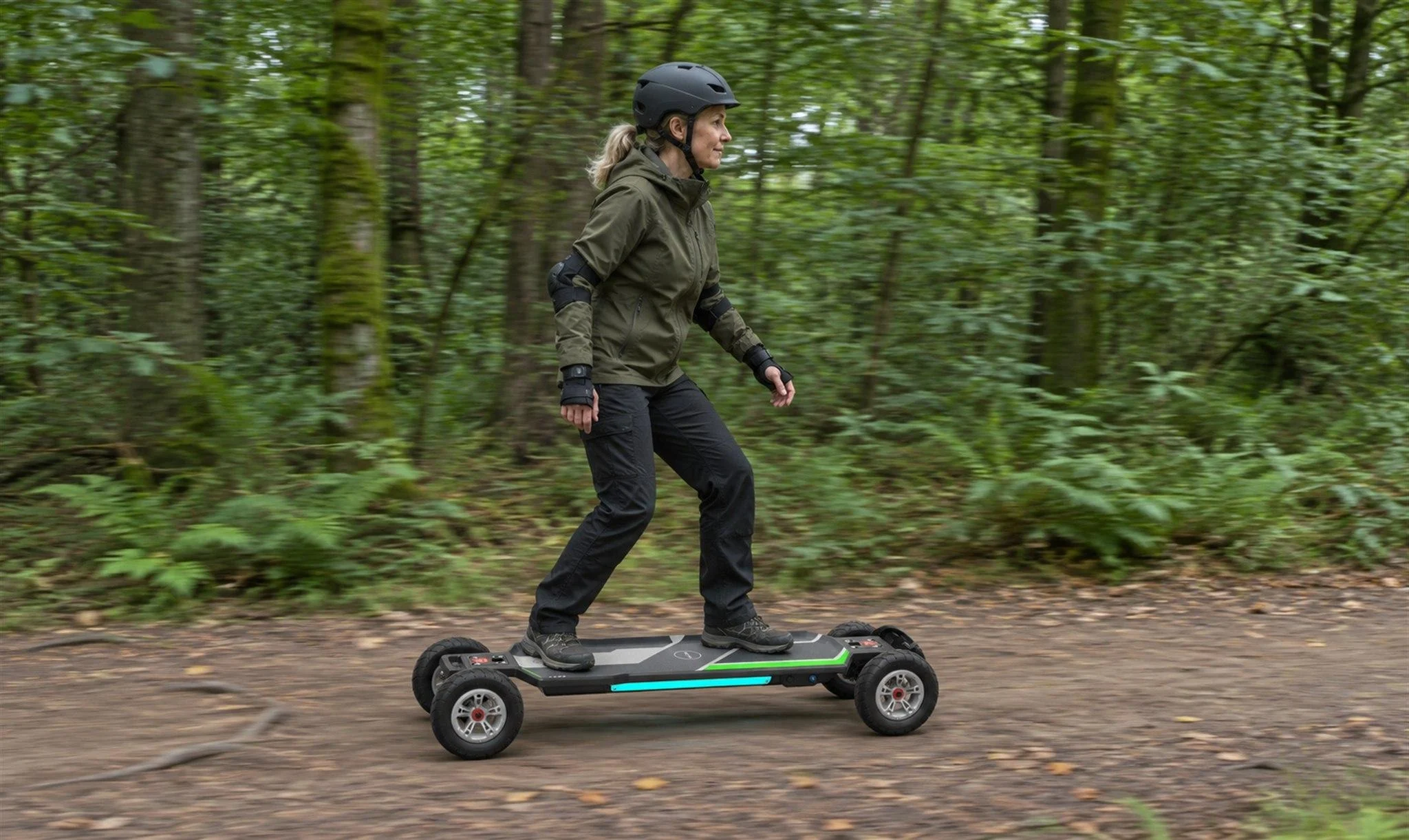
Choosing the right electric skateboard size is not simply a matter of matching deck length to your height. Adult riders also need to consider stance width, foot size, rider weight, wheelbase, wheel type, route conditions, and whether the board must be carried between rides. The best size is the one that supports a natural stance without making the board unnecessarily difficult to control, store, or transport.
What Does Electric Skateboard Size Include?
Product listings often emphasize deck length, but that measurement reveals only part of how a board will fit and behave. Width, wheelbase, standing area, concave, truck width, wheels, and overall weight can be equally important.
Deck Length and Usable Standing Area
Deck length is measured from one end of the board to the other, but the entire length may not be available for your feet. Kicktails, handles, raised wheel sections, and tapered ends can reduce the usable standing platform. Two boards with similar overall lengths may therefore provide noticeably different amounts of foot space.
Compact electric skateboards are generally easier to carry, store, and maneuver through confined spaces. Their shorter standing areas require a more compact stance, which may feel restrictive to riders with long legs or large feet. Longer decks provide more freedom to adjust foot position and can feel more settled during straight-line riding, but they occupy more storage space and are less convenient on stairs or public transportation.
Deck Width and Foot Placement
Width influences how securely your feet fit on the platform. A narrow deck can feel responsive and easy to turn, but a rider with large shoes may find that too much of each foot extends beyond the edges. A wider deck provides more contact area and can make it easier to establish a stable stance.
More width is not automatically better. An unnecessarily wide board may require greater effort to apply heel-and-toe pressure when carving, particularly for riders with smaller feet. The useful question is whether the deck supports the ball and heel of each foot without forcing an uncomfortable position.
Deck shape also matters. Concave edges can help riders locate their feet without looking down and may improve leverage during turns. Deep concave, however, can feel restrictive if it does not match the rider’s foot size and preferred stance.
Wheelbase and Stability
Wheelbase is the distance between the front and rear trucks. A longer wheelbase generally creates a more stable, gradual response, while a shorter wheelbase tends to turn more quickly. This difference can be more noticeable than a small change in overall deck length.
Adult riders who value straight-line stability and have enough room to make wider turns may prefer a longer wheelbase. A shorter setup can be useful in crowded urban environments, but its quicker response may require more precise weight distribution. Truck geometry, bushings, deck flex, and adjustment also influence handling, so wheelbase should not be evaluated alone.
Match the Board to Your Body and Stance
There is no universal height chart that determines the correct electric skateboard size. Riders of the same height may have different leg lengths, shoe sizes, balance skills, and stance preferences.
Begin by standing naturally with your knees slightly bent and your feet positioned as they would be on a skateboard. Measure the distance between the centers of your feet. The board should provide enough usable standing area to accommodate this stance without placing either foot on an unsuitable tapered section or over the trucks.
Taller riders often appreciate a longer platform because it allows a wider stance, while shorter riders may find a compact board easier to shift and maneuver. These are tendencies rather than strict rules. A tall, experienced rider may enjoy a shortboard, while a shorter rider may prefer the space and stability of a longboard.
Foot size deserves separate attention. Riders with larger shoes should examine deck width and shape instead of relying only on deck length. Some toe and heel overhang is normal, but excessive overhang can make foot placement less secure and may complicate carving.
Consider Rider Weight and Load Capacity
Rider weight does not determine deck length by itself, but it affects how the complete electric skateboard performs. The relevant load includes the rider, clothing, backpack, protective equipment, and anything else carried during the trip.
A board’s published maximum load is a structural limit, not a guarantee that every rider below that figure will receive the same acceleration, range, braking response, hill performance, or deck feel. As total load increases, motors must work harder, batteries may drain faster, and stopping distances can become longer. Flexible decks may also bend more under a heavier rider.
Instead of choosing a board that barely meets your total load, leave a reasonable margin. Riders near the stated limit should also consider deck stiffness, truck width, bushing setup, motor capacity, route gradient, and braking expectations. These factors become especially important when the journey includes repeated hills or frequent stops.
Choose a Size That Fits the Route
Body fit is only one part of the decision. The board must also match the roads, distances, and obstacles encountered during normal riding.
Smooth Urban Routes
A compact or medium-size board can work well on maintained bike lanes, campus paths, and smooth neighborhood streets. Smaller wheels and a shorter deck may keep weight manageable and make the board easier to carry indoors.
The trade-off becomes more noticeable on expansion joints, patched asphalt, and rough intersections. Small, hard wheels transmit more vibration and require greater care around cracks and debris. Adult riders using compact boards should make sure that portability is genuinely more valuable than the comfort of a longer platform or larger wheels.
Rough Pavement and Mixed Surfaces
Longer boards with larger wheels or pneumatic tires generally offer more space, ground clearance, and vibration isolation. They may be better suited to broken pavement, firm gravel, and longer recreational routes. The larger footprint can also feel more planted, although tire type and truck setup contribute heavily to that impression.
These benefits come with greater weight and bulk. A large all-terrain board may handle the riding portion of a commute comfortably but become inconvenient when the rider reaches a staircase or crowded train. Before choosing among electric skateboards for adults, consider the entire journey, including every section where the board will be carried rather than ridden.
Hills and Longer Distances
Steep routes and long journeys often require a larger battery and more capable drivetrain. These components add weight and may require a larger platform or enclosure. In this situation, the appropriate board size is determined partly by the performance the route demands.
Do not choose a large board solely because it advertises a high top speed. Battery capacity, hill capability, wheel type, cooling, and comfortable cruising range are more relevant to regular transportation. Manufacturer-rated range should also be treated as an estimate because rider weight, speed, temperature, wind, hills, and surface conditions affect actual results.
Balance Ride Comfort Against Portability
A board can fit your stance perfectly and still be impractical if you cannot comfortably move it when the motor is off. Check the complete weight rather than judging portability from deck length.
Before buying, imagine carrying the board through the most inconvenient part of your normal journey. Can you lift it upstairs with one hand? Will it fit in your vehicle, apartment, locker, or workplace? Is there a handle, and is it positioned where the board remains balanced? A compact board may be preferable if carrying happens every day, even when a larger model would feel more comfortable on the road.
A heavy board can still be a reasonable choice when it is stored at ground level and ridden directly from the door. Conversely, frequent transfers between riding and walking make every additional pound more noticeable. Compact storage and lightweight portability should therefore be evaluated separately.
A Practical Electric Skateboard Size Checklist
Use the following questions to narrow the options:
- Does the usable deck area accommodate my natural stance?
- Is the deck wide enough for my shoe size without feeling difficult to carve?
- Does the wheelbase provide an appropriate balance between stability and maneuverability?
- Is the board rated for my total riding load with a reasonable margin?
- Do the wheels suit the cracks, joints, and surfaces on my regular route?
- Can the battery and motors support my distance and hills without depending on maximum ratings?
- Can I carry the complete board through stairs, stations, or indoor spaces?
- Will it fit where I need to store or transport it?
- Does the exact configuration match the dimensions and weight shown in the specifications?
Where possible, stand on a board with similar dimensions before ordering. If that is not possible, mark the listed deck length and width on the floor with tape and test your normal stance within the outline. This will not reproduce the board’s concave or handling, but it can reveal whether the standing area is obviously too short or narrow.
Conclusion
The right electric skateboard size for an adult rider balances body fit, route demands, stability, and portability. Choose enough deck space for a relaxed stance and enough wheel capability for the road, but avoid buying a board so large or heavy that it becomes inconvenient between rides. The most useful size is the one that works throughout the entire journey.
Frequently Asked Questions
What electric skateboard length is best for adults?
There is no single ideal length for every adult. Compact boards favor portability and quick maneuvering, while longer boards offer more standing space and generally feel more settled. Stance width, leg length, route, and carrying needs are more useful than height alone.
How wide should an electric skateboard be?
The deck should support secure heel-and-toe placement without forcing an unnatural stance. Riders with larger feet may prefer a wider platform, while riders with smaller feet may find an excessively wide deck harder to carve.
Can a tall adult ride a mini electric skateboard?
Yes, provided the usable standing area and load capacity are appropriate. Taller riders may need a narrower stance on a mini board, so comfort and stability should be evaluated before choosing portability over deck space.
Does a bigger electric skateboard provide more range?
Not necessarily. Larger boards often have space for bigger batteries, but physical size alone does not determine range. Battery capacity, motor efficiency, wheel type, rider weight, speed, hills, temperature, and surface conditions all affect the distance available.