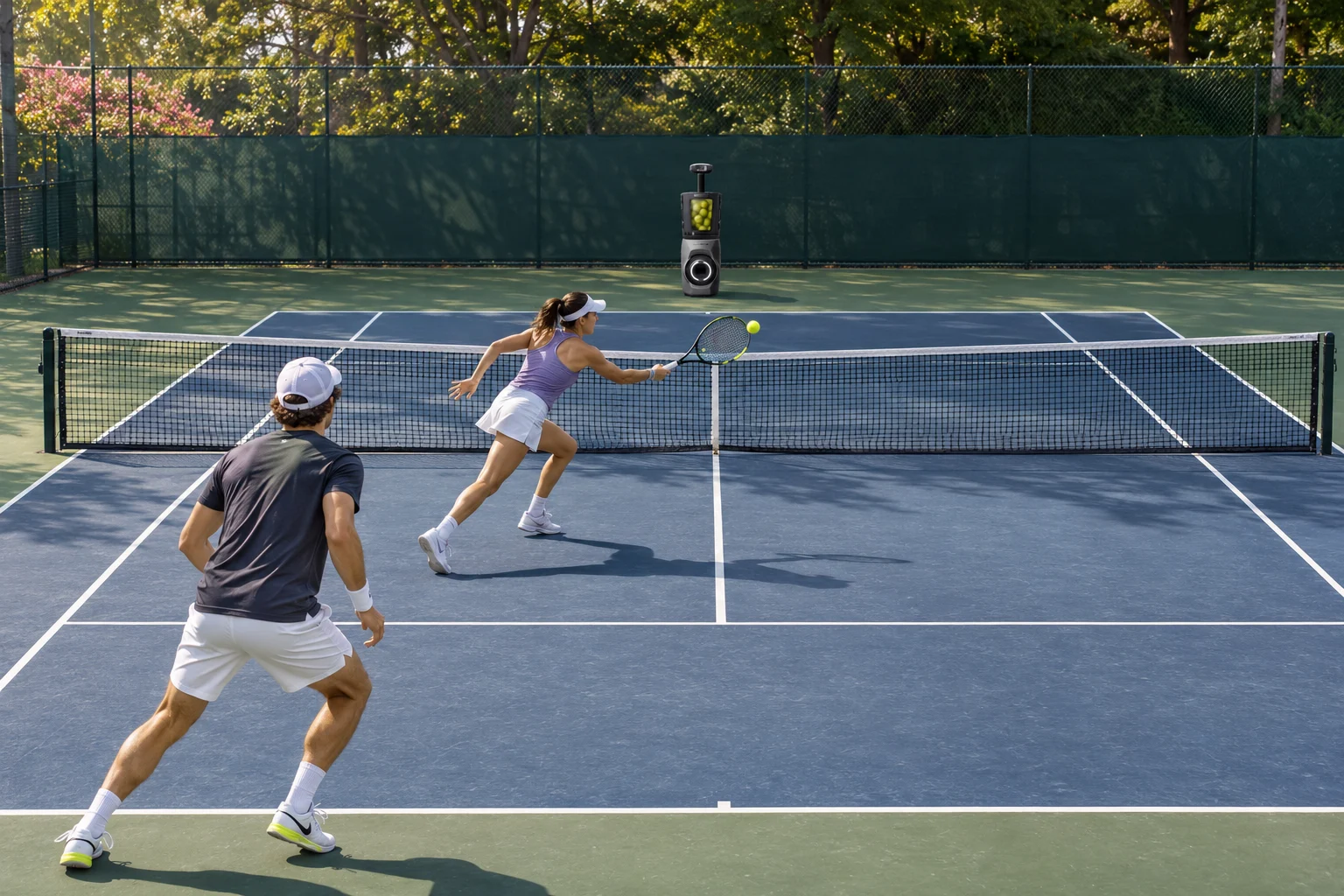
Reactive tennis training technology should do more than launch balls in changing directions. A credible system must observe something happening on the court, interpret that information, and produce a relevant response that changes the next part of the drill. Lumistar’s TERO Pro is positioned as an AI tennis training robot with visual perception and adaptive returns, but those labels should still be evaluated through clear questions and realistic court tests before you decide whether the technology fits your training.
What Does “Reactive” Actually Mean in Tennis Training?
Reactive technology changes its behavior in response to information collected during the session. This is different from a machine following a stored sequence or selecting placements randomly, even when the resulting feed pattern is difficult to predict.
It helps to separate tennis training machines into three broad categories:
- Programmed feeding: The machine repeats a defined sequence of speed, spin, placement, and interval settings.
- Randomized feeding: The machine varies one or more settings, but the changes are generated without interpreting the player’s shots.
- Reactive feeding: Sensors or cameras observe relevant court activity, and the system adjusts its response as the rally develops.
All three approaches can support useful practice. A smart tennis ball machine such as TERO, for example, supports preset drills and app-customized training patterns that are valuable for repetition, footwork, and tactical sequences. However, smart controls and extensive drill libraries should not automatically be described as reactive unless the system is actually using live court information to influence what happens next.
What Should a Reactive System Be Able to Observe?
A trustworthy reactive system should clearly identify what it observes and how that information affects the training experience. Vague descriptions such as “AI-powered” or “plays like a real opponent” do not explain the actual mechanism or its practical value.
Look for specific, user-facing capabilities. TERO Pro’s dual-lens vision system, for example, analyzes ball speed, trajectory, and landing position in real time. Its adaptive return function then adjusts responses as the rally develops. These details give a potential user something concrete to evaluate rather than requiring them to trust a broad AI claim.
Before relying on any reactive training product, ask:
- What objects or movements does the system detect?
- Which measurements are shown to the player?
- What part of the next feed changes because of those measurements?
- Does the technology work throughout a rally or only during a particular drill?
- Are any advertised features still under development?
The manufacturer should be able to answer these questions in plain language without relying on unexplained technical terms.
How Can You Test Reactive Performance on Court?
Test reactive performance by changing one court condition at a time and observing whether the machine responds in a relevant and repeatable way. A visually impressive demonstration is less useful than a controlled test that reveals what the system is actually doing.
| Court test | What it evaluates | Warning sign |
| Return similar balls to different locations | Whether the system recognizes meaningful changes in the rally | The next feed remains identical every time |
| Repeat the same shot several times | Whether responses are stable under similar conditions | Large unexplained changes between repetitions |
| Change shot depth while keeping direction similar | Whether the system distinguishes trajectory or landing differences | The system appears to follow a fixed sequence |
| Use a deliberately slower rally | Whether the response remains appropriate at a different pace | The drill loses timing or becomes unusable |
| Move the setup within the approved court area | Whether calibration produces consistent results | Performance changes without a clear reason |
| Compare reactive and preset modes | Whether the reactive mode creates a genuinely different task | Both modes feel functionally identical |
Run several short rounds rather than one long session. This makes it easier to remember what changed and prevents fatigue from influencing the comparison. If possible, record the test so you can review feed timing, landing patterns, and your own movement afterward.
How Should You Judge Response Speed?
Response speed should be judged by a clearly defined action, not by a number presented without context. A statement such as “responds in a fraction of a second” could refer to visual processing, planning, ball launch, or the total time between shots, and those are not the same measurement.
The useful question is whether the machine can maintain an appropriate rally rhythm after collecting the information it needs. TERO Pro plans a return within 0.1 seconds, which is a narrower and more meaningful description than treating that figure as the response time of the entire mechanical system.
During a test, pay attention to whether you have enough time to recover naturally without being able to predict every feed. The system should create decision pressure without producing rushed, unsafe, or unrealistic sequences. Faster is not automatically better if the drill no longer matches the player’s level or training goal.
Does Adaptation Improve the Drill or Merely Add Variety?
Useful adaptation should change the decision a player must make, not simply make the ball pattern more chaotic. Random placements can challenge movement, but they do not necessarily teach the player to read the developing rally.
A meaningful reactive drill might require the player to recover after each shot, recognize a changing ball, and choose an appropriate response. The technology becomes valuable when it supports perception, preparation, and decision-making alongside stroke execution.
Evaluate the session by asking whether it helped you practise a skill that would be difficult to reproduce with a fixed sequence. If the only noticeable difference is greater unpredictability, a randomized drill on a simpler machine may provide similar value at lower complexity.
Are the Training Data and Feedback Clearly Defined?
Training data is trustworthy only when the product explains what is measured and avoids turning estimates into coaching conclusions. A dashboard filled with scores may look advanced, but each metric should connect to an observable part of the session.
Check whether the system:
- Names the data it records
- Separates measured information from generated recommendations
- Lets you review results after the session
- Produces comparable information across similar drills
- Explains when recording or analysis features cannot run simultaneously
- Identifies features that are current versus coming soon
TERO Pro’s Deep Stats tracks swing and movement data, while its Video Archive supports post-session review. AI Coach recommendations are listed as coming soon, so they should not be confused with currently available training data. This type of feature-status distinction is important when evaluating any technology-led product.
What Practical Details Can Affect Reactive Performance?
Reactive performance depends on setup, visibility, court conditions, controls, and maintenance as well as software. Even capable vision technology may be less useful if regular calibration is confusing or the equipment is difficult to position consistently.
Before trusting a system, test the complete routine:
- Move the equipment from storage to the court.
- Complete the required court setup or calibration.
- Start and adjust a reactive drill.
- Pause the session without repeatedly returning to the machine.
- Review the available data or footage.
- Pack the equipment away and prepare it for the next session.
Also ask how lighting, court markings, background movement, ball condition, and machine placement may affect operation. A responsible product explanation should acknowledge operating requirements instead of implying that reactive performance will be identical in every environment.
Can Reactive Technology Replace a Coach or Hitting Partner?
Reactive technology cannot fully replace a qualified coach or the tactical variety of a human opponent. It can create repeatable situations, add decision-making to solo practice, and provide information for later review, but it does not understand every technical, physical, or strategic reason behind a player’s result.
The best use is often complementary. A coach can identify the skill that needs work, the technology can support structured repetitions between lessons, and the player can return with footage or data that makes the next conversation more specific.
Choose Evidence Over AI Labels
The safest way to evaluate reactive tennis training technology is to ignore the headline language at first and examine the observable chain: what the system sees, what it measures, what it changes, and how that change improves the drill. A trustworthy product should make each step understandable and testable.
Explore Lumistar’s training systems to compare programmed smart practice with visually informed adaptive training, then choose the level of technology that genuinely supports your goals rather than the option with the most impressive label.